“Dr Minh Alexander referred Paula Vasco-Knight to CQC on 12 October 2015 regarding Fit and Proper Person issues, and as of 11 May 2016, has not yet received a substantive response. However, St. George’s has disclosed a copy of a letter from Mike Richards CQC Chief Inspector of Hospitals to St. Georges dated 16 February 2016, closing the matter. This is the letter.”
Sarah Wilton
Interim Chair
Chief Executive’s Office
Room 28, 1 st Floor, Grosvenor Wing
St George’s University Hospitals NHS Foundation Trust Blackshaw Road
Tooting, London SW17 OQT
16 February 2016
Care Quality Commission
Health and Social Care Act 2008
Fit and Proper Persons: Information of concern received
Provider name: St George’s Healthcare NHS Trust
Dear Ms Wilton
Thank you for your letter of 4 February 2016 which outlines the action the registered provider took to review the fitness of Dr Paula Vasco-Knight. This was supplied in response to our earlier correspondence with Mr Christopher Smallwood, now retired, raising information of concern we had received.
We have fully considered the more detailed information you have provided on behalf of the registered provider in respect of the queries we raised. We note that, on the basis of this information, Mr Smallwood was satisfied that Dr Paula Vasco-Knight is a fit and proper person. We note the extent to which he sought to gain an accurate picture of the allegations against Dr Paula Vasco-Knight and that the fit and proper person check for the registered provider has been completed and is thorough.
The Fit and Proper Person Management Review Meeting on 10 February 2016 concluded that, subject to confirmation by the Nursing and Midwifery Council (NMC) of their judgement, St George’s Healthcare NHS Trust, the Registered Provider, has not breached regulation 5. We were subsequently able to gain this confirmation from the NMC and consider the matter closed.
This concludes our review of the registered provider’s processes. We reserve the right to re-open the case if further information that comes to light indicates that we should.
Yours sincerely
Professor Sir Mike Richards
Chief Inspector of Hospitals
Cc Dr Paula Vasco-Knight, St George’s Healthcare NHS Trust cc Jim Mackey, NHS Improvement
Open letter 26 April 2016 to the Council of Governors, St. George’s University Hospitals NHS Foundation Trust
Dear Sirs,
Ms Paula Vasco-Knight and Fit and Proper Person issues
My name is Clare Sardari. I am an Organisational Development Professional by background and one of two NHS whistleblower’s from Torbay in South Devon. In 2012 we raised concerns of nepotism by Ms Paula Vasco-Knight, who was then Chief Executive of South Devon Healthcare NHS Trust. We suffered reprisal and were both dismissed. In January 2014 an Employment Tribunal concluded that the trust run by Ms Vasco-Knight had covered up the nepotism and victimised us for whistleblowing.
Sir Robert Francis, who led the MidStaffs Public Inquiry, responded to the outcome of the Employment Tribunal with this strong criticism of the trust:
“It is important that no tolerance is afforded to oppressive managerial behaviour of the sort identified only last week by an employment tribunal in the South West, which victimises staff who raise honestly held concerns.”
“Every such case is damaging to the confidence of other staff who are contemplating raising concerns. It is clear there is much to do in this area.”
Ms Vasco-Knight stepped down as Chief Executive following these events. However, in September 2015 I was deeply shocked to hear that senior figures in the NHS had welcomed Ms Vasco-Knight back into the fold and that she had been employed at St. Georges as an interim Chief Operating Officer. I was even more astonished this week to hear that she had been promoted to Acting Chief Executive.
NHS Trusts are legally obliged to ensure that their directors are of good character and meet the Fit and Proper Person test, and under Regulation 5 the Care Quality Commission (CQC) is supposed to ensure that NHS Trusts do this effectively. I struggle to see how the board of St. Georges and the CQC could come to a reasonable conclusion that Ms Vasco-Knight is a Fit and Proper Person to be in charge of people’s lives in the light of serious criticism of her conduct by the Tribunal and its comments about her as a witness. It seems to me that only a tokenistic, diluted attempt could have been made at the Fit and Proper Person test.
Indeed, information from the Trust shows that both St. George’s staff and governors expressed concerns about Ms Vasco-Knight’s appointment. It also shows that the governors were only given a list of documents relating to the whistleblowing case, and not the actual documents themselves.
The way Ms Vasco-Knight and South Devon Healthcare NHS Foundation trust dealt with me was personally devastating, and I am now unemployable. Prior to that, I had served in the NHS and Local Government for over 25 years. I truly do not want anyone else to experience what I endured, and I am very concerned for staff and patients at St. George’s. St. George’s is under pressure and it is crucial that staff can raise concerns with confidence and resolve
them safely. However, I do not know how trust staff will have confidence to raise concerns in the light of Ms Vasco-Knight’s appointment and promotion to the top job.
The praise given to NHS whistleblowers for their courage is only lip service if the senior managers who harm them are quickly recycled back into the NHS, as if nothing ever happened.
I ask for the sake of staff and patients that the Council of Governors now examines all the relevant documents and robustly scrutinises the evidence that the St. George’s trust board claims shows that Ms Vasco-Knight is a Fit and Proper Person. I am happy to be contacted for more information.
Yours sincerely,
Clare Sardari
cc Sir Robert Francis QC
Health Committee
Jane Ellison MP Battersea, Balham and Wandsworth
Rt. Hon Sadiq Khan MP Tooting
Care and Health Overview and Scrutiny Committee Wandsworth Council
A HOSPITAL consultant has been suspended after he blew the whistle on a surgeon who refused to take off her hijab for an operation – even though it had BLOOD on it.
SWNS•ROSS PARRY•IG
Vladislav Rogozov has ben suspended by the Royal Hallamshire
Vladislav Rogozov confronted his colleague when he realised she was going to keep herheadscarf on during the procedure at Royal Hallamshire Hospital, Sheffield.The hospital initially backed Dr Rogozov, 46, because its rules state religious headscarves are “excluded in areas such as theatre, where they could present a health and cross-infection hazard”.
SWNS•ROSS PARRY
The Royal Hallamshire
But after writing about the incident on a blog the Czech-born anaesthetist was suspended by the trust, who had not made the incident public when it happened in 2013.He said other medics wanted to speak out but were afraid to.
He wrote: “No one dared to highlight this issue because they feared being accused of racism.”
And he also said Muslim staff at the Yorkshire hospital took unscheduled prayer breaks during surgery.
IG Dr Vladislav Rogozov
It has nothing to do with the medics being Muslims. It’s his fear they let their beliefs come before the patients
Medical source
A source close to the doctor said: “Dr Rogozov won’t tolerate anything that puts patients at risk.“It has nothing to do with the medics being Muslims. It’s his fear they let their beliefs come before the patients.”
It is understood he was suspended, pending an inquiry, after a Slovakian paper and a Czech website published articles.
SWNS•ROSS PARRY
The Royal Hallamshire
Dr Rogosov’s claims are under investigation, and the surgeon he complained about left Royal Hallamshire after the trust sided with him.Sheffield Teaching Hospitals’ Dr David Throssell said: “Patient safety is our top priority. As soon as we were made aware of the publication of allegations we began an investigation.
Image caption Paula Vasco-Knight was suspended in 2014 after being accused of nepotism for recruiting her daughter’s boyfriend to a job at Torbay Hospital
A health boss previously criticised for her treatment of whistleblowers who had concerns of nepotism has been suspended over “financial allegations”.
London’s St George’s University Hospitals NHS Foundation Trust said the claims against acting chief executive Paula Vasco-Knight related to a previous employer.
Dr Vasco-Knight was suspended from Torbay Hospital in 2014, accused of recruiting her daughter’s boyfriend.
She resigned in May 2014.
Dr Paula Vasco-Knight has been acting chief executive at St George’s for two weeks.
The trust said: “The trust board has asked the medical director, Professor Simon Mackenzie, to fill Dr Vasco-Knight’s role.
“The allegations are financial in nature and relate to her work at a previous employer.
“The trust is not in a position to comment further at this stage.”
A spokeswoman for Torbay and South Devon NHS Foundation Trust told BBC News: “So far as we are aware these allegations do not relate to any previous role held at South Devon Healthcare NHS Foundation Trust.”
HR and Charity news Posted By Lisa Baker on Apr 20, 2016
The new NHS whistleblowing policy is not going to be easy for HR teams to implement and manage. It’s not through lack of commitment by trusts, but enforcing a set of standards fine-tuned to a specific trust, will be a considerable challenge. Ben Western, public sector business development manager, at Software Europe, provides advice on how trusts can navigate the new policy and provide tips for getting started.
The arrival of the national whistleblowing policy shouldn’t be a surprise to trusts. The initial consultation took place in November last year and we’ve already had trusts talk to us about receiving policy support in the last few months. However, forewarned is not always forearmed.
There’s a lot to do and not much time. Existing local policies and procedures, if they exist, will now need urgent review to take into account the new whistleblowing policy.
Some trusts that we speak to don’t actually have an existing whistleblowing policy and others, which are able to demonstrate a policy, lack the tools to effectively manage any cases raised. Excel spreadsheets have become the de facto tool for logging all types of employee relations case, but unfortunately it doesn’t cut the mustard here.
Excel lacks the functionality to record key data, make it available to multiple people, lock down information from other people, or provide any sort of timeline or deadline alerts. No surprise really, it wasn’t designed for this job. Excel is just not going to give staff the confidence that whistleblowing cases are being handled properly.
In the next 12-months, it’s going to be important for trusts to review the new national policy, draft, ‘tweak’ or merge local policies to suit their employees and find the right tools to support them. Here’s my four tips for getting started.
Policy guidance
Firstly, when looking at existing policy, trusts must ensure that they are simple and easy to understand and ensure the policy is easily accessible to everyone. It should include and support as much of the workforce as possible. It needs to clearly set out the standard of behaviour expected by employees. It’s got to make clear what sort of disclosures or malpractices are covered. Transparency around whom and how to approach managers with any concerns is paramount.
Environment
HR managers also need to look at the wider business. Is there an environment which embraces the whistleblowing culture so it is no longer frowned upon? HR will need to make sure employees are comfortable with the whistleblowing process and understand that they will not suffer any detriment or dismissal through raising the concern.
Tools
HR will also need the right tools in place to do the job. Without those tools HR is hamstrung and no employee will have the confidence that a whistleblowing policy is going to be taken seriously. Any whistleblowing IT system needs to keep HR updated at every stage of the process. Email reminders and alerts are essential to keep the case on track. The system must be able to log concerns appropriately, securely and with no details missing. Depending on the case type, it should be possible to markup and treat certain cases as sensitive and confidential. It should also be possible to generate reports and automate the sharing of information with senior management and other parties so that they can evaluate the success of the policy and evaluate trends.
Analysis
Analytics is essential. A good system should be able to manage and interrogate case data, providing insights which managers can use to proactively identify issues and intervene. For example, if multiple whistleblowing concerns are being raised against a specific line manager, HR will be able to investigate and implement additional training or other programme to rectify the issue early.
The four tips above provide a good starting point for all NHS trusts facing the challenge of effectively handling whistleblowing cases compliant with policy before the 2017 deadline.
EQUAL OPPORTUNITIES FOR ALL AT THE CARING QUALITY COMMISSION – A SPARKLY LITTLE TIMELINE
8 April 2016
An individual interested in applying for CQC’s National Guardian post wrote:
“I’m seeing David Behan re the NG post next week”
15 April 2016 a question was raised with CQC cc David Behan
“May I enquire if potential candidates are free in the meantime to contact Mr Behan or other senior CQC staff and to request a meeting? If so, has this opportunity been publicised to ensure equal of opportunity. Please direct me to any published information on contacting CQC and arranging a meeting regarding the position.
Yours sincerely,
Dr Minh Alexander”
19 April 2016 the CQC recruitment department advised that they would not offer candidates contact with the recruiting manager before jobs are advertised:
“I can confirm that once a vacancy is advertised on our website, if we receive a role specific query from a candidate we would allow them to speak with the recruiting manager to discuss in more detail. As a recruitment team we would not offer this prior to advertisement.”
25 April 2016, the question of 15 April was repeated to CQC cc David Behan
“I would be grateful if Mr Behan could address the questions from my email of 15 April, below, relating to the period before the National Guardian post is advertised:
“May I enquire if potential candidates are free in the meantime to contact Mr Behan or other senior CQC staff to request a meeting? If so, has this opportunity been publicised to ensure equality of opportunity. Please direct me to any published information on contacting CQC and arranging a meeting regarding the position”.
Best wishes,
Minh”
3 May 2016 CQC replied that potential applicants had NOT been invited to meet senior CQC staff:
“Dear Dr Alexander,
CQC has not invited potential applicants to contact senior CQC staff, but would consider and, where possible and appropriate, facilitate requests Russell Reynolds may receive from potential applicants to discuss the post.”
3 May 2016 a further question was put to CQC cc David Behan:
“Please could Mr Behan advise if any meetings between him and individuals interested in applying for the National Guardian post were (1) arranged (2) took place before the National Guardian post was advertised on 29 April 2016.
Best wishes,
Minh”
5 May 2016 reply from CQC confirming that David Behan had met with candidates prior to advertisement of the National Guardian post on 29 April 2016:
“Dear Dr Alexander,
Mr Behan has had meetings and phone conversations with people interested in applying for the National Guardian post. Meetings were arranged and took place before 29 April. Where an individual requests a meeting – via Russell Reynolds, and where Russell Reynolds have advised that the person meets the criteria for the role – Mr Behan would be willing to meet/discuss the role with any potential applicant, subject to availability and if a mutually convenient time can be arranged.”
Remember campers, closing date for applications is 18 May 2016. Don’t all rush at once!
Mr Behan has had meetings and phone conversations with people interested in applying for the National Guardian post. Meetings were arranged and took place before 29 April. Where an individual requests a meeting – via Russell Reynolds, and where Russell Reynolds have advised that the person meets the criteria for the role – Mr Behan would be willing to meet/discuss the role with any potential applicant, subject to availability and if a mutually convenient time can be arranged.
Statutory requests for information made pursuant to access to information legislation, such as the Data Protection Act 1998 and the Freedom of Information Act 2000, should be sent to:information.access@cqc.org.uk
From:Minh Alexander [mailto:minhalexander@aol.com] Sent:03 May 2016 14:56 To:Docherty, Matthew Cc:Behan, David Subject:CQC recruitment to National Freedom to Speak Up Guardian post
Many thanks Matt.
Please could Mr Behan advise if any meetings between him and individuals interested in applying for the National Guardian post were (1) arranged (2) took place before the National Guardian post was advertised on 29 April 2016.
CQC has not invited potential applicants to contact senior CQC staff, but would consider and, where possible and appropriate, facilitate requests Russell Reynolds may receive from potential applicants to discuss the post.
Kind regards
Matt
From:Docherty, Matthew Sent:25 April 2016 14:57 To:‘Minh Alexander’ Subject:RE: CQC recruitment to National Freedom to Speak Up Guardian post
Dear Dr Alexander
Thank you for your email I will ensure that a response is sent to you.
Kind regards
Matt
From:Minh Alexander [mailto:minhalexander@aol.com] Sent:25 April 2016 14:44 To:Docherty, Matthew Cc:Behan, David Subject:CQC recruitment to National Freedom to Speak Up Guardian post
Thank you Matt.
I would be grateful if Mr Behan could address the questions from my email of 15 April, below, relating to the periodbeforethe National Guardian post is advertised:
“May I enquire if potential candidates are free in the meantime to contact Mr Behan or other senior CQC staff to request a meeting? If so, has this opportunity been publicised to ensure equality of opportunity. Please direct me to any published information on contacting CQC and arranging a meeting regarding the position”.
Thank you for your query regarding the CQC’s recruitment to the post of the National Guardian. The recruitment timetable is being finalised and I can confirm that the post will be advertised on the NHS jobs website, the CQC website and in the national press. The recruitment process will be supported by an external search company who will be able to provide all the necessary information about the post. As is standard in all recruitment by the CQC, the process will incorporate the CQC’s diversity and equality policy.
Statutory requests for information made pursuant to access to information legislation, such as the Data Protection Act 1998 and the Freedom of Information Act 2000, should be sent to:information.access@cqc.org.uk
From:Minh Alexander [mailto:minhalexander@aol.com] Sent:15 April 2016 16:09 To:Enquiries Cc:Behan, David Subject:CQC recruitment to National Freedom to Speak Up Guardian post
Enquiries Team CQC 15 April 2016
Dear Sirs,
CQC recruitment to National Freedom to Speak Up Guardian post
Thank you for your email of 7 April 2016, below, in which you advise that the next advert for the National Guardian will be placed soon on the NHS Jobs site.
May I enquire if potential candidates are free in the meantime to contact Mr Behan or other senior CQC staff and to request a meeting? If so, has this opportunity been publicised to ensure equal of opportunity. Please direct me to any published information on contacting CQC and arranging a meeting regarding the position.
Thank you for contacting the Care Quality Commission (CQC), your enquiry reference number is ENQ1-2453415259.
Please accept our sincere apologies for the significant delay in responding to your email enquiries dated 21 January and 1 February 2016, regarding the“Advertisement of posts that comprise the National Guardian’s Team”.
I have been informed that the NationalGuardian role will shortly be advertised externally viaNHS Jobsextending to some national press, but we are currently unable to give exact dates. However, it is possible to set up alerts through NHS Jobs, which will keep you updated as soon as anything is posted.
Once the National Guardian is appointed, we expect this will likely influence roles within the team, which will be advertised via NHS Jobs.
I do hope the above is helpful but please let us know if we can assist with anything further.
The Care Quality Commission is the independent regulator of all health and adult social care in England. We make sure health and social care services provide people with safe, effective, compassionate, high-quality care and we encourage care services to improve.
www.cqc.org.uk. For general enquiries, telephone the National Contact Centre: 03000 616161.
Statutory requests for information made under access to information legislation such as the Data Protection Act 1998 and the Freedom of Information Act 2000 should be sent to:information.access@cqc.org.uk.
From:Minh Alexander [mailto:MinhAlexander@aol.com] Sent:01 February 2016 21:36 To:Enquiries Subject:Fwd: ENQ1-2435133394 RE: Advertisement of posts that comprise the National Guardian’s Team
To Suzanne White National Customer Services Officer, CQC, 29 January 2016
Dear Ms White,
RE: Advertisement of posts that comprise the National Guardian’s Team
As I indicated in my later email to the enquiries team of 27, I am seeking clarification becauseyour social media team did not provide full clarification.
I would be grateful for answers to my questions of 27 January to the enquiries team could be processed.
Thank you for contacting the Care Quality Commission (CQC), your enquiry reference number isENQ1-2435133394.
I can see on your Twitter feed that our Social media team have been discussing your queries with you. I trust these are now resolved, however, if you have any further questions please do get in touch via any of the below methods.
I hope that this helps. If you have any further queries please do not hesitate incontacting us again.
We welcome feedback and your thoughts, comments and suggestions are very valuable to us. Please share your experience with us by clickinghere.
The Care Quality Commission is the independent regulator of all health and adult social care in England. We make sure health and social care services provide people with safe, effective, compassionate, high-quality care and we encourage care services to improve.
www.cqc.org.uk. For general enquiries, telephone the National Contact Centre: 03000 616161.
Statutory requests for information made under access to information legislation such as the Data Protection Act 1998 and the Freedom of Information Act 2000 should be sent to:information.access@cqc.org.uk.
From:Minh Alexander [mailto:minhalexander@aol.com] Sent:21 January 2016 17:43 Subject:Advertisement of posts that comprise the National Guardian’s Team
Health bosses at top NHS trust put thousands at risk with aggressive cuts
Executives ignored warnings from whistleblowers, threatened to sack them
Liverpool Community Health Trust bosses desperate for foundation status
They presided over an ‘oppressive’ culture of bullying and harassment
Resigned: Chief Executive Bernie Cuthel
Health bosses at a top NHS trust put thousands at risk by aggressively driving through cuts at the expense of patient safety, a report has revealed.
In a case likened to the Mid-Staffordshire scandal, executives ignored endless warnings from whistleblowers – and threatened to sack them when they complained.
The £160,000 report said bosses at Liverpool Community Health NHS Trust were so desperate to gain the Government’s coveted foundation status that huge budget cuts came before care.
They presided over an ‘oppressive’ culture of bullying and harassment between 2011 and 2014, where staff were afraid to speak out.
In one case, a district nurse was taken hostage at knifepoint and sexually assaulted by a patient’s relative in 2013 – but they did nothing. Some workers were ‘driven to the brink,’ while others even considered suicide.
Only when whistleblowers alerted an MP were watchdogs brought in and top managers forced out.
It is thought to be the first time NHS staff have forced out chiefs and kept their jobs. At least one boss is still working in the NHS, but the report recommends they should be investigated.
The report, ordered by the trust’s new management imposed in April 2014 and written by an independent law firm, likened the situation to that at Mid-Staffs Hospital, where up to 1,200 patients died.
It revealed that regulators and commissioners who inspected LCHT – providing community health services for 750,000 people in Liverpool and Merseyside – also failed to notice what was going on.
Last night, Labour MP Rosie Cooper, contacted by the whistleblowers after complaints about her own elderly father’s care, demanded an inquiry. The report also revealed that bosses stockpiled £3million of taxpayers’ money due to be spent on district nurses.
Review author Moosa Patel, head of governance at law firm Capsticks, said problems began in 2011 soon after LCHT was formed.
He said chief executive Bernie Cuthel, her executive nurse and operations director Helen Lockett, director of human resources and organisational development Michelle Porteus – and the non-executive board – were determined to gain foundation status.
It meant they pushed through savings regardless of the impact on patients or staff. Introduced by Labour in 2002, foundation status enables best-performing trusts to set their own pay and build wards without prior Whitehall approval.
Named: Michelle Porteus (l) and Helen Lockett (r). A report said bosses at Liverpool Community Health NHS Trust were so desperate to gain the Government’s foundation status that huge budget cuts came before care
But the policy was discredited after it was revealed that criteria were too focused on savings.
Mr Patel found there was ‘a sustained drive from day one to achieve NHS foundation status. Inappropriate and unsafe care was not addressed and the response to adverse incidents was grossly deficient.
Speaking out about concerns was not easy. Such was the impact of this culture that some staff were driven to the brink.’
The report found that when staff raised concerns they were ignored or threatened with the sack.
When dentistry directors refused to sign off a 49 per cent or £2.7million budget cut they were suspended. Only when the chiefs were removed and new managers installed were they re-instated.
Last night Miss Cooper, who prompted the Care Quality Commission to investigate in January 2014 which led to the resignation of all three top managers, said a clinical inquiry was ‘vital’.
‘This report has uncovered an NHS scandal similar to Mid-Staffs but in community services,’ she said. ‘It is a peek through the keyhole.
‘There can be no hiding place for the executives who presided over this disgraceful state of affairs.’
An LCHT spokesman admitted there had been ‘deep-rooted’ problems but more than 150 nurses and other frontline staff had been recruited to boost quality of care.
The Queen’s surgeon in Scotland has quit his post at NHS Grampian – a year after being controversially suspended by the health board.
Professor Zygmunt Krukowksi was suspended from his job at Aberdeen Royal Infirmary in May following a probe into his conduct.
Last night, health chiefs confirmed the 67-year-old had left NHS Grampian.
His colleague Dr Wendy Craig, who had also been suspended, has also stepped down from her job at the health board.
Neither Prof Krukowski nor Dr Craig could be contacted for comment.
The Queen’s Surgeon in Scotland is responsible for the care of the monarch when she stays at Balmoral.
It was not clear last night whether Prof Krukowski will continue with his royal duties.
When his suspension was announced last year, his predecessor Colonel Michael Stewart publicly backed him and described him as “a most professional and remarkable surgeon”.
The resignations of Prof Krukowski and Dr Craig were confirmed just days after the conclusions of a report into the behaviour of senior staff at the north-east’s flagship hospital were made public.
The report, carried out by the Royal College of Surgeons in England (RCS), called for “major changes” to be made at ARI.
It found there was “real potential” for the working environment to “impact on patient care”.
The health board came under fire following its decision to suspend both surgeons, and refer them to the General Medical Council.
The board’s former medical director, Donnie Ross, was among those who accused health bosses of taking “revenge” on the pair after they raised concerns about the running of ARI.
In addition, a total of 21 medics – all with links to NHS Grampian – criticised the suspensions, and demanded that the truth about the move was made public.
In an open letter to Health Secretary Shona Robison, they suggested it was simply because they had spoken out against management and urged her to reinstate them.
The signatories demanded a judge-led inquiry into the management of the health board.
The RCS was commissioned to lead an investigation into a “dramatic breakdown” in team work at the hospital.
The inspectors were asked to examine the behaviour of surgeons, as well as outcomes of 16 operations – mainly on the gall bladder, liver and bile ducts – in September 2014.
Initially, health bosses refused to publish the report, despite a groundswell of opposition to their decision.
The Press and Journal made two attempts to view the report under freedom of information laws – only to be given a copy of the 69-page document with 49 pages blacked out line-by-line.
However, on Monday, the Press and Journal revealed the conclusions of the report after a Scottish Information Commissioner’s ruling paved the way for them to be made public.
It emerged that a number of unnecessary operations were carried out on patients.
The report stated that “with the benefit of hindsight, the surgical treatment of these patients may not have been in their best interests”.
It also raised concerns over communication between staff at the hospital.
Jeremy Hunt has been left red-faced after the leaked email was posted on social media by top health commentator Roy Lilley
Red-faced: Jeremy Hunt
Jeremy Hunt has been left red-faced tonight as a bombshell leaked email exposes a “desperate” Tory plot to organise their own letter from doctors.
It comes just days after more than 100 leading doctors signed a letter accusing the Tory-led coalition of endangering the NHS in England.
They described how the health service is “withering away”, and warned that patients would be faced with higher costs but lower standards due to the growing involvement of private firms in the NHS.
Tonight the leaked email was published on social media by top health commentator Roy Lilley who tweeted: “Tories canvassing for a ‘support the NHS’ letter from doctors – the games continue!”
Email to Doctors asking them to write to Jeremy Hunt’s advisor to get a letter asking the government to stop using the NHS as a political football
Titled “CONFIDENTIAL – Conservative Health”, it said: “Dear doctor members, There is a letter being put together saying that the NHS shouldn’t be used as a political football during the election campaign.
“If you are willing in principle to support this, please reply to Jeremy Hunt’s adviser (Christina Robinson, cc’d) and she’ll share the draft text with you.
“You can then confirm to Christina if you are happy to be a signatory.”
A Labour source told the Daily Mirror: “This is desperate stuff from a Tory election campaign that is stuck in the gutter.
“David Cameron has nothing to offer patients and can’t escape his dismal track record on the NHS. It won’t escape people’s notice that it comes on the same day waiting lists hit a new high.”
In the letter to The Guardian earlier this week, the doctors wrote: “People may be unaware that under the coalition, dozens of accident and emergency departments and maternity units have been closed or earmarked for closure or downgrading.
“In addition, 51 NHS walk-in centres have been closed or downgraded in this time, and more than 60 ambulance stations have shut and more than 100 general practices are at risk of closure.”
Prime Minister David Cameron talking at a Dementia Friends, Alzheimer’s Society event at The Clare Charity Centre in Saunderton, Buckinghamshire
Signatories to the letter include Dr Clare Gerada, a former chair of the Royal College of General Practitioners; Prof John Ashton, retired director of public health; epidemiologist professor Michel Coleman; and Simon Capewell, professor of public health in Liverpool.
Trisha Greenhalgh, professor of primary care at Oxford; Martin McKee, professor of European public health, and Raymond Tallis, emeritus professor of geriatric medicine in Manchester, also gave their names to the document.
The Conservatives responded to the doctors’ letter by accusing Labour of orchestrating it in an attempt to “weaponise” the NHS.
Labour and Dr Gerada denied the claim.
Dr Gerada said she had put the letter together with “a few other medical leaders”.
She added: “I’m not doing this from a party political point of view. My views on the health service and the health and social care act go back and are well-known. This letter was drafted by me and some others.”
The email exposed tonight will be embarrassing for both Mr Hunt and Mr Cameron after the Conservatives have repeatedly accused Labour of “weaponising” the NHS.
A Conservative spokesman did not deny trying to organise a letter and told the Daily Mirror: “Of course we think it’s completely wrong for the NHS to be used as a political football and want as many doctors as possible to make this clear.”
Kelvin Cheatle was appointed to investigate bullying allegations against the whistle-blowerCREDIT: CAPSTICKS
An independent investigator who suggested an NHS pharmacist was too honest to work for the service is involved in Jeremy Hunt’s flagship scheme to encourage whistle-blowers to speak out, the Daily Telegraph can disclose.
Kelvin Cheatle was brought in from a private law firm to carry out an independent inquiry into the conduct of a staff member after she raised concerns at the now defunct Berkshire West Primary Care Trust.
He was exposed by this newspaper for apparently coaching witnesses during disciplinary proceedings against the whistle-blower, which prompted concerns about his independence.
He is now involved in Freedom to Speak Up workshops at NHS trusts across the country, encouraging health staff to raise concerns without fear of reprisal from management.
Maha Yassaie had been working as chief pharmacist at the NHS when she made a number of protected disclosures to regulators in 2011.
Maha Yassaie was dismissed from Berkshire West Primary Care Trust in 2012CREDIT: JULIAN SIMMONDS/TELEGRAPH
Accusations of bullying were then lodged against her, which Mr Cheatle was brought in to investigate in 2012.
In one exchange during a meeting with Mrs Yassaie, the investigator said: “I am thinking that if I had your values I would find it very difficult to work in the NHS.”
The HR consultant claimed there had been a “breakdown of relationship” at her workplace. Mrs Yassaie was later dismissed from her role.
The whistle-blower was later awarded £375,000 in a settlement in 2014, with the Department of Health admitting parts of the investigation and disciplinary processes were “flawed”.
A spokesman for Capsticks, where Mr Cheatle works, said the company had not been engaged by the Department of Healthregarding the Speak Up initiative, but confirmed they had jointly hosted an event last year.
He said: “Capsticks and Mr Cheatle provide ongoing support to NHS Trusts around the country in the implementation of the Speak Up initiative.”
The spokesman insisted that Mrs Yassaie’s whistle-blowing allegations were investigated separately by the Trust and not by Mr Cheatle. He said Mr Cheatle had not questioned Mrs Yassaie’s ethics.
He added that Mr Cheatle’s exchanges with Mrs Yassaie concentrated on bullying allegations, and denied any coaching or rehearsing of witnesses. The decision to sack Mrs Yassaie was taken by the Trust, he said.
An NHS whistle-blower who raised concerns about patient safety was told she was “too honest” to work for the organisation, The Telegraph can disclose.
Maha Yassaie, chief pharmacist at the now defunct Berkshire West Primary Care Trust, was told by a human resources consultant that her “values” made it difficult to work for the health service.
The investigator, Kelvin Cheatle, who was brought in from a private law firm to examine bullying claims and has carried out several similar inquiries for other NHS trusts, told the whistle-blower during a meeting: “If I had your values I would find it very difficult to work in the NHS”, according to a transcript of the conversation.
The independence of the consultant who made the comments has also been called into question since the conclusion of his investigation, when it emerged that he appeared to coach witnesses during the inquiry.
Mrs Yassaie was subsequently sacked from the Trust. However, following an employment tribunal in 2014, the whistle-blower was awarded £375,000 by the NHS, and the Department of Health was forced to admit that “the investigation and disciplinary processes… were, in some respects, flawed”.
The disclosures about the investigation into Mrs Yassaie after she raised concerns will fuel fears that NHS whistle-blowers are not treated fairly.
It comes a year after a landmark report made recommendations to improve the poor treatment of people who expose wrongdoing, which the Government agreed to accept.
Former NHS head says whistle-blower report will be “largely ignored”Play!01:21
Mrs Yassaie had been working as chief pharmacist and leading a team at Berkshire West Primary Care Trust when she first alerted senior management to a string of concerns in 2011. These included claims that a colleague was taking money from drug companies to prescribe certain products and a GP who accessed controlled drugs and used them to attempt suicide.
In 2012, the Trust appointed Mr Cheatle to carry out an independent investigation.
Mrs Yassaie said that she was asked to participate in an independent inquiry – believing it would address the safety concerns she had raised – only to find that she had become the target of separate disciplinary action, having been branded a “bully” by management after she made her protected disclosures.
During the inquiry, Mr Cheatle met Mrs Yassaie on several occasions.
In one meeting on August 15 2012, the investigator questioned the chief pharmacist’s “level of ethics” in light of her blowing the whistle on colleagues.
According to a transcript, which was created and circulated by one of Mr Cheatle’s colleagues, the investigator queried whether it was right for Mrs Yassaie to have raised concerns about her colleagues.
“I may know for a fact that some of the neighbours on my street are underpaying their taxes,” he said.
Mrs Yassaie felt her claims about patient safety were never investigated
“If I report them I will probably never be invited to a street party or any other event. And this is essentially what you do. It is obviously not wrong, but it alienates your colleagues.”
“Surely you would feel you did the right thing though, if you reported your neighbours,” Mrs Yassaie replied.
“The street party would be a small price to pay for feeling good about doing the right thing.”
To which the investigator responded: “After listening to all this, I am thinking that if I had your values I would find it very difficult to work in the NHS.”
Mr Cheatle failed to uphold bullying claims, but concluded that Mrs Yassaie’s relationship with the Trust had broken down. She was subsequently dismissed from her job.
A separate inquiry by pharmacists’ regulator the General Pharmaceutical Council was later launched. This concluded in February this year and upheld only one of 17 misconduct allegations against Mrs Yassaie.
Mrs Yassaie told The Telegraph that she felt her claims about patient safety were never investigated. She accused the NHS of carrying out a “deliberate hatchet job” after she told regulators about her patient safety concerns. Mrs Yassaie has accused the NHS of “covering up” the allegations she made.
Since the conclusion of the investigation by Mr Cheatle, it has also emerged that he appeared to coach witnesses against the whistle-blower and encouraged them to “rehearse” statements.
“We need to discuss their evidence with them and ask them to focus on why [Mrs Yassaie] cannot return to work. I have held Friday pm, Monday pm, Tuesday and Wednesday and potential slots to rehearse… They should be asked to address their statements and how they feel relations have broken down,” he wrote in one email to the trust’s HR department.
A spokesman for Capsticks, the legal firm where Mr Cheatle works, said that the report he produced was “wholly independent and based purely on witness evidence, objectively obtained”.
They said that the “case was the subject of an internal process and was considered by an independent panel”.
A Department of Health spokesperson said that since Mrs Yassaie’s case they have “taken further steps to create a culture where staff feel confident and supported to raise concerns” and “strengthened protection for whistleblowers”.
Dear Dr Wollaston and Health Select Committee members
I have attached a Times article (1 April 2016): Lawyers press NHS to ditch “kangaroo court” disciplinary process for your information.
This relates to a case which you must be aware of. Amin Abdullah was a prize-winning nurse, a model of professionalism. He committed suicide by self-immolation after being dragged through an unpleasant disciplinary procedure at his Trust. His crime was exercising his legitimate right to speak up on behalf of a colleague. His treatment and suicide are to be seen in the context of this government’s commitment to Learning not Blaming.
Mr Abdullah’s death is reminiscent of Jeremy Hunt’s words to the House of Commons on 11 February 2015 following the launch of the Sir Robert Francis’s Freedom to Speak Up Report:
He (Sir Robert) said he heard again and again of horrific stories of people’s lives being destroyed—people losing their jobs, being financiallyruined, being brought to the brink of suicide and with family lives shattered.
Amina Abdullah suffered all these except of course that he did not stop at the brink of suicide.
The Health Committee is well acquainted with the problems staff who raise concerns encounter when they face disciplinary procedures.
In September 2013 in your report After Francis; making a difference, in section 3: Raising concerns and resolving disputes:
Disciplinary procedures, professional standards hearings and employment tribunals are not appropriate forums for constructiveairings of honestly-held concerns about patient safety and care quality.
The Health Committee clearly understands the conflict of interest in allowing Trusts to be judge and jury over staff who they want to dismiss.
In the Times article Aprita Dutt speaks of “the vindictive behaviour of NHS managers in disciplinary cases.” That is something many of us reported to Sir Robert Francis in his review.
Following the publication of Complaints and raising concerns in January 2015 you, Dr Wollaston, were widely reported in the media as referring to the mistreatment of whistleblowers as a stain on the reputation of the NHS.
At the heart of this mistreatment, openly described by Sir Robert in his report as victimisation, is of course NHS disciplinary procedure.
This is the mechanism by which NHS Trusts dismiss whistleblowers, usually for SOSR. It is the instrument which is used by managers to rob whistleblowers not only of their jobs but often also of their careers; their physical and mental health, their ability to provide financially for their families. In short it is an instrument of torture often used to bring pain and ruin on good staff, to stifle concerns and to keep staff silent. This is why an inquiry into NHS disciplinary procedures is long overdue.
I ask the Health Committee to support John Hendy and Paul Gilroy’s call for a full independent judicial inquiry and to make representations to the Secretary of State for the same. In view of his recent statements you may find Mr Hunt receptive to a suggestion for an inquiry. He already recognises that there is in some organisations a problem with independence.
On 9 March in a statement to the House of Commons he said:
“NHS Improvement will ask for a commitment to openness and learning to be reflected in all trust disciplinary procedures and ask all trusts to publish a Charter for Openness and Transparency so staff can have clear expectations of how they will be treated if they report clinical errors.”
This was a reiteration of what Mr Hunt told the Global Patient Safety Summit a few days earlier. Sadly, asking those Trusts who currently misuse disciplinary proceedings to publish a “Charter for Openness and Transparency” is likely to be ineffective. What is needed is evidence of the way Trusts have in the past used the disciplinary procedure to dismiss good staff. When this analysed will provide the basis for a set of recommendations which will enable reform.
Mr Hunt ended his speech to the Global Patient Safety Summit with a wellknown quotation from Karl Popper:
“True ignorance is not the absence of knowledge but the refusal to acquire it.”
The knowledge needed to reform NHS disciplinary procedures and “create a model which complies with fair trial requirements” is easily at hand.
I have copied in Professor Kapur who organised the protest over Amin Abdullah’s death. I have also copied the lawyers named in this article and my own MP (for information only at present) Mr Andrew Mitchell.
David Bell’s shock move back to his old NHS job follows the resignation of his boss, Dame Eileen Sills, before she even started work
Deputy National Guardian David Bell has followed his old boss Dame Eileen Sills in stepping down VERY quickly
Health secretary Jeremy Hunt’svow to protect medics who expose patient safety fears has hit a fresh setback.
The UK’s new deputy NHS whistleblowing tsar has left after less than six weeks in the role.
David Bell’s abrupt move back to his old NHS job follows the resignation of his boss, Dame Eileen Sills.
Campaigners say the latest exit is a sign that the new Office of the National Guardian – due to open last Friday – is in a “crisis” that means patients “will suffer”.
It was to be a centre-piece of Mr Hunt’s pledge to protect whistleblowers following the Stafford Hospitalscandal.
REX/Shutterstock
Campaigners claim Health Secretary Jeremy Hunt is presiding over a ‘crisis’
Dr Minh Alexander, who was forced to quit after she exposed suicides and abuse at a mental health trust in Cambridgeshire, said of Mr Bell’s departure: “This shows the Office of the National Guardian is in crisis.
“I am not surprised – the design of the office has been flawed. What is needed is a truly independent body.
“It is patients who will suffer if the Government continues to insist upon flawed half measures.”
The national office and a network of local Guardians based in every NHS trust were key demands of Sir Robert Francis’s review in February 2015 into NHS whistleblowing.
PA
Dame Eileen Sills quit before even starting work
The Care Quality Commission, the health watchdog involved in setting up the national office, declined to say if Mr Bell had quit or been pushed to return to his job at the NHS South East Commissioning Support Unit.
Dame Eileen quit last month, nine weeks after the Daily Mirror exposed how she would work only two days a week and would keep her £174,000-a-year job as chief nurse at Guy’s and St Thomas’ NHS Foundation Trust in London.
NHS England is today taking significant steps to make it easier for primary care staff to raise their concerns so that action can be taken and improvements made.
The proposals, developed after working with partners and stakeholders, include:
Each provider should name an individual, who is independent of the line management chain and is not the direct employer, as the Freedom to Speak Up Guardian. They can offer support and listen to staff raising a concern.
NHS primary care providers should be proactive in preventing any inappropriate behaviour, like bullying or harassment, or discrimination towards staff who raise a concern;
All NHS primary care providers should review and update their local policies and procedures by March 2017, to align with the agreed guidance;
Neil Churchill, NHS England Director for Patient Experience, said: “Becoming the world’s safest health system requires us to listen to staff and act on valid concerns. In order to do this, it’s vital that NHS staff who witnesses something that risks patient safety feel able to speak out without reprisal.
“This guidance builds on existing good practice, gives staff in primary care more options to share any concerns and sets out our expectations about how those concerns should be handled. A safe NHS is an open and honest NHS where we routinely learn from mistakes and use that learning to improve patient safety.”
Today also marks NHS England becoming a ‘Prescribed Person’ under the Public Interest Disclosure Order 1999, meaning primary care service staff working at GP surgeries, opticians, pharmacies and dental practices, can raise concerns about inappropriate activity to NHS England.
The new status will provide another source for NHS employees across England to raise concerns and disclosures about their workplace in circumstances where a direct approach to their employer is not favoured, suitable or appropriate.
Karen Wheeler, National Director: Transformation and Corporate Operations welcomed the prescribed persons status, stating it was essential that staff feel empowered and without fear of reprisal for raising concerns about patient care.
“Our priorities are to ensure that NHS staff who witness something that could potentially put a patient at risk of harm feel confident that they are there to help maintain a safe, open and honest NHS where we constantly improve, routinely learn from mistakes and address how to improve patient safety.
“This will really help employees working in primary care who wish to approach NHS England as an external body. Where NHS staff have concerns, we want to encourage them to raise them within their organisation directly and at an early stage. We recognise, however, that there will be times when NHS workers will want to approach NHS England. This may occur where for some reason staff are not able to raise a concern internally or feel they have been ignored.”
Anyone with concerns can contact the customer care centre on:
Recommended by Sir Robert Francis in his Freedom to Speak Up review this policy contributes to the need to develop a more open and supportive culture that encourages staff to raise any issues of patient care quality or safety.
Our policy will ensure:
NHS organisations encourage staff to speak up and set out the steps they will take to get to the bottom of any concerns
organisations will each appoint their own Whistleblowing Guardian, an independent and impartial source of advice to staff at any stage of raising a concern
any concerns not resolved quickly through line managers are investigated
investigations will be evidence-based and led by someone suitably independent in the organisation, producing a report which focuses on learning lessons and improving care
whistleblowers will be kept informed of the investigation’s progress
high level findings are provided to the organisation’s Board and the policy will be annually reviewed and improved
We expect this policy to be adopted by all NHS organisations in England as a minimum standard to help to normalise the raising of concerns for the benefit of all patients.
The Telegraph By Laura Donnelly and agencies 21 Jan 2015
All NHS whistleblowers who are vindicated should be offered a personal apology, and ‘practical redress’ such as compensation or a new job, MPs say
Dr Sarah Wollaston, the MP for Totnes, said that she believed that Downing Street had shelved the idea of open primaries over fears that they may favour “outspoken” candidates.
The treatment of whistleblowers by the NHS is “a stain on its reputation” which has destroyed livelihoods and caused “inexcusable pain” to health professionals, MPs have warned.
The Commons Health Select Committee said repeated failures to listen to staff who warned of risks to patients is jeopardising safety and deterring others from blowing the whistle.
Its inquiry into complaints and raising concern said every NHS whistleblower who is vindicated should be given an apology, and “practical redress” – such as a new job, or financial compensation for the damage to their career.
The damning conclusions come as a separate review of whistleblowing considers more than 17,000 submissions about the treatment meted out to those who have tried to raise the alarm on poor care.
They include Dr Raj Mattu, a cardiologist, who was suspended for eight years, then sacked,
after raising concerns about patient safety. The heart specialist told he was “hounded mercilessly” out of his job at Walsgrave Hospital in Coventry, before winning an unfair dismissal tribunal last year.
Nurse Helene Donnelly told the Mid Staffs inquiry that she became frightened to leave work unaccompanied after warning managers at Stafford Hospital that targets were being manipulated.
In a damning report, MPs said the NHS needed to do far more to ensure staff with concerns felt able to speak out.
“The treatment of whistleblowers remains a stain on the reputation of the NHS and has led to unwarranted and inexcusable pain for a number of individuals,” the report warns.
“The treatment of those whistleblowers has not only caused them direct harm but has also undermined the willingness of others to come forward and this has ongoing implications for patient safety,” it warns.
MPs also called for major changes to the NHS system of complaints, saying there should be “one gateway” for all concerns by patients, regardless of whether their concern was about a hospital, GP or social care.
Dr Sarah Wollaston, chairman of the committee, said too often those raising concerns were “plagued by delays,” while lessons failed to be learned because cases were handled by call centres hundreds of miles away.
She said: “There can be no excuse for not implementing a complaints service which is easy to use and responsive to patients and their families but sadly the situation remains variable.”
The report calls for one” single, easily identified gateway for complainants” which passes complaints to the right place.
Dr Wollaston said too often, cases were passed from pillar to post, with one complaint about a doctor in the South West of the country ending up being handled first by an NHS centre in Leeds, and then diverted to London.
She said: “In the case of primary care for example, we do not feel that complaints should be investigated in an entirely different part of the country or plagued by delays.”
The report says a separate ongoing review of NHS whistleblowing, led by Sir Robert Francis QC, the barrister who led the public inquiry into Mid-Staffs, is now considering 17,500 online responses and more than 600 written submissions.
“Carol Woods is illegally detained in Orchard mental health institution, Lancashire, denied phone calls and visitors, secretly moved following CQC investigation at Cygnet, possibly sectioned under the mental health act.
Millions of Supporters of Carol Woods Safety Group”
“———- Forwarded message ———-Date: 5 February 2016 at 14:46
Subject: Fw: Police corruption Lancs. Use dead people.
Dear Sirs, I have recently been sent an email by persons who were under the impression my case was about me and my mother. That was in innocence so I told them, my mother has been dead over 20 years, dying young. The use of my dead mother has its motive so I record the why and wherefore here for all agencies and each time the Lancashire Gestapo use my dead mother again I will send this out.
Some detail they try to use to confuse my mother. In 2006 The Investigatory Powers Tribunal started to investigate my case but ended the inquiry in a short space of time.
It was March 2008 before I found out they had been told I did not exist and was really my older sister.
The IPT did not challenge me but believed it. To help that FRAUD to see to be FACT the Gestapo accessed MY E-ON records and added an 0161 number as contact to be proof I was my sister and not me in Lancaster. BUT my sister has never had an 0161 number, she is Greater Manchester but not the 0161 area. That was so easy to check but no one thought of checking. (See recent E-On scandal- in my experience they are corrupt.) In May 2008, the Gestapo found out that I knew of their fraud to the IPT but I had disappeared from all records. I had not for example been able to vote in 2007 and told I could not use the library as I was not a resident etc, I did not know I had disappeared from all records. In May 08 they recorded formally that I was my daughter, “She is her daughter” they recorded.
In April 2006 (19th) a psycho cop JANET WOODALL had posed as me in the EAT, (one case Mike Todd was murdered for investigating later) and the president was Michael Burton. Mr Burton was one of the IPT, the Gestapo had to stop the enquiry because he was about to discover the deception and impersonation of me in HIS court. (I had had my appeal stayed because of major witness intimidation; I had it stayed by Jeanne Spinks the Chief Excecutive, the police did nothing about the serious intimidation as they organised it. Thus I knew nothing about it going ahead until later. One from the Home Office told me. SIMON WATKINS. He found a ref on the Internet. Woodall had been helped by staff in the EAT MICHAEL ARBUCKLE, PAULINE DONLEAVY and JULIA JOHNSON. They all knew she was not me and that I had not prepared the appeal papers. That was another reason I had to be non-existent. Woodall looks nothing like me.
In late 2011, I went to Ashton cemetery (not far from where my sister lives) to see my mother’s spot, the staff could not locate the spot where her ashes had been placed as her records had “disappeared”. I went to the main Oldham registry and all records had “disappeared”. My mother was apparently not dead. The Gestapo pretended that my sister, who had cared for our mother, was caring for me and I was my dead mother. I was staying at my sister’s at the time. I then bought my car which spoiled such a lot. X165 YUB and my sister has never driven, the daughter they claimed I was has never driven. I was really me. Our mother never drove. I have had my licence many years and have a full no claims bonus. Obviously for my social work post I was an essential car user BUT the Gestapo trying to make me someone the opposite of me had one of theirs and follow on sleazy “health” staff claim I was mentally ill, totally deluded in saying I had had the jobs I said I had had. Thus I had not worked for LCC and had not blown the whistle and thus was not me. They used that AGAIN on 7 Nov 2015 and stuck to it until I retrieved my work files and showed them to those who had recorded that and illegally detained me as being mentally ill. They did not apologise and say “Sorry, mistaken ID” they changed the delusion! They decided I was deluded in saying high profile persons knew of my case. I showed a letter to me “Dear Carol” from HRH Prince Charles and Baroness Young of Old Scone, MP’s etc which I happened to have among the files I retrieved. I thought they were quite high profile. They just changed the delusion and even hinted that I only claimed to have my children! That goes on, they just make it up and they clearly are insane in being able to think of what they think of. The main lunatic is IAN YOUNG Gestapo legal rep.
Leaving my sister’s Jan 2012 I returned to MY home area to regain my house. I rented a caravan at 298 Oxcliffe Rd Morecambe LA3 3EJ where the landlady Mrs Margaret Middleton was about the same age my mother would be had she not died. Mrs Middleton became me as my dead mother claiming DWP monies saying she was “ill” and needed carers. The Gestapo I took photos of aiding her. She took part in telephone interviews e.g. Sept 2012 as if it was me. I had no phone at all and landlines cannot be installed in caravans. That reported events at 298 included the attempts to murder me and more DWP fraud was uncovered. I left there 1 July 2013 and rented a council flat, 3 Penhale Gardens LA3 2QA. It was sheltered accommodation which I did not want or need but there they had someone else be me as my dead mother. BUT in that they also had a roughneck pose as daughter of the old fraudster to be me and my mother with a looter of the dead living in flat 5 posing as sister to the “daughter” thus they were to be my sister and me and our mother.
In flat 3 I found out that the roughneck RYCROFT flat 4 had been one to bully to death the former tenant of flat 3 a Mrs Margaret Porter. Mrs Porter’s assets were looted, no court was appointed to oversee her “estate”. RYCROFT tried to sell MY house Aug 2013 posing as me “too disabled” to live in my house. (I can prove all this incidentally.) Mrs Porter’s murder was covered up; I found out she had not been the first victim of such. Her car YK02 VPF was stolen by the troll in flat 5 who posed as “sister”. She then given a provisional licence IN MY NAME to pose as me as an “L” driver – making me? I was to become Mrs Carole Woods BUT the Gestapo and council then pretended I was Mrs Porter’s daughter who had inherited the flat on her death. Rycroft kept the bank card and kept spending Mrs Porter’s money as if Rycroft was me as if I was daughter of Mrs Porter thus ENTITLED to spend the Halifax money. FRAUD. The car used for Rycroft was Y96 OBU. She did not drive so the council drove her about as if she was me. There is a great deal to that but I left the flat March 2014 and move to 28 Fell View Caton LA2 9RP and find EXACTLY the same. the RYCROFT replacement is a malicious old troll in 30 JUNE WILLIAMS, but who was my “mother” in the flats? A malicious old troll SYBIL WESTWELL flat 2 who the police took out at least 3 times and away for a holiday “Look, she’s not dead”. They always used unmarked car N10 KWW; I have it all on photos and much else. Westwell was to be “replaced” by similar in 32 Fell View MARY LAMB and another car bought in fraud PF08 WDJ a black Mitubishi. Lamb and Williams went out as mother and daughter a few times when Williams was posing as me. Williams has ID IN MY NAME provided by the Gestapo. Who was the old lady who suffered as Mrs Porter? It was a Mrs Olive Greenbank, bullied out and to death ultimately so I could have 28 Fell View. The document showing why 28 was wanted for me went out months ago.
My maiden name is GREENWOOD I kept my married name after my divorce. It is WOODS not WOOD. I am not Mrs, I am not CAROLE and have never pretended to be. But as Greenwood the Gestapo tried to make me Mrs Greenbank’s daughter thus another, “She is her daughter”. Leaving my sister or my daughter then to be me. (I have other daughters as well as that one and I haven’t made them up either.) Westwell, Rycroft, troll flat 5, Mrs Middleton, Williams, Lamb have no daughters and children, except Mrs Middleton who has a son and he for a while was MR CAROL WOODS with the Gestapo giving him work for Bibby’s of Ingleton in that name to invent a MR CAROL WOODS. That non-existent person is another reason Mike Todd GMP was murdered. Thus MY mother is dead. What sick minded person thought of resurrecting her and making her me to then have old parasites pretend to be my mother?
Our mother worked all her life, all her relatively short life. These are long term parasites and they are all part of what I was taking to London on photos with related document. I am Carol Woods illegally detained.”
PRESS RELEASE!
from NB
Carol Woods, CHERRY TREES, SUNNYSIDE LANE, LANCASTER, postcode LA1 5ED
whistleblower against crimes by Police stealing children, ex-Child Protection Officer, ex-Level 3 Social Worker is missing after exposing crimes by public servants in Lancaster!
Lancashire County Council is under the control of Outside Forces, responsible for covering up serious crimes against babies and children of child kidnap and child trafficking,and ex government members secrets, in conspiracy with Police.
Here is the witness testimony which proves this:
As a public servant, it is your personal duty to serve and protect the public, particularly whistleblowers, otherwise you are complicit in the serious crimes it is your duty to following the principles of public life.
Please let the supporters of Carol Woods Safety Group know she is safe and well! And her release will be forthwith.
She has been terrorised by members of people in public office in Lancaster. Anyone involved in these crimes is hereby removed from public office!
DAY, 25 SEPTEMBER 2007
Carol Woods exposing employment tribunal corruption
Manchester Employment Tribunals and Lancashire County Council
Exposure of corruption.
This is the third time this entry has been entered, the accessing and removal of this entry suggests that the matters are to be kept uncovered.
They are not:
They are to be uncovered.
When injustice becomes law – resistance becomes duty.
This entry is second in the series and is the longest entry.
Follow on entry from the corruption exposed within the Local Government Ombudsman’s York office. Link
http://www.criticalreader2006.blogspot.com
Lancashire County Council (LCC) were leaders in that corruption, courts compounded the corruption beginning with Manchester Employment Tribunals (MET).
This entry has been added twice before; ‘they’ keep removing it and replacing the sites with advertising.
No matter, the imagination for naming blogs knows no limit: the earlier ones being
and http://www.criticalreader07.blogspot.com/
It needs to be recorded that Lancashire Social Services were on ‘Special Measures’ throughout 2001 and had been for years and continued to be for even more. They were quite useless.
The corruption shown by ROGER BARHAM at least in York LGO office began the process.
The tribunal (MET) where I applied for a claim of Constructive Dismissal against (LCC) recorded my claim as being 2406569/01 and was initiated on 28 August 2001.
The IT1 recorded breaches of employment contract such as ‘no supervision as a child protection social worker’ denied access to the Equal Opportunities policies, denied access to the Grievance Procedures, and criminal acts perpetrated by my employer, Lancashire Social Services.
I had blown the whistle finally on LCC in 2001 re Fylde Community School and my claim in MET included the Public Interest Disclosure Act 1998.
Within all that I had been expelled by my then union, UNISON contrary to the Trades Union and Labour Relations (Consolidation) Act 1992. UNISON are well known to have freemasonry-style relationships with management in public employers and are well known the abandon members when it suits them. In my case I had a Trevor McLoughlin, or had not depending on how one views it.
I heard nothing from MET for months. The Employment Tribunal Service (ETS) was devised for litigants in person, there was no perceived need for a solicitor.
By Christmas 2001, on receipt of the LGO letter (see link) I received a letter from LCC, BEVERLEY CULLEN saying that LCC would not inform me who their witnesses were to be.
IAN FISHER identified himself as Head of Legal Services.
MET continued to ignore the case.
On 17 Sept 01 I had received a letter from DAVID FAIRCLOUGH Head of Human Resources Social Services saying he would have my case held in abeyance and I had written to MET saying I would not agree to the holding of my case in abeyance. However, the indications were that it had been held in abeyance firstly against my knowledge and then against my express wishes.
Meanwhile I applied to the High Court for a Judicial Review of the LGO’s ‘findings’ re Fylde.
I made an affidavit to swear in Lancaster Magistrates Court as is my right in March 2002 but the Head of Legal Services, JOHN ROBINSON refused to allow me access for no reason. A local solicitor assisted me, the case went forward and I was invited by Judge Hooper to apply for a date for an oral hearing.
July 2002 approached and I was summonsed to MET for a hearing without proper notice time. I did not know then I was entitled to proper notice of time and attended.
The Chairman was ANNA WOOLLEY. LCC was represented by B CULLEN and a VICTOR WELCH, I went alone.
A Woolley found I had a strong case and set the substantive hearing for 10 days in March 03, 17-28 incl
I requested an earlier hearing.
I was told that there was shortage of chairmen. Article 6 of the Human Rights Act 1998, statute law, affords me rights to speedy hearings and shortage of staff is not accepted as a reason for delaying proceedings. The HRA and Article 6 was ignored by MET.
Ms Woolley instructed me to compile a statement of 48 pages, paginate the documents and release all to LCC within 14 days.
I objected to that, as a litigant in person I was trying to work (albeit part time because of illness caused by LCC) to mitigate losses, deal with this on my own and the High Court Judicial Review.
(I had gained employment as a lecturer and researcher after leaving social services) LCC and A Woolley told me that I could not have 2 court cases running at the same time and thus I would have to drop one case. I believed a chairman of MET and agreed to drop the Judicial Review for the claim in MET.
I complained that LCC would use my statement and documents to manufacture their own case against me. A Woolley pointedly told Cullen and Welch that there would be sanctions for perjury.
She herself was to hear the case, I was also then granted 3 weeks to deliver up my statement and documents.
I requested the release of certain clients’ files to me, SP, SP, BM, KM, MB, LF. I was denied the file of MB but was to see the others when I delivered my statement and related documents.
LCC were given 9 weeks to send me their witness statements and documents.
I wrote to Judge Hooper explaining why I was withdrawing my application re Fylde. He did not reply.
I delivered my statement and documents to LCC legal dept. in July 2002 and told Cullen that LCC had destroyed my GP notes of 2001. I had only copied the first and the last in that series.
After handing over my statement (reduced to 43 pages) and documents I was allowed to see the files but not allowed to make notes. I could ask for photocopies of pages.
The files of SP and SP were not the files and were nothing to do with me. As a member of the public, which I was at that time, I should not have been allowed to see those files. The breach of confidentiality for the clients in question was appalling, I made that clear.
The files of BM and KM had been altered and were incomplete.
The file of LF had been seriously altered.
All the alterations were to the detriment of the clients in attempts to discredit my work as a social worker.
I complained to the Corporate Information Security Manager, FRANK LOUGHLIN, to the legal dept. to the Director of Social Services at that time, PAULINE OLIVER, Social Services Inspectorate, MET, the LGO, nobody commented except MET who ordered LCC to deliver up the true files of SP and SP.
I eventually inspected those files and they too had been altered to the detriment of the clients.
All the children involved were very young.
I informed all as above again and the Information Commissioner (ICO) via JIM PRESSLY and remained ignored.
LCC were dismayed at my statement and documents, all events were outlined as facts with evidence to support the facts such as being denied the grievance procedure, denied training, denied applications for other jobs, forced to work with known bullies, TONY BRADSHAW, PATRICIA ALLEN, GILLIAN ARMSTRONG, in GREENBANK STREET OFFICE PRESTON., no supervision, being asked to alter files and perjury myself in High Court Family Division, Blackburn (LF case). Illegally convened Case Conferences to try and discredit my work, covert monitoring of me, informing colleagues that they were not to associate with me, offer me harassment, threats, intimidation, forcing me to apply for my own job whilst off sick with stress, forcing me to interview whilst off sick with that illness and dismissing me in that period. I was dismissed on 10 August 2001 by ARMSTRONG over the telephone and she told me not go in anymore.
I did. I asked my GP to sign me as fit to work and returned to Greenbank Street.
They were not pleased to see me. MY desk had been cleared, my files had gone and I was locked out of the ISSIS recording system. They were preventing me from doing my job.
I informed all that Armstrong had no contractual right to dismiss me, had offered me no feedback after her ludicrous ‘interview’ of 10 Aug 01, any one of the abuses I suffered at the hands of those inept, stupid people would have won me a tribunal claim.
I was confident in my claim. Under Section 7 of the Data Protection Act 1998 I made a Subject Access Request and received my personnel file papers from LCC. LCC had had 40 days to comply under the Act but made me wait for 84 days knowing they would enjoy collusion with the corrupt in the ICO. I informed Pressly in the ICO: the law was not applicable to the LCC.
Knowing that LCC had filled my personnel file with manufactured ‘reports’ ‘meetings’ etc all which discredited me and were for use in the tribunal I could show that they were all false in content.I would be declaring perjury under the terms of the Perjury Act 1911 case law R v Sharpe/Stringer 1937.
But on 28 August 2001 I wasn’t even at the beginning of the learning curve and resigned.
I had been constructively dismissed as well as being unfairly dismissed.
B Cullen wrote to me in August 2001 saying that she would need to revise all their statements after seeing mine.
I had been forced to sign a form on each occasion I visited the legal department to see the files. Immediately after returning home I wrote saying the form had been signed under duress. My signature therefore counted for nothing.
LCC did not comply with the Order to deliver up their statements and documents and I was forced to complain again about their behaviour. Their statements came in dribs and drabs. Ms Woolley ordered LCC to send a copy to the court, she already had mine. LCC had sent it to her hoping to discredit me with it. The opposite happened. Ms Woolley ordered Sue Mitchell and Pauline Oliver then Director to appear with the rest.
Pauline Oliver took ‘early retirement’ in October 2002.
November 2002 and MET forced me to another directions hearing at the request of LCC.
There was no need for this, all documents had been exchanged by then but LCC then had a barrister best known for her yobbish, screeching, no points of law behaviour: TANYA VERONICA GRIFFITHS.
In Nov. 02 friends of mine expressed an interest and accompanied me. Now a DAVID LEAHY was Chairman and he clearly knew Griffiths and LCC also, they had definitely met to discuss my case prior to my being call in.
Before I sat down Leahy was aggressively shouting, “We have to consider the Local Authority”.
Leahy said he would not ask LCC for the witnesses from senior management completely overriding Ms Woolley’s order. He denied me witnesses saying, “I’m not having a queue of people tell me how wonderful you are”.
He said, “They’ve had to get a barrister. Have you any idea what Ms Griffiths earns in a day?”
(She wasn’t worth it being as lazy, ignorant of the law, unintelligent and poorly qualified like the rest of the deranged in LCC legal dept baying for vengeance.)
That lasted exactly 20 minutes then he reduced my claim for Constructive Dismissal to Unfair Dismissal hoping that as a litigant in person I wouldn’t know the difference.
I formally complained to Leahy and the Acting Regional Chairman, BRIAN DOYLE remaining ignored until I submitted appeal papers against the document produced by Leahy. I wrote to the then Lord Chancellor, Lord Irving of Lariq and told him what had happened.
Another directions hearing was hurriedly convened for 17 Jan 03.
A Woolley was back as Chairman making it clear that she had a good overview of the complex case and refused to collude with Griffiths who was in full throttle again.
I had taken another two people to witness events.
Ms Woolley said I would have 3 days to read my statement and cross reference facts to related documents throughout. She ordered LCC to release their work diaries to me. LCC were furious.
They refused to comply with the Order and did not release their diaries.
On March 17th 2003 I had 2 with me for the first day of the substantive hearing. LCC had a few in number. The Chairman was a PETER RUSSELL and the lay members Barnes and Nicholls. The clerk was Claire Hobley and she told me that LCC had had Ms Woolley taken from the case.
We were on Floor 7 for a special reason.
Claire told me that LCC had had Ms Woolley removed because she was partial to me. No she wasn’t, she just saw the truth and knew it was me that was telling it.
I was rushed through my statement in less than one day and not allowed to refer to documents at al. RUSSELL sat bored and gazing at the ceiling most of the time.
GRIFFITHS leapt to her feet as soon as she could, her gibberish spilled out.
Their defence was that “You’ve been to Cuba, you’re political!”
My going to New Orleans was made something of as well.
Griffiths kept me on the witness stand for 3 days without asking me one single proper question.
Finally a document was thrust at me, JANE WEBB, Detective Lancashire police, case in point, BM/KM Jane Webb had destroyed 6 pages of evidence in that case of serious sexual abuse of a 12year old girl with learning difficulties and her 13 year old brother. The 6 pages named the perpetrator, it was inconvenient, it showed WEBB with PATRICIA ALLEN Social Services Manager Child Protection to be what they were, inept at best.
That person named in the 6 pages was the person I had named at the time. WEBB was now teaching me the proverbial lesson.
I declared Webb’s letter to be a perjured document under Section 5 of the Perjury Act 1911.
Stunned silence.
I showed how I could prove the perjury.
RUSSELL became interested all of a sudden asking if there were any other perjured documents in the bundle from LCC. “Yes, every single one”.
“Show us then, show us” screeched the abysmal excuse for a barrister.
She was having hysterics and not very quietly.
The court ended for the day with LCC and Peter Russell meeting privately in his chambers. I thought it was unfair, I didn’t know it was illegal.
March20th day two, TONY BRADSHAW LCC witness, perjurer, proven, by now LCC attending mob-handed, hostile, oppressive atmosphere.
Meetings between bench and LCC regular. Claire Hobley kept me informed.
21st Friday, day 3 PATRICIA ALLEN for LCC couldn’t read her statement, she is only semi-literate, perjury proven and witnessed by one member of the public who’d walked in and was told to leave by Russell.
On Saturday and Sunday I prepared a document to read out on Monday 23rd. I objected to what was being allowed and recorded that there were no signed witness statements from LCC, all had been written by one person, a farce was in progress.
Peter Russell tried, on Monday 23rd to prevent me from reading that one page but I insisted and read it. I had two people to witness events.
Witnesses for LCC that 2nd week: TONY BRADSHAW again, GILLIAN ARMSTRONG, MARIA LEWIS, PAT DAMMS, TONY MORRISEY, VICTOR WELCH, DAVID FAIRCLOUGH, JUDY DEERING, JANE GRAY, JOHN BUTTON, STANLEY ELY, CLIVE GIDDINGS, ELIZABETH MURPHY.
Griffiths read out the unsigned witness statement of LOUISE YOUNG, saying she was ‘on leave’.
Louise didn’t work for LCC and hadn’t done when her statement had been written for her, probably by B Cullen. No witnesses for LCC had ever seen their statements before reading them out. It was expected that I wouldn’t go so far, Griffiths refused to call Sue Mitchell or Bob Gower, Pauline Oliver had resigned to protect her pension.
In my summing up I declared violations of human rights with relevant legislation. P Russell said, “We don’t bother with those”.
JUDY DEERING routine perjurer for LCC as solicitor in child care also worked as a bar night club manager, Temple Night Club in Bolton, in breach of her employment contract, I reported her to the Law Society as I did Cullen and those from the legal department including IAN YOUNG and CLAIRE GREALIS. The corruption of the Law Society in protecting those criminals will be a related entry later. DEERING ‘disappeared’ in the same way that P. Oliver had.
Summing up on 28/3/03 I had 1 witness and was told that I had won and to expect a remedy hearing. I was also asked if I would accept a remedy at the same time instead of having another case of bullying heard against FAIRCLOUGH and YOUNG of LCC. I waited many weeks, nothing arrived.
I went to Bury St Edmunds smelling a rat.
My claim 2406569/01 had never been registered, it had therefore never been legally heard. It had all been a waste of taxpayers’ monies.
On May 7th I received Peter Russell’s Extended Reasons document. I had lost and would pay costs. A cost hearing had been arranged for 28 May 03.
I wrote saying I would charge them with fraud, BRIAN DOYLE told me it was my responsibility to call in the CPS. He also said he’d consider my complaint when the process was complete. He did not.
I wrote to Barnes and Nicholls, Doyle wrote to me saying he had my letters to them and they wouldn’t be allowed to have them. I complained to the Royal Mail for which corruption of 4 years via Freemason JOHN BUTLER in Lancaster then Preston Sorting Offices and his associates within the RM HQ ROSA THORPE and TOBY THOMAS see related entry
http://www.royalmailcorruptionwatchuk.blogspot.com/
P Russells’ Extended Reasons document was amateurish and contradictory in the extreme. It was unsealed with no court seal, it was not on headed paper, it was undated, it did not comply with basic rules and procedures and so on. It was expected that I wouldn’t see the junk mail for what it was. Given that he knew I’d be entering it into the EAT at least it was a perjured document under the terms of the 1911 Act Sec 5. There had been no Decision Judgement Document signed by all three members.
I requested a DJD numerous times but remained ignored. One did not exist. Peter Russell also recorded that LCC had not destroyed my GP notes and that my PID was of no interest to the public, neither was the altering of children’s files or the committee meeting minutes.
The hearing for 28/5/03 hurriedly arranged was then hurriedly cancelled “because counsel cannot attend” no other date was set. Fraud frightened them.
I initiated an appeal in the Employment Appeal Tribunals (EAT),link
http://www.criticalreader2004.blogspot.com/
At the end of July 2003 I received from LCC their ‘revised closing submissions’. (I know, they inhabit a complete fantasy land), the letter to court from LCC copied to me anonymously was words to the effect “Hurry up, give her a cost hearing before she reports us to the police”.
I had tried to report them to the police in Lancaster (for which corruption see related entry) and the CPS in Preston via a Tracey Ames who was doing her job when IAN RUSHTON pushed her aside to ‘see me off’.
http://www.cpscorruptionwatchuk.blogspot.com/
The new cost date was set for 1 Sept 03, for days prior to the EAT hearing making it illegal in any event.
I did not go to MET on 1/9/03 and the costs awarded against me were almost £40k. I was expected to fund what can best described as organised crime.
The court computerised records show that the cost hearing had gone ahead on 28 May 03 in my absence for the purposes of Russell cobbling something together with LCC to be passed off as points of law when they even struggle to spell ‘law’ let alone understand it.
The records of all that are still in my possession.
The records, obtained via the DTI who were then data controllers for the ETS and I’d made my Sec 7 SAR to them.
The records show 1) that P Russell and LCC met privately in April 2003 for 2 days, that would for purposes of compiling his banal junk mail, no court seal, no court crest document, no date Extended Reasons. 2) The case had never been registered and thus never legally heard, 3) no costs had ever been awarded against me either in March 03 or April 03.
FRAUD documented and proven.
The money was for LCC to give to Russell as PAYOLA for ‘throwing’ my case. LEAHY, DOYLE and a PETER BEAUMONT are all part of that established practice/corruption.
Peter Beaumont’s entry to be linked.
President of the ETS, JUDGE MEERAN only answered one of my letters and in that letter he lied to me which was proven. MEERAN clearly sets the standards for the ETS.
FALCONER replaced the Lord Irving of Lariq as Lord Chancellor link
http://www.lordchancellorsresignation.blogspot.com/
Chief Executive of the ETS, Roger Heathcote was a decent man and did what he could. His replacement, Jeanne Spinks, the usual token female, is the puppet in the hands of the ‘men’ pulling the strings.
Claire Hobley clerk resigned over this.
ACAS and UNISON will be linked to show the references and the picture will emerge.
The links are as above and link to others within.
N.B. The would-be-thief, liar, bully and perjurer PETER RUSSELL records that my documents were scotch mist. They were and are not. They are still in my possession.
Carol Woods Lancaster.
CAROL, CASINOS, CORRUPTION & CRIME – LANCASHIRE TIBERIUS
On 15th Dec 2000 when I was employed as a social worker for Lancashire County Council (LCC) I attended a meeting of staff, clients, their families etc, subject: home closures on a site known as Fylde Comunity School near Blackpool, Lancs.
Hilton Dawson, then MP for Lancaster, Fylde and Wyre attended as did the LCC Consultant, Ed Nixon. The staff union involved, UNISON, declined to send a rep.
The meeting was well attended but astonishingly I was the only field social worker in attendance.
Some in LCC planned to seize 134 acres of land, evict families from their homes on that site telling them they had no tenants’ rights, close a working farm, a full time school, dismiss 46 staff members illegally and close 4 homes for disturbed adolescent boys.
I said in that meeting, “You can’t do that” and I was taken to one side and told, “You’re right, keep quiet, or else”.
That was later sent to me via senior managers in a letter.
Hilton Dawson as my MP ignored my pleas for help.
I followed all the proper procedures and policies for complaining within LCC (I had 4 clients on that site who had nowhere else to live if it closed as it was doing, ad hoc and illegally. Then boys were all in care to the Local Authority as were all other boys on site, approx. 100). LCC had no foster carers or field support workers and on 21 April 01 I wrote to the Social Services Committee warning that something would happen if the boys were evicted into the community unmonitored.
LCC whistle blowing contact, Clive Giddings, had told me I would be disciplined and sacked for gross misconduct if I continued to complain about the Fylde closure.
My protected disclosure was not protected.
I finally surrendered my post at the end of Aug 01 after being bullied etc for 8 months by management intent on forcing me out on instruction from HQ Preston. Tony Bradhsaw, Pat Allen and Gillian Armstrong were the worst offenders then acting on instruction from David Fairclough, then Head of Human Resources for LCC.
On 30th June 01 my predictaion as to a serious evenmt happened. 2 of the boys from Fylde discharged into the community where no one knew where they were, had recruited a teenaged gang and murdered a pensioner, Sheila Bridge. (see Internet)
I ha dtaken my complaint to the LGO, York office and was assigned an investigator, Roger Barham. We got on well and sometimes just chatted on the phone. LCC had told him that they would not submit documents if he was to send them to me. R Barham said that the Sec of State would ensure their compliance. I eventually got the documents.
I was to analyse the evidence in the documents and compile a report which I did.
By then I had discovered that Ed Nixon had lied to all staff, clients and their families in the “Consultation”. He had said in a letter to all, “I am Director of Atlantic Children’s Trust. I am independent and impartial”.
E Nixon was a friend of senior manager, Sue Mitchell and Tony Morrissey (both child care) and was unemployed which is why they recruited him.
Also, I checked with Companies House. His company did not exist; he had bought the name from the Exchange and Mart. (False CV at least, criminal offence.)
D Fairclough as Head of Human Resources had compiled the letter with Bob Gower, another senior child care manager in HQ for Ed Nixon to send out. They knew what they were doing. Naturally I have all that in writing as I ahve every last document referred to in this.
I concnetrated my report on points of law, Local Government Law and human rights etc and noted Case Law.
R Barham was encouraging, he rang saying he couldn’t help me write my report but could say whether I was on the right track or not.
I told him what I was concentrating on and he said we’d get LCC for maladministration at least.
I was pleased with my report. It was 12 pages handwritten then, since typed for clarity, and I submitted it early Sept 01 but heard nothing.
At the end on Oct 01 I received a card from R Barham saying that pressure of work prevented him dealing with the case.
On Christmas Eve of 2001 I received a letter from R Barham, no report, and it was nothing like he’d ever written to me previously. It was almost 5 years later that I learned he had not written that letter (report, call it what you will), Ian Young of LCC legal dept had written it for him, Barham had simply signed it.
In May 2002 I discovered that the March 01 Committee Meeting Minutes for LCC had been altered in that month of May 02. They then included the legal recommendations I had said they should have made re Fylde. They were rewritten to allow senior managers to distance themsleves from the corporate manslaughter of Mrs Bridge.
(My letter to Ian Fisher Head of Legal dept LCC saying they should be charged with corporate manslaughter started a whole new aspect to this, anyone can aske what that was.)
In July 2002 I discovered, after a court ordered release of files to me, some children’s files had been altered by P Allen, T Bradshaw and G Armstrong to try and discredit my work as a social worker (child protection.) The altered files were detrimental to the familes and children as well as me.
The LGO investigator, Colin Oxley, chum of R Barham did nothing although I reported the Minutes and the files issues.
The children were all minors and had no one to speak for them.
In 2002 I had learned of Judicial Reviews and applied to the High Court. Judge Hooper gave me permission for an oral hearing which would have been heard July 2002.
He said he couldn’t order the re-opening but he could order a proper investigation into the closures, sackings, evictions etc.
I was actively prevented from attending that oral hearing.
And that’s when the corruption was further compunded and continues to be so today. Feb 5th 2007.
Readers can know what I didn’t know until the end of 2002 and that was , “Who was legal advisor for LCC on those closures leading to corporate manslaughter? Cherie Blair.
In 2003 I also had cogent evidence that Pat Allen for LCC worked with a false CV and swore in Family Courts High Division that she had qualifications that did not exist. Perjury to pervert the course of justice for vulnerable families.
P Allen had been a cleaner in a children’s home and had sexual relations with senior manager, including D Fairclough hence her rapid rise through to management when she could scarcely write her name and address.
The LGO in York ignored all that cogent evidence.
But the Ombudsman at the time until Sept 05) was Pauline Thomas.
I traced Mrs Thomas in June 06 (she retired in Sept 05) and she agreed to see me. (I was suitably vague in my letters).
Mrs Thomas knew nothing about Fylde or the children’s files or the Committee Meeting Minutes.
R Barham had conspired to pervert the course of justice with Fishger and Young at least from LCC. Was he paid to do that? He will not deny it. PAYOLA. Usual for LCC.
The Director of the time, Pauline Oliver was advised to take early retirement in 2002 which she did to protect her pension.
Anne Seex succeeded Mrs Thomas and much is known about Mrs Seex.
But I know something else. Our paths crossed on a personal matter in 1998. She did not win.
Hilton Dawson resigned as MP for Lancaster and Anne Sacks quietly slipped into his place. She lost in the election.
Judy Deering, solicitor for LCC working on the perjury with P Allen was advised to take early retirement in 2003 when it became known that I knew that she was also woprking as a bar manager in a night club in Bolton, (Temple Bar) in breach of her contract for LCC.
P Allen is well protected. She would undoubtedly seek revenge if ‘allowed to go’.
The land was seized illegally, all 134 acres of it. The Freemasons were involved: greed, money, land grabbing, corrupt police and murder. Traits of those in that silly boys’ club.
Every last statement of fact as above can be proven via documentary evidence. It is still safe despite collective attempts to take it from me. All public interest.
One member of staff said: “It would be better to provide no service at all than to give service users false hope that their concerns will be meaningfully investigated.”
PETER BYRNE/PA
Pressure is mounting on the NHS ombudsman to resign as whistleblowers at the watchdog expose a “toxic environment” fuelled by unachievable targets with hundreds of patients’ complaints remaining unsolved.
Dame Julie Mellor, the parliamentary health services ombudsman, has been accused of creating a climate of fear in which workers are penalised for raising concerns that patients’ complaints are poorly handled and pushed through simply to meet targets. Last week about 180 members of the executive committee of the Public and Commercial Services Union backed a motion of no confidence in her.
This month Mick Martin, Dame Julie’s deputy, took leave of absence pending an investigation into allegations that he helped to cover up a sexual harassment case at a hospital that cost the taxpayer almost £1.5 million.
A handful of current and former staff have spoken out against the PHSO. Their testimonies, published by the Health Services Journal, reveal an atmosphere in which inadequacy and poor quality are accepted.
One member of staff said: “It would be better to provide no service at all than to give service users false hope that their concerns will be meaningfully investigated.”
A spokeswoman for the PHSO said: “Our staff are our greatest asset. We are working positively with staff and trade unions to address the issues they have raised, as we continue to modernise our service for the benefit of the public.”
The part-time post cost taxpayers the huge sum after it was spent on a City headhunting firm with links to the Tory party
Dame Eileen Sills was appointed as the country’s first ever National Guardian but quit before starting the role
Health chiefs blew more than £61,000 on the recruitment of the NHS whistleblowing tsar who quit before starting the job.
The amount is actually more than the £56,000 annual salary for the controversial part-time post.
With the NHS facing financial meltdown, the Daily Mirror can expose the “ridiculous” sum – and disclose how it was spent on an “executive search” by a City headhunting firm with links to the Tory party.
The shocking revelation immediately sparked fury among MPs, whistleblowers and patient groups.
Dame Eileen Sills was appointed as the country’s first ever National Guardian in January to help staff expose poor care after the appalling Stafford Hospital scandal.
But she resigned nine weeks later – before her official start date – after the Daily Mirror told how she would only be working two days a week and would keep her £174,000-a-year hospital job.
Dame Eileen Sills receiving an honour from Prince William
She later admitted it was “not possible” to serve as the new NHS whistleblowing tsar at the same time as being chief nurse at Guy’s and St Thomas’ NHS Foundation Trust.
The NHS is currently under huge pressure to slash costs.
But we can reveal health chiefs spent £61,300 on the process of recruiting for the part-time whistleblowing job.
The amount would have paid for three full-time NHS nurses.
The cash was splashed on “recruitment services” provided by Russell Reynolds Associates, a leading City headhunting firm whose directors include former Tory minister and ex-chair of the Conservative party Lord Patten.
The colossal sum wasted also included advertising costs and “minimal individual expenses”.
Health chiefs declined to provide a precise breakdown.
A furore has erupted after explosive details were disclosed following Freedom of Information Act requests made during a probe by the Daily Mirror.
Getty Images
Dame Eileen was appointed after the scandal at Staffordshire General Hospital
Senior MPs said patients would be “alarmed” by the revelation, and demanded the Government “explain how” the fiasco “has been allowed to happen”.
Prominent whistleblowers and patient groups also described the “huge” amount of cash blown on the recruitment process as “ridiculous” and “a dreadful waste”.
The National Guardian job was a centre piece of his vow to protect patients and whistleblowers following the Stafford Hospital scandal.
The national post and a network of local Guardians based in every NHS trust were key demands of Sir Robert Francis, who led a review into NHS whistleblowing back in February 2015.
His groundbreaking inquiry came after he led the probe into hundreds of patient deaths at scandal-hit Stafford Hospital.
Sir Robert’s whistleblowing review discovered reporting systems were either insufficient or not used or because medics did not feel able to speak up.
He warned patients were being put at risk of harm because details of mistakes or concerns were not routinely being raised by NHS staff.
The findings will pile more pressure on Jeremy Hunt
Mr Hunt eventually confirmed in July last year he would act on the recommendation of Sir Robert to create a National Guardian post and local Guardian posts in every NHS trust.
But the Health Secretary disappointed some whistleblowers by passing responsibility for setting up the Office of the National Guardian to health regulator the Care Quality Commission (CQC).
Key figures have blamed the Health Secretary for the bungled hiring of Dame Eileen in a part-time capacity.
Mr Hunt has declined to comment on the fiasco.
But a Department of Health source has previously insisted the decision to appoint Dame Eileen on a part-time basis had been taken by the CQC and the source claimed the Health Secretary could not have intervened to make it full time.
Dame Eileen, a highly respected nurse of more than 30 years, was appointed in January and hailed by Mr Hunt, who declared that he was “confident” she would “inspire” staff to speak out about poor treatment.
She is widely admired for her campaigning work and history of achievements in the NHS.
Dame Eileen is chief nurse at Guy’s and St Thomas’ NHS Foundation Trust
She is chief nurse at Guy’s and St Thomas’ NHS Foundation Trust – recently rated as “good” by the health watchdog.
But she resigned from her new part-time role as National Guardian earlier this month – before her official start date of April 1.
She quit after admitting she had realised she could not combine her £174,000-a-year job at one of Britain’s busiest hospital trusts with her new two-day role encouraging NHS staff across the country to speak up about patient safety concerns.
In a dignified statement, she said she could not do “justice to both roles”.
Her honesty has been welcomed by health figures, with some privately praising the experienced nurse for having the courage to admit she could not perform the role of a national whistleblowing tsar on a part-time basis.
Dr Minh Alexander, a prominent whistleblower who was forced to quit after she exposed suicides and abuse at a mental health trust in Cambridgeshire, has previously blamed the fiasco on Mr Hunt, saying: “The Health Secretary bears responsibility.”
Andrew Gwynne has said the findings will be alarming for patients
She told the Daily Mirror the amount spent on the recruitment of the National Guardian was “ridiculous” and “excessive”.
She added: “I think the people involved in hiring the National Guardian could have saved themselves a whole lot of trouble – and expense – by including whistleblowers in the recruitment process.
“We could have pointed out what a complex role the National Guardian would be and how there was no way it could be done part-time, if they had only involved some of us in the process.”
Labour’s shadow health minister Andrew Gwynne MP added: “Patients will be alarmed that tens of thousands of pounds has been spent hiring a senior NHS official who quit the job days before she even started work.
“NHS staff need to have confidence that whistleblowers will be taken seriously and that the National Guardian role is filled as soon as possible.
“Ministers need to explain how this situation has been allowed to happen and what they intend to do about it.”
And Joyce Robins, of patient campaign group Patient Concern, branded the fiasco “a mess”.
Jeremy Hunt needs to explain how the situation has been allowed to happen, says Andrew Gwynne
She described the £61,300 splashed on recruiting a part-time whistleblowing tsar as “a dreadful waste”.
She added: “The willpower for real change for patients and whistleblowers clearly isn’t there.
“The setting up of the Office of the National Guardian looks and feels like window dressing.
“People want it to look like patient safety and whistleblowers’ concerns are being taken seriously, but don’t seem to be interested in ensuring they actually are.
“Nobody appears to have given much thought to just how big a job this is, and how important it is, because if they had they would never have appointed someone part-time.
“The huge amount of money spent on hiring someone part-time is a dreadful waste.”
Asked whether it was appropriate to spend more than £60,000 on the recruitment process for someone working two days a week, a CQC spokesman said: “When recruiting senior level candidates CQC draws upon the Department of Health’s existing framework for senior recruitment.
“Russell Reynolds Associates are part of this framework and due process was followed during the recruitment of the National Guardian.”
Russell Reynolds Associates declined to comment.
Dame Eileen was appointed after the appalling care at Stafford Hospital was revealed
The CQC said the £61,300 cost of the recruitment would be met equally by the NHS Trust Development Authority, NHS England, Monitor and the CQC.
When Dame Eileen was appointed in January, it was agreed Dame Eileen would not receive a salary for the two-day whistleblowing role, but would keep her £174,000 a year for the hospital job that would now only be doing three days a week.
At the time, the CQC agreed to reimburse Guy’s and St Thomas’ £56,800 a year for their lost time.
The CQC confirmed to the Daily Mirror that in addition to the £61,300 recruitment costs, it “will be paying Guy’s and St Thomas’ NHS Foundation Trust for a nine week proportion of the agreed salary”.
The spending was only revealed after this newspaper made three separate requests for data about the office of the National Guardian under the Freedom of Information Act.
Officials at the CQC warned our reporter that they had been “permitted to aggregate related requests from the same person for the purpose of calculating costs”, adding that if the “combined cost” of providing all the data was then deemed too high, they would be within their rights to “refuse all” our requests.
But officials agreed to disclose how much had been spent after it emerged the figure was also being provided to parliament.
The healthy body said the “cost of recruiting for the post of National Guardian was £61,300 including VAT”.
It added: “This figure includes the cost of executive search, advertising and minimal individual expenses.
“The recruitment services for the role were provided by Russell Reynolds Associates.”
Health chiefs declined to provide a precise breakdown. But it is thought most went on the “executive search”.
Dr Chris Day was left in charge of 15 seriously ill patients plus four other wards but has now been removed from national training scheme for consultants
Dr Chris Day is now scraping a living as a locum working in A&E units
More than 1,000 doctors have written to the General Medical Council backing a trainee consultant who faces losing his career for blowing the whistle.
Dr Chris Day fears his plans to qualify as a consultant are over after he was left in charge of 15 seriously ill intensive care patients. He warned hospitals managers it was dangerous for him to look after intensive care plus four other wards.
Bosses accepted his whistle-blowing concerns that there were too few doctors on duty. But months later – when he was moving to a new hospital – the 31 year-old found that he had been removed from the national training scheme for consultants.
The move was made by Health Education England – an arm of the Department of Health – which is responsible for junior doctor training.
Doctors have written to the General Medical Council
The General Medical Council also has a training role and the doctors are appealing for it to intervene.
Chris, a dad of two young children and married to a nurse, said: “They took away my training number and without that you are out. No reason was given and I had no way of appealing.
“When I asked if I could appeal Health Education England told me it had suspended its appeal process.”
Attempts to take his case for being a whistle-blower to an employment tribunal foundered last week. An employment appeals tribunal ruled that junior doctors are not covered by tribunals because they only have one year contracts renewed every year.
The judge accepted Health Education England’s argument that Parliament never intended to give junior doctors protection under whistle-blowing legislation.
Chris, from Woolwich, South London, who had glowing reports for his work as a trainee consultant, is now left to scrape a living as a locum working in A&E units. He said: “I think my chances of becoming a consultant in the UK are now over. The ruling is very worrying as it’s saying that if you are one of 54,000 junior doctors and you blow the whistle you have no protection. We don’t think that’s what parliament intended but that was the ruling.”
Stefan Rousseau/PA Wire
Health secretary Jeremy Hunt has denied responsibility for the case
Chris said: “At first Hunt replied promising to review the case. But he then changed his position and proceeded to deny all legal responsibility for my whistle-blowing case.”
He is now pinning his hopes on an appeal to the High Court. Chris blew the whistle while working at the Queen Elizabeth Hospital in Woolwich SE London where he says the intensive care ward was ‘routinely’ understaffed against national guidelines.
Rowan Griffiths/Daily Mirror
Queen Elizabeth Hospital in Woolwich
He said: “There should have been three doctors not just me.” A spokesman for the hospital said that since Dr Day raised his concerns intensive care staffing had been increased. A spokesman for Health Education England said it couldn’t comment as legal proceedings may still be pending.


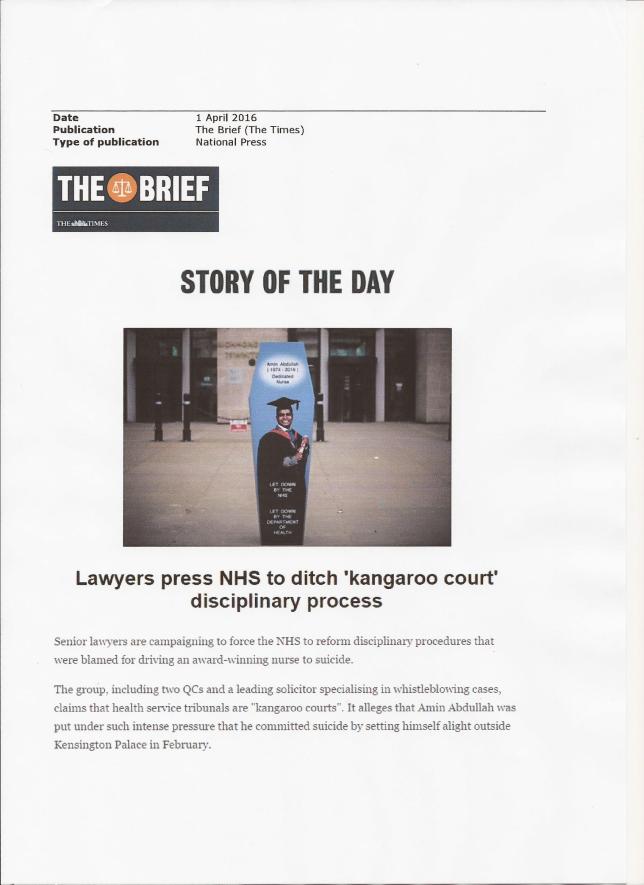
 Deputy National Guardian David Bell has followed his old boss Dame Eileen Sills in stepping down VERY quickly


 PETER BYRNE/PA


 SHARMILA CHOWDHURY