‘Common people’ – play on whistleblowing

First time in history, a play was performed covering stories of whistleblowers with audience participation in order to educate and  raise awareness.

They were represented from UK, Italy and Romania

The play covered stories of 7 whistleblowers:

Ciro Rinaldi, Ornella Piredda – from Italy

Eileen Chubb, Sharmila Chowdhury and Ian Foxley – from England

Liviu Costache, Alin Goga and Glaudiu Tutulan – from Romania

The play was held at National Radu Stanca theatre in Sibiu,  titled, ‘Oameni Obisnuiti’, which translated means ‘common people’, because the play was about ordinary people who had decided to speak up and as a result faced detriment.

Sibiu is one of the most important cultural centres of Romania and was designated the European Capital of Culture for the year 2007, along with the city of Luxembourg. Formerly the centre of the Transylvanian Saxons, the old city of Sibiu was ranked as “Europe’s 8th most idyllic place to live” by Forbes.

The play was organised by the general manager, Constantin Chiriac and directed by Gianina Cărbunariu

Gianina Cărbunariu (1977) is widely considered the “enfant terrible” of Romanian contemporary drama. She started studying directing in 1999 at the I. L. Caragiale National University of Theatre and Film Arts in Bucharest. Three years after having started her studies, something changed in the Romanian contemporary drama environment. Together with three fellow students, Cărbunariu co-founded a new drama competition that soon became a very interesting platform for new playwrights. This group, called DramAcum, offered a fresh look at Romanian theatre, the strongest since the fall of communism. Not only did DramAcum encourage new dramas, it also resulted in new translations of works written in less widely-circulated European languages.

Cărbunariu’s first play, Stop the Tempo is her most internationally known work and was later considered by critics as “the cream of the generation of new playwrights”.  In 2004, the play was invited to the Wiesbaden Biennale (Germany). Since then, it has been performed on stages in Paris, Berlin, Dublin, New York, Istanbul, Vienna, Nice and Leipzig. Her second play,Kebab, which was initiated at the Royal Court Theatre in London where the artist stayed as an international artist-in-residence, was banned by a private theatre in Bucharest, a few days before the premiere, because of its “indecent language.” After having been supported by the Teatrul Foarte Mic in Bucharest (a group that also encouraged Cărbunariu’s career as a theatre director), Kebab became one of the most frequently toured productions abroad; it caught the attention of theatres around the world, from Japan to the UK and from Denmark to Greece.

Cărbunariu’s name has been consistently put forward by Romanian theatre critics for the Europe Prize for New Theatrical Realities. The artist has has been short-listed by the Romanian media as one of the 100 most influential women in Romanian society today.

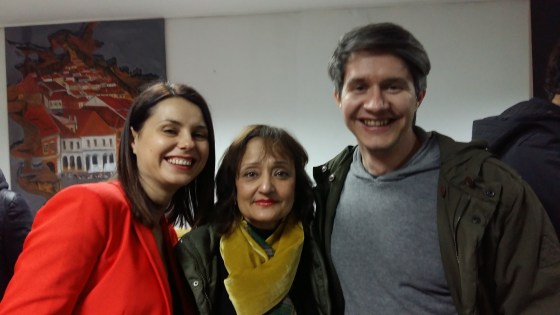
SC with Gianina and MihaiSharmila Chowdhury with Gianina Carbunariu – director, and Mihai Pacurar – scenic director 

Three of the stories were those from UK. Two of them were about NHS whistleblowers.

Prior to production, about six months earlier, we were interviewed and videod by the Gianina and the team. So the actors and production had played and replayed our interviews numerous to ensure accuracy of the stories. By the time the play was scheduled, they knew our individual stories almost  as well as us.

I flew out to Sibiu with Ian Foxley. Eileen Chubb was unable to attend.

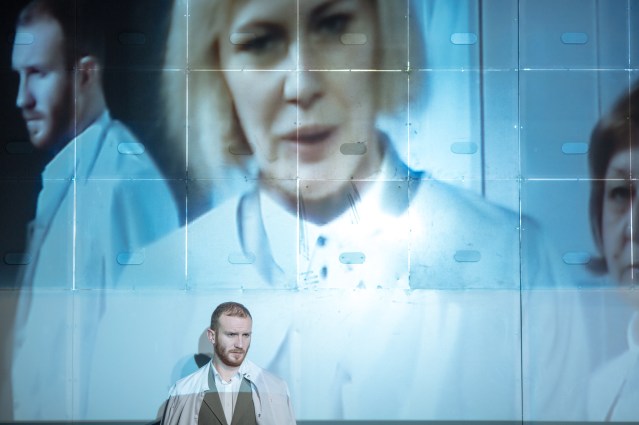
Once in theatre we were seated and the dialogue of the play had subtitles on the screen with clips of our interviews played out.

It must have been quite nerve wrecking for actors playing the whistleblowers sitting in the audience.

My double in the play was Miriana Mihu. I met with her after the play. It was very emotional for both of us!! Mariana had lived and rehearsed my story so many times for the play – she knew my story inside out. I having someone playing my double and  having my story acted out by an exceptional actress.

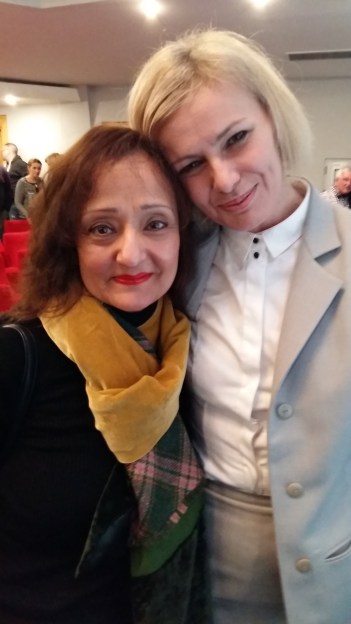
 Sharmila with Miriana SC with Marina

Ian Foxley and Sharmila with actors Ioan Paraschiv and Dana Talosian sc ioan dana.jpg

Ioan played the part of Ian Foxley and Dana played Eileen Chubb.

At end of play and after a small break, audience were invited to  put questions to whistleblowers whose stories were covered . Headphones were provided to translate questions put to the panel.

discutie4

discutii1

discutie6

Also present on the stage was Mr Codru Vrabie – who had written the new whistleblowing policy.  http://rai-see.org/whistleblowing/. The audience also asked him questions regarding the new policy.

It was a very open and transparent discussion involving the public, the whistleblowers and the lawyer who had drafted the new policy.

The discussion was moderated by Mr. Constantin Chiriac, the general manager of the Radu Stanca National Theater.

To view the trailer of the play: CLICK HERE

The play was repeated at theatre festival in Sibiu six months later with amazing audience feedback. It was also shown in Vienna.

In UK we have a long way to go in recognising sacrifices made by whistleblowers. Having plays with audience participation is one of the way forward in educating the public.

Maybe one day instead of victimising and dealing out  ‘life sentences’ to whistleblowers, they will be recognised as valuable part of an organisation, where raising concerns is no longer an issue. Eventually whistleblowers will cease to exist as raising complaints will be encouraged and acted on.  

We have however, a very long way to go.

FotoOameni26

FotoOameni17

fotoOameni2

FotoOameni22

Discipline in the NHS and the death of Amin Abdullah

The Times Law 17 March 2016

There needs to be an overhaul of procedures, with principles of independence, expertise and plurality enshrined in them

The heartbreaking story of Amin Abdullah, the award-winning nurse who committed suicide by setting himself on fire on February 9 this year outside Kensington Palace just days before an appeal hearing against his sacking, highlights the need for urgent reform of a flawed disciplinary system in the NHS.

Amin Abdullah was an outstanding nurse but was being disciplined for how he stood up for a colleague — he was one of 17 who signed a petition in support of the colleague when a patient complained. He also wrote a letter backing up the colleague and stating that the patient was “a professional complainer”, which was mistakenly attached to the petition.

A disciplinary process followed that proved too much for him and he developed depression and took his own life. His partner, Terry Skitmore, commented: “It’s a travesty. They are doing this to people all the time. It’s not just nurses but doctors and especially whistleblowers. I don’t want this brushed under the carpet.”

Sadly, Amin Abdullah’s case is far from an isolated incident. NHS employees are rightfully fearful of speaking out because the personal repercussions can be intense. And evidence shows that black and ethnic minority (BME) staff are more likely to report suffering detriment such as being victimised or ignored by management or colleagues , compared with their white colleagues — despite government rhetoric of a new legal regime and culture that supports openness and transparency.

Disciplinary procedures can also be used to undermine those who speak out. The February 2015 Francis Report into creating an open and honest reporting culture in the NHS, following the care scandal at Mid-Staffordshire NHS Trust, was highly critical of the “horrific” culture it found of workers’ lives being destroyed because they had spoken out for people in their care. It found even then that some were being driven to the brink of suicide. Sir Francis urged action at every level of the NHS to create a more open and honest culture.

Amin Abdullah’s tragic death a full year later shows how little things have changed. Secretary of state Jeremy Hunt’s statement in the House of Commons on March 9, 2016 — that a “culture change must also extend to trust disciplinary procedures” — in this case is sadly too little, too late.

Sir Francis heard that some disciplinary hearings are little more than one-sided kangaroo courts: “Repeatedly we hear of unaccountable managers protecting themselves and undertaking biased investigations, character assassination, lengthy suspensions, disciplinary hearings which resemble kangaroo courts, and ultimately dismissal of staff who previously had exemplary work records . . .”

Even if an employee has an exemplary record for performance or conduct, NHS employers can use the get-out clause of “some other substantial reason” if they wish to get rid of someone, claiming a breakdown in relations with other staff. Official records show that this was used more than 1,200 times by NHS employers in 2014-15.

Imperial College Healthcare, the trust that runs Charing Cross Hospital where Amin Abdullah worked, said: “We are saddened to hear of Mr Abdullah’s dealth and would like to offer our sincere condolences to his family and friends at this difficult time. The trust will engage fully with any investigations into Mr Abdullah’s death.”

There is no doubt, however, that there needs to be a major overhaul of NHS disciplinary procedures, with basic principles of independence, expertise and plurality enshrined in them. The current system results in harm to patient care, huge waste of public funds on legal and other costs; and causes suffering to dedicated NHS staff.

Dr Narinder Kapur is a visiting professor of neuropsychology at University College London. He is a past president of the British Neuropsychological Society and the former head of Neuropsychology at Addenbrooke’s Hospital, Cambridge. He has campaigned for a fairer and more open NHS and published articles on patient safety, including on lessons to be learnt from the Mid Staffs inquiry


  http://www.thetimes.co.uk/tto/law/article4714727.ece
Ralphnaderbolsinmattu3 hours ago

This case is tragic and illustrates the abuse of whistle blowers in the NHS. Nothing has changed since the Bristol Heart Scandel. Bolsin did a great thing, no lessons have been learned. The abuse of whistle blowers remain endemic in the NHS. The problem is that the management attitude of defend, deny and delay is institutionally approved. This approval serves two masters managers avoid responsibility for running a poor service and those who dare to point out gross failures are punished discouraging others.

Dr Mattu of Coventry is the most high profile case. Persecuted over 7 years by acCEO David Loughton who dragged clinical standards into the ditch, Walsgrave became ‘zero’ rated during his tenure as CEO, for his part in revealing avoidable deaths Mattu was reported to the GMC and Lougton and Walsgrave made up 100s of allegations all of which were dismissed by the GMC over a ridiculous 7 year period. Mattu recently sued for millions but Loughton spent £20 million Pursuing Mattu.

The GMC is abused by Hospitals as a way of silencing whistle blowers. The Hooper report highlighted how the GMC is conned into investigating doctors who are being persecuted for blowing the whistle on poor care and avoidable deaths.

One problem is that even after CEOs make up evidence that gets sent to the GMC and often Hospital Medical Directors collude, no action is take by the GMC against those who bore false witness and perjured themselves.

Hunt has shown too little courage to rectify this problem in the NHS which will not improve until managers can no longer cover up and take revenge on whistle blowers.

Whistleblowers let down by government, say MPs

The Guardian 11 March 2016  

Public accounts committee says Cabinet Office has shown a lack of urgency in strengthening laws to protect public servants

Deputy Labour leader Tom Watson
Deputy Labour leader Tom Watson has criticised the Cabinet Office. Photograph: Ben Pruchnie/Getty

The Cabinet Office has failed to introduce measures to protect and encourage whistleblowers in public services, parliament’s spending watchdog has concluded.

The public accounts committee (PAC) said that despite reassurances 18 months ago, it was “disappointed by the lack of urgency shown in dealing with this important topic” and demanded more be done to drive through changes.

The comments, contained in a report published on Friday, follow a number of whistleblowing scandals which have shaken public confidence in institutions.

In a review published last year, Sir Robert Francis QC said a “climate of fear” existed in the NHS in which staff who raised concerns about substandard care were bullied and victimised.

Responding to the report, Tom Watson, Labour’s deputy leader, said the criticisms followed a series of Cabinet Office gaffes which showed the department was struggling to function properly.

“Under the leadership of Oliver Letwin, the Cabinet Office is failing. There was the botched FoI commission, the failure to address diversity for senior civil servants, the changes to voter registration which were rushed through and now a damning report into whistleblowing,” he said.

“The government promised two years ago to strengthen the laws and practices to protect whistleblowers and it has categorically failed to do so. It must act immediately to address the concerns set out in this report.”

In a report in August 2014, the committee said whistleblowers “have been shockingly treated” and warned that attempts by departments to improve their policies had failed “in modifying a bullying culture”.

In Friday’s report, the committee looked for progress in the implementation of policies which could help to encourage staff to come forward with concerns about wrongdoing and ensure that they are properly protected. It criticised the slow progress in ensuring that those who speak out are protected.

“Nearly a year and a half has elapsed since the previous committee reported on whistleblowing, but we heard little to convince us that any real change has occurred on the ground,” it said.

A “task and finish” group, established to look at whistleblowing across Whitehall, has met only once, the committee found. It also discovered that the Cabinet Office does not have the data it needs to identify where improvements are needed.

While new guidance has been drawn up, the focus has been on policy “rather than instilling the positive cultures and behaviours required to support those raising a concern”, it added.

Cathy James, the chief executive of the whistleblowing charity Public Concern at Work, said: “It is about time that there was some real action by government to make sure that we celebrate and champion whistleblowers who protect the public interest.”

A Whitehall source said Watson’s criticisms of the Cabinet Office could not be justified, claiming that progress had been made on diversity in the public sector and that voter registration had been a success.

A Cabinet Office spokesman said: “The government takes this issue very seriously. In January, we collected data for the first time from across departments on whistleblowing cases and will continue do this on a regular basis. This information will will be important as we take action to address this issue.

“As agreed with the committee, we will respond to them by the end of the month to show the progress that we have made.”

NHS whistleblower cases must be reopened

Sarah Wollaston, on behalf of the Health Select Committee, has belatedly responded to my call for the government to reopen NHS whistleblower cases. It is the government’s position that this is not going to happen. Below is the paper I submitted to HSC arguing that an examination of these cases is a matter of natural justice and key to learning lessons that will help change the present victimising NHS culture.

David Drew

11 March 2016.


NHS whistleblower cases must be reopened. Practical redress and apologies are needed

In her letter of 26 March 2015 Dr Wollaston, wrote to me (Dr David Drew) on the recommendations in the Complaints and Raising Concerns report January 2015 concerning “historic” NHS whistleblower cases:

We hope that our successor Committee in the new Parliament will monitor the progress made by the Government and NHS England to implement the recommendations.


We are now some months into the new parliament so it is right for me to ask what if any progress has been made.

My concern in my original email to Dr Wollaston was with recommendation 21. May I summarise the present situation.

On 11 February 2015, following the launch of Sir Robert Francis’s Freedom to Speak Up Review report, the Secretary of State for Health made this statement to the House of Commons:

Sir Robert has confirmed the need for further change in his report today. He said he heard again and again of horrific stories of people’s lives being destroyed—people losing their jobs, being financially ruined, being brought to the brink of suicide and with family lives shattered—because they had tried to do the right thing for patients. Eminent and respected clinicians had their reputations maligned. There are stories of fear, bullying, ostracisation and marginalisation, as well as psychological and physical harm. There are reports of a culture of “delay, defend and deny”, with “prolonged rants” directed at people branded “snitches, troublemakers and backstabbers”, who were then blacklisted from future employment in the NHS as the system closed ranks.

(Hansard)

The emphases are mine.

I was one of the six senior NHS whistleblowers who met Jeremy Hunt and Simon Stevens in June 2014. This meeting led to the Health Secretary commissioning the Freedom to Speak Up Review. Both Mr. Hunt and Mr. Stevens praised us personally for our courage in speaking up for patients. We were of course grateful for their appreciation.

We knew full well from personal experience what an NHS whistleblowers lot is and we were pleased that Sir Robert, when his report finally appeared, described it so clearly. I think this was the first time the widespread, severe victimisation of good NHS staff by senior management has been officially acknowledged.  He also clearly attributed our victimisation to our “trying to do the right thing for patients”.

It was therefore a major disappointment to read at the end of Sir Robert’s report, almost as an afterthought:

Finally I recognise that some of those who have contributed so constructively to the Review will feel that their own personal issues have not been addressed. This was perhaps inevitable given my remit, but I have to observe that in some of their cases the contention has endured over such a long time, and the issues have become so complex, that the most rigorous inquiry devoted to each such case would not have been able to resolve matters for those involved.

This I imagine was exactly what the Department of Health would have wished to hear. Sir Robert was not asked to make any recommendation on how our cases should be dealt with. Nevertheless he did, in the most negative terms possible. He cites duration and complexity as arguments about re-examining our cases. Take whistleblower Dr Raj Mattu as an example. Last year he won his case at tribunal after many years of legal struggle. His case lasted many months and was so complex that he was cross examined for 3 weeks. His remedy hearing has lasted 2 weeks so far and when it resumes this month is expected to take another 2 weeks. If Dr Mattu had considered duration of struggle and complexity to be barriers he would never have vindicated himself. And this is primarily what whistleblowers want, vindication. And the redress that will follow that.

Sir Robert’s view needs to be contrasted with recommendations from your own committee (Complaints and raising concerns January 2015), the Clwyd-Hart Review (October 2103) and the NHS Confederation statement to the Freedom to Speak Up Review. I also refer to comments from David Behan and Simon Stevens. The reaction of the whistle-blowers themselves and the press reaction when the Freedom to Speak was published are salutary.


  1. Health Select Committee.

Recommendation 21:

We expect the NHS to respond in a timely, honest and open manner to patients, and we must expect the same for staff. We recommend that there should be a programme to identify whistle-blowers who have suffered serious harm and whose actions are proven to have been vindicated, and provide them with an apology and practical redress.

(Complaints and raising concerns January 2015),

On 21 January, following the publication of the report, Dr. Wollaston went on National Television and said that the treatment of NHS whistleblowers is a stain on its reputation. Dr. Wollaston was widely quoted in the same vein in the national press. For example:

http://www.telegraph.co.uk/news/nhs/11358111/Treatment-of-NHS-whistleblowers-is-a-stain-on-its-reputation.html

Dr. Wollaston was speaking in her capacity as Health Select Committee chair. It is unusual (in my opinion) to see such genuine moral outrage in our politicians. The recommendation for an apology and redress is clearly based on a sense of the deeply unjust way in which whistleblowers have been treated. (It is generally true that even when NHS whistleblowers have won their claims at ET and the NHS managers have been described as “unreliable witnesses” etc., those managers still do not apologise.) I hope therefore that the Health Select Committee will vigorously pursue its suggested remedy and ensure that our cases are re-opened. 


  1. NHS Confederation.

 We note the Committee’s comments on the experience of some whistleblowers in the NHS and how this is at odds with improvements in culture and confidence elsewhere.  We support the calls for practical redress for those who have been harmed as a consequence of raising genuine concerns.

(NHS Confederation (“the authentic voice of NHS leadership) in response to Complaints and Raising Concerns report)


  1. Clwyd-Hart Report October 2013.

However, we have heard in the course of our work repeated concerns about a number of unresolved questions surrounding this issue. These concerns relate firstly to securing justice for past whistle-blowers whose careers have been seriously jeopardised and who have suffered financially as a result of drawing attention to malpractice. We urge the Department of Health to undertake the review of such cases with a view to both learning lessons for the future and undertaking restorative justice for those individuals affected.

(Clwyd-Hart Report Chapter 6, page 37.)

Ann Clwyd clearly saw the victimisation of whistleblowers as a justice issue.


  1. David Behan, chief executive of the Care Quality Commission:

It takes great courage for health professionals to raise concerns about care and so they must be reassured that when they do come forward that they will not suffer as a result. No one should be punished for acting in the public’s best interest.

(Quoted from Guardian Newspaper 11 February 2011)

The point is that we have suffered and we have been punished for acting in the best interests of patients and the public. The boss of the principal healthcare regulator can glibly say this knowing full well that neither he nor anyone else has lifted a finger to help such public spirited professionals.


  1. Simon Stevens CEO at NHS England

As a nation we can rightly be proud of the fact that NHS care is now the safest it has ever been. But as I’ve sat down and listened hard to whistleblowers over the past year, it’s blindingly obvious that the NHS has been missing a huge opportunity to learn and improve the care we offer to patients and the way we treat our staff.

(NHS England comment on Freedom to Speak Up report 11 February 2015)

Simon Stevens makes a good point which seems to have been entirely lost on Sir Robert Francis. First, numerous clinical incidents were reported to Sir Robert. In our letter to the Telegraph of 13 February 2015 (“Crimes in the NHS”) Dr. Minh Alexander and I wrote:

He is in possession of claims of cover-ups of children’s deaths, deaths in custody, physical abuse and neglect, fraud. Many of these are unresolved.

No-one has shown the slightest interest in learning from these incidents. I feel sure that the burden of patient harm and wrongdoing reported to Sir Robert in the Freedom to Speak Up Review easily exceeded that reported to him at Mid Staffs.

Sir Robert has been unable to prescribe a remedy for those NHS staff who have suffered horrendous victimisation nor has he called to account the managers (CEOs and Trust board members) responsible for this. Forgetting the injustice of this for a second, nothing has been learned about these people. Are they monsters or just ordinary people following orders?

All this learning has been lost by what is essentially a political unwillingness to look closely at what has happened.


  1. NHS Whistlebowers.

There must, I think, be universal agreement amongst the whistleblowers themselves that “historic” cases must be re-examined. I have formed this opinion through social media, emails and other correspondence and face to face meetings. I published my own personal view in an open letter to Sir Robert in the Independent on Sunday on 14 February:

You have sent out exactly the wrong message. Whistleblowers are pawns who will not receive help, even from you. You have left us to our fate. This will have a further deterrent effect on staff raising concerns. The managers who have victimised us will feel more secure than they already were. They remain unaccountable. Patients who depend on our freedom to speak up will be less safe.

You see culture as central and make a number of recommendations for NHS culture change. You call for a just culture in which we learn from honest mistakes and do not punish those who make them. But how can a just culture be built on the foundation of injustice which is laid down by your failure to address the victimisation so many have experienced?

We all make mistakes all the time. We are human. Honest mistakes are not to be punished but learned from. That is essential to a just culture. But intentional wrongdoing must be held accountable. That is also essential to a just culture. Sir Robert (he has been described as the unjust judge in one blog) has allowed the reporters of wrongdoing to go to jail (a life sentence as he admitted) and the wrongdoers (as identified by him) to walk Scot free. A just culture is incompatible with this.


  1. National, International and Local Media.

There was massive coverage of the report’s launch. Many of us did a large number of interviews. I did eighteen. We did this despite the obviously engineered disadvantage we suffered by only having forty minutes with the 200+ page report before we met Sir Robert for questions and then the Press. The coverage overwhelmingly recognised the truth of Sir Roberts account. The best analyses of his report were highly skeptical of his proposed solutions. For example on 12 February Andrew Smith wrote in the Guardian:

In Freedom to Speak Up, the report on the plight of NHS whistleblowers published this week, Sir Robert Francis interviewed 612 victims, many of whom I know had high hopes. But his recommendations have turned out to be toothless and probably ineffectual.

The Mail and other newspapers on the same day expressed the same sentiment:

A report into the NHS’s shocking treatment of whistleblowers was yesterday branded a ‘whitewash’ that will do nothing to protect staff who raise concerns.

A notable theme was the complete failure of the report to hold anyone accountable for the way decent professionals had been victimised for doing their job. At an earlier Health Select Committee hearing Sir Robert said that CEOs supressing whistleblowers should be sacked. By the time of his report he appears to have done a complete U-turn. This has never been explained but I presume is due to political pressure.


The Government Response.

The Government response to the House of Commons Health Select Committee Fourth Report of session 2014–15 Complaints and Raising Concerns was published in March 2015 shortly before Dr Wollaston wrote to me.

 In response to the report’s Recommendation 21

We expect the NHS to respond in a timely, honest and open manner to patients, and we must expect the same for staff. We recommend that there should be a programme to identify whistle-blowers who have suffered serious harm and whose actions are proven to have been vindicated, and provide them with an apology and practical redress.


 The Department of Health commented:

 As the Freedom to Speak Up report indicates, the issues faced by historic whistle-blowers can often be complex. Many cases have already been considered by the courts and the Government’s view is that there can be no general basis for reopening cases that have been through a legal process.


This is exactly the get out of jail response that I would have expected from the Department of Health. In 2001 the Department of Health accepted Ian Kennedy’s recommendation (Bristol Heart Scandal report) that it develop a safe NHS reporting culture. It has failed to do that. A high percentage of NHS staff still fear being ignored or suffering retaliation if they report concerns about patient care and this creates a daily risk to patients. It is a fear that is well founded. The Freedom to Speak Up review is a stark reminder that the Department of Health failed to do as Kennedy recommended. That failure has resulted in an unknown number of patient deaths and much unnecessary suffering. If the Department of Health had secured a safe reporting culture the Mid Staffs tragedy would not have happened & the Public Inquiry would have been avoided. If they had secured a safe reporting culture the NHS professionals who suffered the horrific victimisation described by Francis in his February 2015 report would have been spared their suffering. The Department of Health pays lip service to their courage. In practice it never lifted a finger to help them. Small wonder the Department of Health does not want any historic cases re-opening. That would prove extremely embarrassing. Please consider the rationalisations they present for not re-opening our cases:

“The issues faced by historic whistle-blowers can often be complex”

They are complex precisely because the victimising managers that Sir Robert identified made them complex, taking what in most cases were genuine and serious complaints and turning them into employment disputes in which we as employees found ourselves on the wrong end of breakdown in trust and confidence claims. In any case since when was complexity an argument against addressing widely recognised injustice and the need to ensure a safer future. The Hillsborough Independent Panel (events of 1989) and the Goddard CSA Inquiry (now retrospective to 1940) are dealing with matters of greater complexity but in terms of harm to patients and professionals no greater seriousness.

Many cases have already been considered by the courts

 These cases have been considered in terms of employment law. Sir Robert knows this perfectly well. The disadvantage whistleblowers suffer in the tribunals is widely acknowledged, hence the reluctance most have to risk financial ruin. The Health Committee has already recognised all this and advised, in section 3 of its response to the Francis Public Inquiry report,

Disciplinary procedures, professional standards hearings and employment tribunals are not appropriate forums for constructive airings of honestly-held concerns about patient safety and care quality.

Whistleblowers should never have been put through internal disciplinary procedures which are completely biased and part of the victimisation they suffer. They should never be put through the stress, financial risk and huge disadvantage of the tribunals. This is also part of the victimisation they have suffered. The fact that some of us have had a hearing in the tribunals in the narrow confines of employment law is no argument for turning a blind eye to the injustices we have suffered.

There can be no general basis for reopening cases that have been through a legal process.

 There may be no general basis but there must be a basis for individual cases. Otherwise what can we make of the widespread support there is for reopening cases including that made by Health Select Committee. It is clearly the view of the Secretary of State and the Department of Health that even the gravest injustice cannot be addressed, even the most deserving case must not be re-opened. That would risk further publicity and an avalanche of other claims.


In summary, there is a widespread perception of unfairness in the way the NHS has treated its whistleblowers and the way the Department of Health has consistently failed to protect them. Up to the present Parliament has also failed. Good doctors, nurses and other staff are still suffering the consequences of their victimisation. New whistleblowers to this day are suffering the same fate as the “historic” cases. Whistleblowers are still signing super-gags with the Treasury’s knowledge. The managers responsible for our victimisation are still enjoying their own career progress and there is a widespread perception that they are untouchable.

In August 2014 Margaret Hodge Public Accounts Select Committee chair told the Guardian newspaper that “no senior manager had ever been held to account for victimising a whistleblower”. She stated in the same article that she had been “dismayed by the way ministers and senior managers have failed to protect the public interest”.

Small wonder that the worst NHS managers still feel free to ignore and mistreat staff who raise concerns. The real losers in all this are patients. Their safety depends on a safe reporting culture. Jeremy Hunt told Parliament in February that we are 10 years (or on another occasion a generation) away from that. That is why “historic” cases must be re-opened. Justice must be done and be seen to be done. A clear message (Sir Robert ducked this completely) must be sent to those who victimise whistleblowers. And patients and the public must be reassured that their safety which often depends on professional advocacy is truly being made the top priority.

David Drew

February 2015.


NHS Whistleblowing: Public Accounts Committee report 2016

Making a whistleblowing policy work: progress update  

11 March 2016

Summary

We are concerned that the Government’s response to the previous committee’s report on whistleblowing has been too focused on policy and process, rather than on taking the lead to drive the much needed cultural change required to encourage and support whistleblowers to come forward. We are disappointed by the lack of urgency shown in dealing with this important topic, which is illustrated by the fact that the ‘Task and Finish’ group, set up to look at whistleblowing across Whitehall, which was a key component of the Government’s response, has only met once. We are also concerned that government’s focus is limited to departments rather than ensuring whistleblowing is also dealt with effectively in the wider public sector and in private and third sector providers delivering public services.

Introduction

Whistleblowing is when an employee raises a concern about wrongdoing, malpractice or poor practice in the workplace that has a public interest aspect to it. In August 2014 the previous committee reported on whistleblowing, noting that a positive approach to whistleblowing should exist wherever the taxpayer’s pound is spent. However, the committee found that too often whistleblowers had been shockingly treated, and that departments’ attempts at changing whistleblowing policy and processes for the better had not been successful in modifying a bullying culture, or in combating unacceptable behaviour. The Cabinet Office has issued whistleblowing guidance which includes detailed procedures about how to raise concerns and has responsibility for overseeing whistleblowing arrangements.

Conclusions and recommendations

1.We are disappointed at the slow progress made by the Cabinet Office and departments in improving whistleblowingarrangements. Nearly a year and a half has elapsed since the previous committee reported on whistleblowing, but we heard little to convince us that any real change has occurred on the ground. Witnesses were unable to tell us how many reports on the effectiveness of whistleblowing arrangements go to departmental boards, or which departments are lagging behind in implementing effective arrangements. Opportunities to secure improvements through shared learning are hampered by the absence of a formal platform for HR directors (or other nominated officers) or board members to share and apply good practice and learn lessons following reviews in this area, such as the Francis review of whistleblowing in the NHS.

Recommendation: We expect Cabinet Office to report to us by June 2016 on progress in addressing our recommendations.

2.We are concerned that the ‘Task and Finish’ group, established to look at whistleblowing across Whitehall, has met only once.The ‘Task and Finish’ group, described in the Government’s response to the previous committee’s report as being a key player in ‘reviewing Departments’ practices and providing a challenge to existing processes’ has only met once without any tangible result. The Committee heard that the Group had no plans to meet again, but the Cabinet Office agreed to consider whether further meetings would be useful.

Recommendation: The Government should set out what the ‘Task and Finish’ group’s role is and how it intends to review whistleblowing arrangements across government.

3.Policy and process implementation are steps in the right direction, but by themselves will not create the right environment forwhistleblowers to come forward. We recognise the progress that has been made in producing policy guidance on whistleblowing. But we are concerned that efforts to date have been too focused on implementing policies and procedures, rather than instilling the positive cultures and behaviours required to support those raising a concern, which should result in better treatment for whistleblowers and more effective handling of their concerns. The Cabinet Office was unable to provide any evidence about which departments were performing well, and which were lagging behind.

Recommendation: Cabinet Office should work with departments to create the right environment for whistleblowers to come forward, including support for staff at induction, working with departments to identify the ‘best in class’ in what works in supporting whistleblowers, and holding departments to account where progress is below the standards expected.

4.The Cabinet Office does not have the data it needs on whistleblowing to identify where improvements are needed. The Cabinet Office could not provide information on departments’ performance on whistleblowing as it lacked data in many areas including: the number and type of cases; the outcome of cases; whether whistleblowers have complained of victimisation or discrimination as a result of their actions; and how many still worked in the department after raising their concerns. The Cabinet Office was waiting for data to be collected and analysed in early 2016.

Recommendation: We expect the Cabinet Office to share with us, by the end of June 2016, an analysis of the data it has collected, and an action plan detailing how this data will be used to secure improvements where needed in departments. In the future, the Cabinet Office should collect data on an annual basis to support its role of holding departments to account on whistleblowing arrangements.

5.The Cabinet Office’s focus is limited to whistleblowing in departments rather than seeking to ensure it is also dealt with effectively in the wider public sector and in private and third sector providers delivering public services. The College of Policing review of the police service and the Francis review of the health sector both highlighted the need for effective whistleblowing policies in the wider public sector. But the present approach is limited to collecting data on core departments, which risks missing valuable intelligence on whistleblowing across the wider public, private and third sectors. The Cabinet Office maintained that government does not have the capacity to act in this space, but we consider that departments charged with delivering public services should be able to provide assurances that those delivering services on their behalf are treating whistleblowers appropriately, and feel confident that they have sufficient intelligence to act on systemic issues.

Recommendation: The Cabinet Office should require the wider public sector and private and third sector providers delivering public services to both have effective whistleblowing arrangements in place and report on concerns raised by whistleblowers to identify any systemic issues.


To view full report:

http://www.publications.parliament.uk/pa/cm201516/cmselect/cmpubacc/602/60202.htm

Jeremy Hunt: Learning from mistakes

House of Commons

Wednesday 9 March 2016

Oral Answers to Questions

         NHS: Learning from Mistakes

The Secretary of State was asked—


Mr Hunt made the following statement to the Parliament:
 https://www.gov.uk/government/speeches/an-nhs-that-learns-from-mistakes

This was then followed up by questions from MPs.  For full transcript see bottom of page. These were some of the questions put to Mr Hunt:


Dr Philippa Whitford (Central Ayrshire) (SNP):

I have a final plea. The Secretary of State is offering more support to whistleblowers, but a review and reconciliation for those who have been badly treated in the past might give people more confidence that, if they step up and report something significant, they will not be hung out to dry, as has been the case previously.

Mr Hunt:

With respect to whistleblowers, I will reflect on what the hon. Lady says. We are trying to eliminate the need for things ever to get to the point where someone has to become a whistleblower. We want to ensure that people are supported to speak out about mistakes they have seen or made and concerns that they have, and that they are confident that they will be listened to. We are publishing a table today about the quality of the reporting culture. Much of the raw data that allow us to rank trusts on the quality of reporting data come from the NHS staff survey, which asks staff how valued they think they are, and how safe and easy it is to raise concerns. That is why this is a big step forward.


Mr Hunt does not answer the question. He advised that staff will be supported to speak up but not what he as the Secretary of State will put in place to ensure whistleblowers are not ‘hung out to dry’. So, basically staff will be encouraged to speak up but no redress if they are subsequently persecuted.

‘We are trying to eliminate the need for things ever to get to the point where someone has to become a whistleblower.’ is a good strapline but how will Hunt achieve this?

Despite numerous speeches and assurances, there has been no accountability of senior managers who persecute whistleblowers. In fact in many instances they are even promoted as in case of Raj Mattu where £11m (so far) of taxpayer’s money has been wasted on legal costs. Yet the CEO responsible continue to enjoy a good life without question. 

https://sharmilachowdhury.com/2016/02/05/vindicated-sacked-whistleblower-backed-by-the-mail-wins-1-2m-payout-after-nhs-spent-10m-trying-to-crush-him-after-he-exposed-shocking-failings-in-care/

In fact why are NHS organisations given a blank cheque for legal expenses which is funded by the taxpayer to pay for patients? Why has this not yet been stopped?


In the following example gagging clauses were used so potentially placing patients at risk. However, manager responsible has not been held to account

 https://sharmilachowdhury.com/2016/03/06/health-reform-chief-backed-contracts-with-gagging-clause/

CQC’s Fit and Proper Person Test has also failed in holding senior managers to account. Not one manager who has been involved in persecution of whistleblower has been formally held to account. frequently citing reasons that they are no longer at the Trust where the incident occurred.


Rachael Maskell (York Central) (Lab/Co-op):

Action on Sir Robert Francis’s “Freedom to Speak up” review is very welcome. There are so many cases I could cite, but when a senior junior doctor reported unsafe levels of care in an intensive therapy unit, he was subject to unacceptable behaviour such as bullying and blacklisting, and now can only work as a locum. When he wrote to the Secretary of State, the Secretary of State refused to engage, listen and learn from his experience. Learning cultures have to start at the top with the Secretary of State. Will he set out how he will address retrospective cases of whistleblowing when people have been subject to discrimination?

Mr Hunt:

I hope that the hon. Lady is not quoting selectively from my reply to the person concerned, because when people raise issues of patient safety with me, I usually refer them to the CQC, which is able to give a proper reply. I would be very surprised if I had not done that in this case. Retrospective cases are particularly difficult, and much as we want to help, it is difficult constitutionally to unpick decisions made by courts. We are trying to separate employment grievances from safety grievances and make that the way that we solve these difficult situations.

‘Learning cultures have to start at the top with the Secretary of State.’ This is indeed a view shared by many. As  Health Secretary of State in excess of 6 years, what has Mr Hunt learnt about whistleblowing and what effective measures has he put into place as a result?

Hunt has also refused helping ‘retrospective cases’. So, basically if as a whistleblower you have lost everything – job, career, pension contribution, home, marriage and health, then it’s simply TOUGH because redress would be ‘particularly difficult’ . Why? Because courts are responsible. Many whistleblowers have won in courts or have had to settle out of court, so proving whistleblower’s case.

Hunt goes on to say, ‘We are trying to separate employment grievances from safety grievances’. Nearly all whistleblowing cases go through employment grievances from false or insignificant counter allegations.  In fact in nearly all whistleblowing cases, where the staff member has contacted the Department of Health, DH, for help. DH have refused, advising they cannot intervene due to ‘ongoing employment’ dispute. Yet they do intervene  by  helping and advising organisations on progress and settlement as well as funding their legal expenses, paid by the taxpayer.

Subsequent freedom of Information disclosed in my case that my settlement was ‘a good value for money’. Trust had advised DH that due to ‘new technology’ my post was now redundant. So they were offering me 2 years pay – out of which I had to pay my legal cost of £78,000. A prudent DH official would have asked what was the new technology and given that I had won my case who should have been held to account, given that there were clear evidences of my raised concerns. DH asked neither. Whistleblowers are regarded as a ‘disposable commodity’.

Hunt goes on to advise, ‘I usually refer them to the CQC, which is able to give a proper reply.’ So, basically Hunt is passing on the responsibility to CQC. Yet, CQC do not deal or investigate detriment faced by whistleblowers.

CQC advises: ‘Please be aware that we do not settle individual complaints. The only exception to this is complaints people whose rights are restricted under the Mental Health Act (or their representatives) make about the way staff have used their powers under the Act.’   From page 9 of CQC: how to complain about a health and social care service  

So, whistleblowers are left going in circles for help.

Mr Dennis Skinner (Bolsover) (Lab):

If anybody should be learning from mistakes in the health service, it is the Secretary of State for Health. I have been down to the picket line today, as I have on every occasion, and I can tell him that it is hardening. There are more people on that picket line down at St Thomas’ today than I have seen in all the months since the strike began. I am a bit of an expert on picket lines; I know what it is like. Quite frankly, the biggest mistake that the Secretary of State has made is to think that he can get away with imposing a seven-day week on hospital doctors and everybody else who works in the health service, because he wants to avoid proper premium payments. When I worked in the coal mines, miners got double pay on Sundays, and they got time and a half all day Saturday. It is time he recognised that not just hospital doctors but nurses, radiologists and all the others who will have to work a seven-day week should be paid the proper money. Otherwise, pack the job in, and then he’ll be doing a service to the whole national health service.

Mr Hunt:

Under our proposals, doctors will receive higher premium rates than lower paid nurses, paramedics and healthcare assistants. I thought the hon. Gentleman campaigned for the lower paid! The day that I stop this job will be the day that I stop doing the right thing for patients. He has constituents who need a seven-day NHS, as do I, and this Government will be there for them and will do the right thing.

Mr Skinner also advises, ‘If anybody should be learning from mistakes in the health service, it is the Secretary of State for Health.’ Yet, Hunt seems oblivious to any mistakes made by him. We all make mistakes but greater mistake is not recognising them.

Hunt goes on to say, ‘The day that I stop this job will be the day that I stop doing the right thing for patients.’. The right thing for the patients would be to have a properly funded and a safe NHS where both staff and patients are protected. Hunt has so far failed patients and staff.

Maria Caulfield:

Thank you, Madam Deputy Speaker. People are fed up with the NHS being talked down by Labour Members, and there was a plea to showcase the good work that is taking place in our NHS today.

Mr Hunt:

It is so good to have someone with nursing experience in the House, and I hope that my hon. Friend will make an important contribution for many years to come. She knows what it is like on the front line, and why it is important to get this culture change. She also knows how important it is not to run down the NHS, which is doing extremely well.


Ms Caulfield advised, ‘a plea to showcase the good work that is taking place in our NHS today.’. Indeed there are huge amount of good work taking place in our NHS despite unacceptable pressures placed on them by DH.


Hunt advises with regard to the NHS:  ‘is doing extremely well.’  Really Mr Hunt?


Hansard transcript: http://www.parliament.uk/business/publications/hansard/commons/todays-commons-debates/read/unknown/291/


Response from learning from mistakes initiative:

 http://www.independent.co.uk/voices/learning-from-mistakes-means-youll-have-to-start-listening-to-nhs-whistleblowers-jeremy-hunt-a6921261.html


Jeremy Hunt on twitter with responses:

Read my statement to Parliament on our plans to make the NHS a safer system:

These are some of the responses:

. Dude there’s like fifty four thousand telling you something’s going wrong RIGHT NOW. RIGHT NOW AS I TYPE.

Smoke and mirrors & empty promises are a poor substitute for real governance, Minister

So where is our whilstleblowing protection? And where is YOUR learning culture? You are not proving to be a good example

what about the judgement made in Manchester today on being able to speak out safely?

And that man is even worse -lawyers acted for Hunt AGAINST Chris Day. Hypocrisy

Well thats not what is happening to Chris Day. Will you step in & protect this dr fired for speaking up about patient safety?

. 50000 doctors in England are now on strike -speaking up against you to help prevent things going wrong in the future.

They all blame you, you simpering quarter wit

Hunt, YOU are the thing that’s going wrong. Everybody is telling you this every day. Trouble is, you are refusing to learn.

are you taking the piss? Thousands of junior doctors are out on the streets protesting against YOU. You do understand that yeah

I, along with thousands of others, don’t believe the rubbish you spout anymore

Have you perhaps stopped to consider that the biggest problem with the NHS is you

You have 53000 doctors speaking up now and you are ignoring them.

Tell us when the safest option isn’t an option

Instead of sitting penning more ‘sticks’ to beat up our doctors with. Get out to picket lines and talk to them!!

does it involve destabilising the NHS to make way for a lucrative private health care system by any chance??

‘You spin me right round baby right round’ !!! How is your Cousin these days? sold him anymore of the NHS?

Why? It’s a tissue of lies, spin and obfuscation.

liar and a corrupt callous uncaring shit

I trust the NHS staff that saved my then 5 month old sons life, stop attacking them

does it involve putting patients before your own political & financial ambitions? Thought not.

you mean how to sell it off your chums so they can privatise it and charge us loads to use it

“cloth-eared tool” is too nice. You are a national disgrace.

Bullying doctors until they leave will not make the NHS safer.

you are going to quit?

Just resign, it will make NHS safer. Have you ever worked in a hospital? With out experience how to you know?

the extent to which you’re dissociated from what’s going on around you is a concern. You can access free therapy on the NHS…

Won’t make any difference… he’s just the muppet !!!

It’ll be full of spin, deceit and lies, you have shown yourself to be dishonest and its certainly doubtful you have integrity.

Not having Junior Doctors working long shifts and recruiting more staff would help make our safer!

Please resign you ruddy fool.

I really hope you can learn from your mistakes in that case! Will I be protected when I whistle-blow your incompetency?

You don’t seem to be learning Jeremy, I blame you for your appalling treatment of NHS staff

You’ve had 6 years to make NHS safe & you’re still planning?

Doesn’t NHS stand for National Health SERVICE, not National Health System? Just checking.

why do 98% of junior doctors think you’re wrong? I’d much prefer to read your resignation letter

SAFER….HAHAHAHAHAHAHAHAHAHAHAHAHAHAHAHAHAH HAHAHAHAHAHAHAH HAHAHAHAH

no thank you, I’d rather repoint my entire house

Why, is it your resignation letter?

if I wore a hat sir, I’d now be taking it off to you for that reply to the walking/talking idiot that is

So thousands are speaking up as I write…. Why aren’t you listening and learning?

none of your plans will make the NHS safer because there will be no staff left to carry out your crazy plans. Invest in staff.

As SOS Health you have totally failed in your role. Please stop your arrogance and listen to our Jr Docs. They are intelligent.

the only statement you could make to create a safer NHS would be your resignation!

I’m confused, who protected Dr Chris Day when he raised concerns about , then got sacked, who’s protecting him

Disgraceful!

I can’t be bothered reading it, are you increasing staffing levels? Are you negotiating with doctors?

can’t see anything relating to bullying & demoralising staff, yet that’s the reality.

You sir are a threat to patient safety and also a laughing stock. You’re time is numbered

But when are you going to sack incompetent & vindictive NHS managers who apply the blame culture against medical staff?

So I take it that means your resigning then. Oh well better late than never.

then its time YOU listened & learnt from NHS staff life savers/care providers NOT pen pushers.

it’s never been a system

A safer NHS? Does that start with your p45 in the post?

for the sake of our NHS please back off and resign, you and your colleagues are slowly killing public services.

Absolute BULLSHIT Hunt nothing learned from Winterbourne View 4 years ago PLS RT to expose

Please resign you ruddy fool.

are you resigning?

does it say “I was wrong, I lied and I therefore resign” …. if not it must be more of the same

Ha Ha Ha see you at your next gig Live at the Apollo

Talk to the Junior doctors you incompetent twit.You may not know but they are on strike at the moment because of your stupidity

I’m confused, who protected Dr Chris Day when he raised concerns about , then got sacked, who’s protecting him?

all that comes out of your mouth is lies,why would this be any different.Just resign

how is it possible to believe a word you say,after you’ve told so many lies?

we are striking to make sure the NHS is safe from your privatising hands. Hunt should Quit now.

we are speaking up Mr Hunt and you are not protecting us. Do explain this garishly obvious disparity.

, in medicine learning from mistakes is vital, knowing when you are wrong and putting patients first. , please!

you still around, not resigned yet, just how do you live with yourself & your constant dismantling of The NHS

Im ready to speak up.Which is why I will. You are the problem.If you and your lies disappear,there’s no longer anything wrong!

you’ve lost all credibility. leave the NHS alone

you are what is going wrong at the moment, demoralising and trying to disband the NHS! Find something you are good for and go!

people are only BLAMING YOU so why don’t YOU LEARN from this?

Oi , don’t you think if the majority of the nation is against you, you might be wrong on this one?

What’s wrong is you – resign and the problem is sorted.

STOP manipulatin the stats, listen to the NHS staff sayin ur wrong. no-ones buyin the rubbish you spout. Just admit it ur wrong

What’s wrong is you – resign and the problem is sorted.

you are so far out of touch it’s embarrassing

Things are going terribly, horribly wrong right now, and the fault lies with your department and your government, no one else

WE are speaking up but YOU aren’t listening.You are working hard to destroy the people who one day might have to save your life

Mr Hunt, you have well earned your reputation as a bullying, contemptuous liar. Leave the NHS alone.

And finally ………..

someone in your team should of said might be a idea to stay off twitter for while


Learning from mistakes means you’ll have to start listening to NHS whistleblowers, Jeremy Hunt @Jeremy_Hunt Please RT

The Independent 9 March 2016       Dr David Drew  @NHSwhistleblowr
Hunt is in danger of becoming not just the longest serving but possibly the most unpopular Health Secretary ever. He’s presiding over a culture of low morale
web-jeremy-hunt-1-pa.jpgThe Francis report identified poor treatment of whistleblowers in the NHS. PA

In a couple of months Jeremy Hunt will, if he survives, become the longest ever serving Health Secretary. In his search for a legacy he appears to have seized upon patient safety. This is not surprising, given the political advantage presented to him in February 2013 by the Francis report into Mid Staffordshire. Scarcely a week goes by without him telling us of the horrors Francis uncovered in that hospital.

It is right that we should be reminded. But not on his terms that this was a Labour-generated disaster in patient care. The truth is much more complex. In any case, NHS staff are, in my experience, sick and tired of having the health service used as a political football in this way.

Hunt tells us that the NHS needs to use “black box thinking” and learn from its mistakes. In the time left to him in office it is essential that he learns from his own. He need look no further than his own responsibility for the low staff morale which puts patients at risk.

Healthcare is profoundly labour intensive. The NHS employs 1.4 million people, accounting for 70 per cent of its total budget. Nothing can be achieved without having the workforce on side. Yet Hunt is in danger of becoming not just the longest serving but possibly the most unpopular Health Secretary ever.

The NHS staff survey paints a woeful picture of low morale: high levels of bullying and a culture of fear in many institutions deter healthcare professionals from speaking up for patients. A recent Kings Fund study showed that the principle anxiety of most NHS finance directors is not huge deficits but low staff morale. The CQC inspections Hunt lauds for improving the worst trusts are widely seen as instruments of bullying. Trusts are put into special measures for reasons that are beyond their control. Underfunded and understaffed, they are continually fire fighting to provide any kind of service at all. It is impossible to create sustainable improvement by inspection in these circumstances.


Hunt is now in danger of further alienating the professionals he depends on to deliver his safety agenda. Nowhere is this better exemplified than with his imposition of the junior doctor’s contract. This is not the way to deal with intelligent and highly skilled professionals. Barely a single senior NHS manager supports him in this madness. Senior managers know that he is damaging their doctors – in some cases irreversibly. Don Berwick, Hunt’s one-time favourite patient safety guru, told a recent conference that he should apologise to the junior doctors for the contract negotiations.

Ironically, given his claims about learning from mistakes, the single group he has alienated more than any other is whistleblowers. They are the vanguards of a safe NHS reporting culture. In 2014 Hunt praised their courage openly and asked Robert Francis QC to review the treatment of NHS whistleblowers.

In 2015, Francis reported widespread severe victimisation of staff by senior management when they spoke up for patients. His most substantial recommendation was for a National Guardian to protect staff. This, in the hands of the CQC, turns out to be a part time post with no powers. The appointee, Dame Eileen Sills, quit before starting.


Meanwhile, whistleblower victimisation continues and those responsible for that victimisation are protected. Francis recognised that sacked whistleblowers are blacklisted and recommended a re-employment scheme. Not one person has yet been found a job. This can only serve to reinforce the natural reluctance of staff to speak up.

Black box thinkers are not afraid to admit they made mistakes. They see failure as a great opportunity to learn. If Hunt really is a black box thinker, if he is willing to learn from his mistakes, he may just be remembered as the Health Secretary who made the NHS safer for patients and staff.

Dr David Drew was dismissed by Walsall Manor Hospital for “insubordination” and “gross misconduct”. He claims the action against him followed whistleblowing, but lost an appeal on those grounds. 


More related articles:

http://www.independent.co.uk/life-style/health-and-families/health-news/jeremy-hunt-promises-whistleblowers-safe-spaces-and-legal-cover-a6919721.html

http://www.independent.co.uk/news/uk/politics/jeremy-hunt-s-confrontation-with-junior-doctors-derailed-the-nhs-own-work-to-deliver-seven-day-a6908251.html

http://www.independent.co.uk/news/uk/politics/junior-doctors-strike-nhs-labour-abandon-patients-support-march-9-a6921196.html

http://www.independent.co.uk/news/uk/politics/junior-doctor-morale-review-ordered-by-jeremy-hunt-in-disarray-after-medics-threaten-to-withdraw-a6898571.html

NHS whistleblowing tsar role hits new delay after National Guardian quit before even starting work

Daily Mirror   8 MAR 2016    BY ANDREW GREGORY


Dame Eileen Sills was appointed to help staff expose poor treatment following the Stafford Hospital scandal – but resigned before starting work on April 1


dame eileen sills

Resigned: Dame Eileen Sills quit before she even started

The hunt for a new NHS whistleblowing tsar will not begin until after Easter – and the job may still be ­part-time.

Dame Eileen Sills was made National Guardian to help staff expose poor treatment following the Stafford Hospital scandal.

We revealed yesterday how she quit before her start date of April 1 because she could not juggle the part-time job and her main hospital role.

But now the Care Quality Commission has failed to rule out another part-time post, saying: “The role will be re-advertised after Easter.

“The specification has always allowed for ­flexibility… this included part-time and full employment options.”

David Behan, chief executive of the CQC said he was disappointed to receive Dame Eileen’s resignation but has insisted ‘the work of setting up the office of the National Guardian will continue as planned’.

Read more: New whistleblower tsar only working TWO DAYS a week but keeps £174k NHS job

The revelation is a huge blow for whistleblowers, who say they must be taken seriously so that patient safety is not put at risk.

Top NHS figures have called for a full-time appointment.

The role was created after a report into whistleblowing in the NHS, led by Sir Robert Francis QC, found there was a “serious problem”.

The new office of the National Guardian is scheduled to open on April 1 but the late advertising of the vacant top job means the office could start taking calls with nobody in charge.

‘Bullying culture’ at QE hospital stopped staff speaking out over heart surgery unit, says report

ITV News   8 March 2016 
Queen Elizabeth Hospital in Birmingham Photo: PA


A culture of bullying prevented staff at an NHS trust from speaking out about the fact too many heart surgery patients were dying, a damning report has found.

Inspectors from the Care Quality Commission (CQC) found major problems with the way Queen Elizabeth Hospital in Birmingham runs its heart unit after a long history of high death rates compared with other hospitals.

The report says the NHS trust ignored repeated warnings over its high death rates, while there were a number of “near misses and unexpected deaths” in critical care.

University Hospitals Birmingham NHS Foundation Trust, which runs the hospital, has now been ordered to make improvements and send weekly surgery results to the CQC.

Inspectors found a series of issues at the hospital, including:

  • Staff described a bullying and blame culture in theatres and critical care and found it difficult to raise concerns or challenge poor performance and behaviours. They did not always report incidents.
  • Trainee surgical doctors were not always supervised by a consultant in theatres despite needing it.
  • Difficulties in locating consultants when things went wrong in operations.
  • Some operations took longer than expected and patients were on cardiopulmonary bypass for long periods.
  • There was a higher-than-expected rate of blood transfusions, while re-bleeding rates post-surgery were higher and the number of patients needing to go back into surgery was “much higher” than the national average.
  • Consultant cardiac surgeons did not consistently undertake ward rounds on the cardiac surgery ward. They were also not in theatre “at appropriate times” and did not communicate effectively with staff in critical care.
  • There was a high rate of cancellations, with some patients’ surgery being cancelled on multiple occasions. The “institutional behaviour” of surgeon contributed to this, including late starts to operations, extended length of operation times and waiting for confirmation of a bed in intensive care.
  • There were vacancies in theatres that resulted in operations being cancelled or staff working extra shifts. Nurses expressed worry that they had no specific training in looking after heart patients or using specialist equipment.
  • Medical staff in critical care were not all cardiac-trained and at night there were difficulties accessing the on-call surgeon or the consultant
  • anaesthetist. There had been a number of near misses and unexpected patient deaths in critical care.

The report said the trust has only recently started a quality improvement programme (QIP), despite concerns being identified in 2013 and consultants approaching the executive team in 2014 with concerns around patient deaths and outcomes.

The trust was also informed that its death rates were outside the national average in March 2015.

.
Credit: ITV News Central
1713    adult heart operations between April 2011 and March 2014.
95.54%    recorded survival rate, which is below the acceptable rate of 96.5%.
77  deaths in 3 years. 17 more than the acceptable rate.

The hospital saw 1,713 adult heart operations between April 2011 and March 2014, there was a 95.54% recorded survival rate, which is below the acceptable rate of 96.5%. There were a total of 77 deaths, 17 more than the rate.

England’s chief inspector of hospitals, Professor Sir Mike Richards, said:

When we inspected cardiac surgery at the Queen Elizabeth Medical Centre we found a lack of strong leadership and a staff team with low morale that felt unable to raise concerns or report incidents.

Initial data regarding surgery outcomes in the months since our inspection show an improvement but we need to continue to monitor the service.

I have made it clear to the trust that it must continue its work to develop a

culture of strong team-working and improve staff training as it addresses the wider issues identified on inspection.”

– PROFESSOR SIR MIKE RICHARDS

According to The Guardian, data posted on the Society for Cardiothoracic

Surgery website last September – the most recent available – shows the hospital has been a “red outlier”, with death rates outside an acceptable range, over the three years from April 2011 to March 2014.

Too many avoidable errors in patient care, says NRLS report

8 March 2016

These are the findings of two reports launched today by researchers from Imperial College London.  Both reports, produced by NIHR Imperial Patient Safety Translational Research Centre (PSTRC), provide evidence on the current state of patient safety and how it could be improved the future.  They urge healthcare providers to embrace a more open and transparent culture to encourage continuous learning and harm reduction.

The first report focuses on the current system used by NHS staff to report patient safety incidents, called the National Reporting and Learning System (NRLS).

Erik Mayer, lead author of the report, from the Department of Surgery and Cancer at Imperial, explains:

The UK has one of the biggest incident reporting systems in the world. But despite this, evidence suggests that as little as 5 per cent of patient safety incidents are reported. This is often related to the culture of institutions and the culture of medicine. For instance, staff may witness an incident that should be reported, but are hesitant to do so for fear of repercussions.

The second report, Patient Safety 2030, suggests a ‘toolbox’ for patient safety. This would include: using digital technology to improve safety; providing robust training and education, and strengthening leadership at the political, organisational, clinical and community levels.

However, the authors warn that interventions implemented to reduce avoidable patient harm must be engineered with the whole system in mind, and empower patients and staff to become more involved in preventing harm and improving care.


The publications: “NRLS Research and Development Final Report”, funded by NHS England.

The “Patient Safety 2030”, funded by a grant from the Health Foundation, an independent charity.

                                                                     View Report


Lord Darzi: System for reporting NHS errors ‘needs overhaul’

Express and Star 8 March 2016
As few as 5% of errors relating to patient safety are ever reported, according to new research led by former health minister Lord Ara Darzi.

Lord Ara Darzi led the report into errors within the NHSLord Ara Darzi led the report into errors within the NHS

While the UK has one of the biggest systems in the world for reporting incidents, the “culture of institutions and the culture of medicine” puts staff off reporting errors for fear of being blamed, experts said.

They added that patients are at increasing risk of harm, with older people suffering more complex illnesses potentially leading to more errors, budget cuts putting staff under pressure and the increasing threat of simple infections becoming resistant to antibiotics.

The two new reports come after the NHS staff survey last month found m ore than a quarter of health service workers do not believe their hospital learns from errors.

The poll of 299,000 NHS staff – around a quarter of the permanent NHS workforce in England – also found a lack of confidence that whistleblowers and those involved in incidents will always be treated fairly by their NHS trust.

In the new studies, experts from Imperial College London said the NHS system for reporting errors was not sensitive enough and needed an overhaul.

They also pointed to the NHS culture as a barrier for improving reporting. F ear of blame by peers and managers has been linked to ” apprehension of reporting harm and potential problems,” they said.

They added: “Culture counts. Health systems and organisations must truly prioritise quality and safety through an inspiring vision and positive reinforcement, not through blame and punishment.”

Meanwhile, budget cuts – including asking doctors and nurses to “do more with less” – could drive up the number of errors, they added.

“Sustained spending pressure coupled with tighter budgets will likely generate large gaps between healthcare needs and available resources; this gap could have large consequences for patient safety,” they said.

“A response to constrained budgets is to try to do ‘more with less’. However, this type of approach, if not carefully devised, could have an impact on patient safety.”

Lord Darzi, senior author of the reports and d irector of the Institute of Global Health Innovation at Imperial , said: “For too long the mindset has been that patient harms are inevitable, and that nothing can be done to prevent them.
“But keeping patients safe is a fundamental part of care. Although we currently face many changes – such as increasingly complex patient cases and limited resources – we must focus on creating safer environments for patients.”

He added: “We also must ensure patients and staff are integral to any solution, and not just seen as victims or culprits.”

Erik Mayer, report author from the department of surgery and cancer at Imperial, said: “The UK has one of the biggest incident reporting systems in the world.

“But despite this, evidence suggests that as little as 5% of patient safety incidents are reported. This is often related to the culture of institutions and the culture of medicine. For instance, staff may witness an incident that should be reported, but are hesitant to do so for fear of repercussions.”

Mr Mayer said the information produced by the NHS error reporting system is difficult to analyse, making it hard to spot dangerous trends or problems.

He said: “At the moment there is no standardised method to code or group the reports.

“So, for example, a delay in a medication being given may be recorded in a number of different ways, depending on the hospital. We need to standardise this and ensure that we have an improved approach to incident reporting.”

The most recent NHS data shows that more than 600,000 patient safety incidents have been reported in acute hospitals in England in a six-month period.

In the six months from October 1 2014 to March 31 2015 there were 621,776 patient safety incidents.

Of these, 20,827 caused moderate harm and a further 2,373 caused severe harm. Some 716 patients died as a result of incidents and mistakes.

Dr Peter Lachman, clinical lead for the Safe programme at the Royal College of Paediatrics and Child Health, said: “At a time when there are an estimated 2,000 healthcare and non-healthcare related preventable deaths a year in the UK, it is absolutely vital that we all make a concerted effort to see these figures drop.

“We know that problems can arise from something as simple as varying quality in communication between hospital staff and patients. And as these reports both point out, a more transparent and shared culture is what is most needed to help reduce avoidable error in patient care.”

People not given answers when they complain to NHS, latest ombudsman report reveals

Some people who complain to the NHS are not getting the answers they desperately need meaning they are forced to bring their complaints to the Ombudsman service to get answers.

The Parliamentary and Health Service Ombudsman’s latest snapshot of cases it has investigated includes cases about grieving parents and partners not being given answers as to why their loved ones died and mistakes not being admitted, which means that much needed service improvements are being delayed.

The latest snapshot of cases published today details how one family was forced to bring their complaint to the Ombudsman service, after their nine-year-old son died of sepsis after he was wrongly discharged from hospital.

Our investigation found that his death could have been avoided if he received the right care and treatment. Following our investigation, the trust provided the parents with an open and honest acknowledgement of the failings, apologised and paid them £15,000 recognising that the death of their son was avoidable.

The hospital trust also took action to learn from the failings and to ensure that they did not happen to someone else.

Parliamentary and Health Service Ombudsman Julie Mellor said:

‘The NHS provides an excellent  service for thousands of people every day, which is why when mistakes are made it is so important that they are dealt with well.

‘When people complain to public services they deserve answers. If mistakes are made, an open and frank apology should be given and action should be taken to stop it from happening again.

Unfortunately we are seeing far too many cases where grieving families are not being given answers when they complaint to the NHS, forcing them to endure more anguish and distress.’

The report contains a snapshot of unresolved complaints brought to the Ombudsman service for investigation. They cover the NHS in England and UK government departments and other public bodies, such as the Crown Prosecution Service.

Most of the summaries published are of complaints upheld or partly upheld. These are the cases which provide clear and valuable lessons for public services by showing what needs to changed to help avoid the same mistake happening again, including complaints about failures to spot serious illnesses and mistakes by government departments which caused people financial hardship.

Cases include:

  • The death of a nine-year-old boy from sepsis could have been avoided if he received the right care and treatment. Following our investigation the hospital trust provided the parents with an open and honest acknowledgement of the failings we identified, apologised and paid them £15,000. It also prepared an action plan ensuring it had learnt lessons from the failings. (Merseyside) Case summary 966 on page 42.
  • A man who became paraplegic after a road traffic accident was wrongly refused IVF treatment by the NHS. Following our investigation, the request was reconsidered under the exceptional circumstances criteria and evidence was provided when the second application was declined. (South East). Case summary 959 on page 35.
  • The next of kin were not informed by a hospital that a patient had died, denying them the chance to go to the funeral, due to a series of errors by the hospital trust and a council. Following our investigation the trust and council apologised to his sister, who complained, paid her £650 in recognition of the distress caused and for the loss of opportunity to attend her brother’s funeral and a further £374 to cover the two months when bills were unnecessarily paid by his estate. They also took action to prevent it from happening again. (London) Case summary 950 on page 22.
  • The trial of a man accused of threatening a mother and her teenage daughter with sexual violence collapsed, because the Crown Prosecution Service failed to inform the mother of the date of the court hearing. This meant that she did not attend the court hearing and the CPS prosecutor offered no evidence which resulted in the alleged offender being acquitted. Following our investigation the CPS apologised and paid the mother £2,000 in recognition of the injustice she suffered. Summary 940 on page 8.
  • Hospital took 72 weeks to arrange hip surgery on straightforward case, leaving patient in unnecessary pain, 17 months after she was first referred by her GP. Following our investigation, the trust apologised, paid her £2,500 and took action to stop it from happening again. (North Staffordshire) Case summary 952 on page 25.
  • A hospital trust communicated with a grieving family via its solicitors when they complained about the end of life care their father received when he had terminal cancer. Following our investigation, the trust apologised for the distress caused. (Lincolnshire, East Midlands) Summary 962 on page 38.
  • A failure to x-ray a child’s teeth led to root canal treatment. Following our investigation, the practice acknowledged and apologised for the failings. It paid £2,600 for the cost for of the private root canal treatment he had and paid him £750 in recognition of the impact of the failings. (London) Summary 957 on page 33.
  • A GP practice failed to urgently refer patient to a neurologist leading to a long delay in diagnosing his Motor Neurone Disease. Following our investigation, the practice apologised, took action to stop it from happening again and paid his daughter £4,000 in recognition of the impact the failings had on the daughter. (Greater Manchester) Summary 965 on page 41.
  • A war pensioner had to wait 18 months for travel expenses to be paid by the NHS for trips to have an artificial limb fitted. Following our investigation, the NHS Business Services Authority apologised, took action to help prevent it from happening again and paid him £600 in recognition of the frustration and inconvenience caused. Summary 945 on page 15.
  • Hospital trust incorrectly diagnosed a woman with schizophrenia. Following our investigation the trust acknowledged and apologised for the misdiagnosis and paid her £7,500 in recognition of the injustice she suffered. (Hertfordshire). Summary 947 on page 18.
  • A dental practice’s failure to diagnose decay in a child’s teeth over a three-year period, resulted in her having four teeth extracted and a crown inserted. Following our investigation the practice apologised and paid the family £5,150 in recognition of the pain and discomfort the extractions and the crown caused, and to enable her to have implants fitted to replace the lost teeth. (Cornwall) Case summary 960 on page 36.

The report contains a snapshot of 40 case summaries of the 544 investigations of unresolved complaints the Parliamentary and Health Service Ombudsman completed investigating in April and May 2015.

Approximately 80% of the cases investigated by the Parliamentary and Health Service Ombudsman are about the NHS and the rest are about UK government departments and other organisations.

The Parliamentary and Health Service Ombudsman investigates approximately 4,000 complaints a year and upholds around 37%. When it upholds complaints it makes recommendations for the organisation to put things right if they have not done so already.

Case summaries are published on the Parliamentary and Health Service Ombudsman’s website, and can be searched by entering key words such as cancer, diagnosis and death, as well as by organisation, for example the name of a hospital trust and by location.

This is the seventh report of case summaries published. The first batch was published in August 2014. The Parliamentary and Health Service Ombudsman makes final decisions on complaints that have not been resolved by the NHS in England and UK government departments and other UK public organisations.

If someone is unhappy about the service they have received from the NHS in England they should first make their complaint to the organisation in question and give them the chance to respond. If they’re not happy with how their complaint is dealt with, they can contact the Parliamentary and Health Service Ombudsman by calling 0345 015 4033 or submitting their enquiry online here.


Health reform chief backed contracts with ‘gagging clause’

The Sunday Times   Martyn Halle Published: 6 March 2016

Mackey: deals stopped former staff revealing informationMackey: deals stopped former staff revealing information

THE senior official tasked with implementing urgent reform of the NHS authorised the use of contracts that were later outlawed amid concern they could dissuade whistleblowers from speaking out.

In his last five years as chief executive of Northumbria Healthcare NHS Foundation Trust (NHFT), Jim Mackey sanctioned dozens of compromise agreements — now known as settlement agreements — which prevented departing employees from disclosing information about the trust.

Figures obtained under the Freedom of Information Act show that 62 of the agreements were signed between 2011 and 2015. The 45 agreements signed between 2011 and 2013 included a clause that prevented staff from disclosing the existence of the agreement.

Mackey has been chosen by Jeremy Hunt, the health secretary, to lead NHS Improvement, a new regulatory body created by the merger of the NHS Trust Development Authority and Monitor, which comes into effect in April.

Three years ago, Hunt was forced to ban “gagging clauses” in compromise agreements. He took the step after Gary Walker, a former chief executive of United Lincolnshire Hospitals Trust, broke such a clause to speak about his dismissal in 2010 and concerns over care. At the time, Hunt said: “There has been a culture where people felt if you speak up about problems in the NHS, you didn’t love the NHS. Actually, it’s exactly the opposite.

“We are now saying we won’t approve any [compromise agreements] with a confidentiality clause that prevents people speaking out about patient safety or patient care.”

NHFT said none of its compromise agreements involved staff members who had raised concerns about safety or care. It said that, like many trusts, it used the agreements when employees decided to accept a voluntary severance package.

Ann Stringer, executive director of human resources at NHFT, said: “Our use of settlement agreements are in line with national best practice, fully support the openness and transparency agenda and should in no way be confused with the Public Interest Disclosure Act, which allows any employee, whether or not they are party to a settlement agreement, to make a disclosure in the public interest. We . . . would categorically refute any suggestion that our staff are not able to raise concerns.”

But Fiona Bell, who received an apology from NHFT for the poor treatment received by her grandfather, who died in 2009, and who obtained the figures, said: “Gagging staff with compromise agreements is a way of stopping them speaking about patient safety.”

Mackey declined to comment. The Department of Health said: “Under no circumstances should clauses seek to prevent the departing employee from making a disclosure in the public interest.”

CQC statement on the resignation of Dame Eileen Sills as National Guardian

Care Quality Commission 4 March 2016

Dame Eileen Sills has announced her resignation from her role as the National Guardian for speaking up safely within the NHS. 

Sir Robert Francis QC has offered non-executive support to the Office of the National Guardian until a new appointment is made.

Dame Eileen is Chief Nurse at Guy’s and St Thomas’ NHS Foundation Trust. She was appointed to the new role in January.

She said: “It has been a very difficult decision to take but after two months it is very clear that it is not possible to combine the role of the National Guardian – and establishment of the office – with the increasing challenges NHS providers face, while doing justice to both roles. My commitment to our patients and staff at Guy’s and St Thomas’ NHS Foundation Trust means that I have to step down from the National Guardian role.”

David Behan, Chief Executive of CQC, said: “I was disappointed to receive Dame Eileen’s resignation but I respect her honesty in making this difficult decision. A new appointment process will begin immediately. The work of setting up the office of the National Guardian will continue as planned, with a focus on supporting and working with freedom to speak up guardians in NHS trusts and NHS foundation trusts.”

Sir Robert Francis QC said: “The office of the National Guardian is a vital element in the drive to change the culture of the NHS to one which welcomes and supports staff who raise concerns. Separately from my role as a CQC Board member I am happy to offer non-executive support for the Office as it continues its work until a Guardian is appointed.”


Notes to editors

The need for an independent National Guardian for the NHS was a recommendation of Sir Robert Francis’s Freedom to Speak Up review in February 2015. The role of the National Guardian is to lead, advise and support a network of individuals within NHS trusts, appointed as ‘local freedom to speak up guardians’, who will be responsible for developing a culture of openness at trust level.  The office of the National Guardian is hosted by CQC, with the appointment of the National Guardian made by CQC with NHS Improvement and NHS England. The focus of the reappointment process will be on identifying the best person for the role, with flexibility accorded to individual circumstances.


For further information about Sir Robert Francis’s Freedom to Speak Up review, please visit:https://www.gov.uk/government/publications/sir-robert-francis-freedom-to-speak-up-review.


Freedom to Speak Up Event (London) with the National Guardian

MON, 14 MAR AT 10:00, LONDON, GREATER LONDON

Freedom to Speak Up Event (London)

Mon, 14 Mar 2016 at 10:00 – London, United Kingdom

Event Information

Event Description

Dear colleague,

I will shortly be publishing my response to the public consultation on how the National Guardian will operate, outlining my plans for the scope and function of the role and how it will work with the local freedom to speak up guardians.

When I was appointed I promised to make it a priority to meet with all those who had already expressed an interest in this.  If you would like to meet – I hope you will be able to join me at the Friends House, Euston on 14 March 10 am to 1pm.

You may have heard that I am also holding two other events in March for NHS staff who want to learn more about the Office of the National Guardian. These are primarily intended for provider organisations that will be implementing the Local Guardian role.

I have recently set out my initial thoughts on the priorities for my first months in post, which include establishing a strong network of local freedom to speak up guardians, sharing best practice, and independently reviewing cases where there may have been failures to follow good practice. You can read more on this, and my expectations, on the CQC website here.

Best regards,
Eileen
Dame Eileen Sills

National Guardian

Office of the National Guardian – Freedom to Speak Up

WHEN
Monday, 14 March 2016 from 10:00 to 13:00 (GMT) Add to Calendar
WHERE
Friends House – 173-177 Euston RoadNW1 London, Greater London NW1 2BJ GB – View Map

Mr Hunt fails whistleblowers @Jeremy_Hunt Please RT


This is the response I have received to my open letter to the Health Secretary Jeremy Hunt which was published in Health Service Journal on 4 January.


I asked Health Service Journal to publish this response with my comments but was told it was not sufficiently newsworthy. I disagree profoundly with that view. The ongoing failure of Jeremy Hunt and the Department of Health to address the mistreatment whistleblowers is at the heart of the debate on NHS culture. That must be newsworthy.

Hunt response 23.2.16 1Hunt response 23.2.16 2I expressed my letter to Jeremy Hunt in terms of my own personal predicament and that of so many other whistleblowers in health and social care. It was a plea from the heart. Mr Hunt’s response is bureaucratic and unhelpful. Let me remind him what he told the House of Commons on 11 February 2015, the day the Francis Freedom to Speak Up report was published:

‘Sir Robert has confirmed the need for further change in his report today. He said he heard again and again of horrific stories of people’s lives being destroyed—people losing their jobs, being financially ruined, being brought to the brink of suicide and with family lives shattered—because they had tried to do the right thing for patients. Eminent and respected clinicians had their reputations maligned. There are stories of fear, bullying, ostracisation and marginalisation, as well as psychological and physical harm. There are reports of a culture of “delay, defend and deny”, with “prolonged rants” directed at people branded “snitches, troublemakers and backstabbers”, who were then blacklisted from future employment in the NHS as the system closed ranks.’


Jeremy Hunt 11 February 2015  with Jane Ellison


It is still, more than a year on, hard to accept that having recognised the way whistleblowers have suffered he has not lifted a finger to help one of us. We suffered all that because we tried to do the right thing for patients. And many of us continue to suffer. He acknowledged that we were blacklisted from NHS employment and promised assistance with getting back into work.

Mr Hunt’s claim that “NHS England is leading work to develop the Employment Support Scheme” may be true but nothing of practical importance has happened. Not one blacklisted whistleblower has been helped back into employment or provided with redress. And there is no sign of this happening soon.

It almost looks as if Jeremy Hunt wants to hold us up to the NHS workforce as an example of what happens when staff raise concerns. In a similar way his failure to hold accountable even one of the CEOs who he knows victimised us and drove us out of the NHS is a clear permit for them to keep up the good work.

Cover-up culture remains in the NHS, say staff: More than a quarter say their hospital is not doing enough to learn from mistakes

Mail on Line  24 February 2016
  • Doctors and nurses still being bullied by managers if they raise concerns
  • Over a quarter say their hospital not doing enough to learn from mistakes
  • Ministers have repeatedly promised to change culture of secrecy in NHS 

Doctors and nurses are still being bullied and harassed by managers if they dare to raise concerns, the NHS‘s own survey of its staff reveals.

More than a quarter say their hospital is not doing enough to learn from previous serious mistakes or near misses.

And one in five said they had been bullied by a manager or colleague in the previous 12 months – some because they raised concerns about safety.

Doctors and nurses are still being bullied and harassed by managers if they dare to raise concerns, the NHS's own survey of its staff reveals

Doctors and nurses are still being bullied and harassed by managers if they dare to raise concerns, the NHS’s own survey of its staff reveals

Ministers have repeatedly promised to overhaul the culture of secrecy in the NHS to make it easier for whistleblowers to speak up.

Last year a major review commissioned in the wake of the Mid Staffordshire scandal called for better training for all staff and ‘safety’ guardians to be installed in every hospital.

But the NHS’s latest annual survey of 299,000 frontline and back office employees suggests these pledges have had little effect.

A total of 11 per cent said they would not feel ‘secure’ raising concerns about unsafe care, and another 11 per cent said they weren’t encouraged to report mistakes.

A further 11 per cent said care of patients was not the hospital’s top priority, raising concerns that managers are more obsessed with meeting targets and cutting costs.

Gary Walker, who was sacked as chief executive of United Lincolnshire Hospitals NHS Trust after raising concerns that patients were dying, said: ‘Nothing practical has been done to make if safe for staff to raise concerns without fear of reprisal.

‘Health Secretary Jeremy Hunt promised to re-employ sacked whistleblowers and not one has been.

‘This culture is unsafe for staff and patients and it’s time Jeremy Hunt kept his promises.’

But Simon Stevens, chief executive of NHS England, claimed the health service was gradually becoming a ‘more supportive employer’.

A further 11 per cent said care of patients was not the hospital's top priority, raising concerns that managers are more obsessed with meeting targets and cutting costs

A further 11 per cent said care of patients was not the hospital’s top priority, raising concerns that managers are more obsessed with meeting targets and cutting costs

Read more: http://www.dailymail.co.uk/news/article-3461263/Cover-culture-remains-NHS-say-staff-quarter-say-hospital-not-doing-learn-mistakes.html#ixzz41DZQNRhY

‘One patient died – it was complete and utter chaos’ – senior surgeon claims he was sacked for blowing the whistle

Lancashire Telegraph  Bill Jacobs, Local government reporter  

Wednesday 24 February 2016

SURGEON: Aditya Agrawal worked across Lancashire

A SENIOR liver surgeon who worked at both the Royal Blackburn and Burnley General Hospitals claimed he was sacked for blowing the whistle about alleged dangerous working practices.

Aditya Agrawal told a judge at an employment tribunal, the practices imposed on him and his former colleagues, contributed to at least one death and one unnecessary major operation taking place.

The £70,000-a-year surgeon told the Manchester hearing that, bosses at East Lancashire Hospitals Trust, were determined to punish him rather than tackle the dangers and ‘malpractice’ he exposed.
Trust bosses are set to contest the consultants claims as the hearing unfolds this week.

Mr Agrawal is appealing the decision to dismiss him in July 2015, which followed a four year suspension on full pay, on the grounds of unfairness, racial discrimination and punishment for whistleblowing.

He told the tribunal headed by Judge David Franey, that after his appointment to his consultants post, the trust and its clinical director Rob Watson ‘abruptly’ imposed a new roster which was ‘a recipe for disaster’.

Mr Agrawal, who until this point had an ‘unblemished’ record with trust bosses, said he and a small number of consultants were overworked and patient safety and continuity of care were compromised.

Mr Agrawal told the tribunal: “There was utter chaos. Mistakes often occurred.

“Thus was a high risk patient who had improved clinically and did not need surgery ended up having major abdominal surgery with post operative complications.

“A case in point was the unfortunate patient in her early 30s with a benign liver condition who died in the Intensive Care Unit from mismanagement and lack of timely intervention. With such incidents occurring, it was impossible not to be alarmed.

“Disaster was waiting to happen.”

In another case the surgeon said an operation took place at Burnley General against his advice leading to ‘postoperative complications’ and the patient’s transfer to the Royal Blackburn Hospital for urgent treatment.
Mr Agrawal said he raised his concerns about the new ‘Consultant of the Day’ system with Mr Watson and then trust medical director Rineke Schram.

He highlighted other concerns including operating without basic instruments, operating in small theatres with poor lighting, a broken operating table and inexperienced ancillary staff.

He told the hearing he was reprimanded and told not to raise concerns again.

The consultant said he was then investigated over a series of ‘malicious, vexatious and frivolous’ allegations and ‘imaginary deaths and complications had been conjured up to create a case against me’.

Mr Agrawal said he was ‘abruptly and arbitrarily suspended’ and then dismissed on ‘entirely fabricated’ grounds damaging his career and causing financial and professional damage.

He said Mrs Schram’s investigation was ‘botched’ and the process from the beginning was about ‘punishment’ for raising his clinical concerns.

Mr Agrawal said Mrs Schram had ‘abused her position of power, responsibility and trust’ and ‘concealed actual incidents of negligence’ without ‘examining the veracity’ of the allegations against him.

Mr Agrawal told the tribunal: “The cause of this scandalous state of affairs is that I blew the whistle on unsafe practices.

“Sadly it transpires that these safety concerns appeared to be well founded and part of a general pattern since the recent Keogh Review found high mortality rates and serious failings within the trust and the trust was placed under special measures as a result.”

Barrister Mark Sutton QC, for the trust, questioned Mr Agrawal over whether he did know or should have known of the new rota system before accepting his job, and whether he fully understood the system for voicing clinical concerns and whistleblowing.

Mr Sutton also cross examine Mr Agrawal about whether his professional relationship with his medical colleagues had broken down before his suspension.

The hearing continues and is expected to last three to four weeks.

MP Peter Bottomley, who raised Mr Agrawal’s case in Parliament, is expected to make a submission and Mrs Schram and Mr Watson are scheduled to give evidence.

Share article

Previously, Kevin Moynes, director of Human Resources & Organisational Development at East Lancashire Hospitals NHS Trust, has said: “It is inappropriate to comment on this case given that it is subject to on-going procedures and in light of the Trust’s obligations of confidentiality to its employees.

“The public can be assured that we always put the care and safety of patients at the centre of all decisions.”

NHS national guardian: ‘I understand what it’s like to provide care on the frontline’

The Guardian 24 February 2016
Eileen Sills    Chief nurse at Guy’s and St Thomas’ NHS foundation trust in London

Dame Eileen Sills, the first national guardian with a remit to support NHS whistleblowers, explains what she hopes to acheive in her new job

Dame Eileen Sills
Dame Eileen Sills: ‘I have no doubt that we can make the changes that are needed to deliver a new culture of transparency and openness.’ Photograph: Eloise Parfitt

never expected to be where I am today. In April, I will have an office and new function to support the NHS and I want to go away and know what I have done makes a difference.

I think the new job will be difficult and challenging, but it is so important to do it well. I understand what it is like to provide care on the frontline. I also understand how difficult it is for staff always to have the confidence and courage to speak out.

In this role, therefore, I will take my current experience, working with individuals and organisations to learn the lessons from reviews and investigations to date.

With the support of the staff who work in the NHS, I have no doubt that we can make the changes together that are needed to deliver a new culture of transparency and openness.

I will work two days a week; it is very important to me that I remain present in my NHS trust. My new appointment has to give credibility to the role, but I also need to be there for staff.

I have always done clinical work even in a general management role – it is very personal to me. I will carry on with spending Fridays on the wards – one week I might walk the wards of St Thomas’, another week work at Guy’s. If someone needs help, I will work alongside them.

Nursing is the best job in the world. No two days are the same. No minute to the next is the same. The vast majority of nurses get out of bed to do the right thing. Sometimes when it doesn’t happen, it is to do with the team.

Nursing may have changed much in terms of skills, but what stands a nurse out from the crowd is to give really good compassionate care focused on the patient. That is what gets me out of bed in the mornings.

I am not driven by status, but I want to make sure what I do matters. If I can do both these roles justice, then I will sleep at night.”


NHS staff survey prompts call to tackle bullying and discrimination

The Guardian  23 February 2016
James Meikle

A third of participants say they have had work-related stress, quarter have experienced harassment by colleagues and 10% have felt discriminated against

NHS nurses
The NHS harassment figure has barely changed in four years. Photograph: UIG/Getty

NHS bosses in England have told senior managers in trusts and other parts of the service to do more to tackle worrying levels of stress, harassment, bullying, abuse and discrimination reported by staff.

An annual staff survey answered by nearly 300,000 people – about a quarter of the total workforce – found that a third felt they had experienced work-related stress, a quarter had faced harassment by colleagues and one in 10 had felt discriminated against.

The harassment figure has barely changed in four years and nor has, at 15%, the proportion who say they have been on the receiving end of physical violence from patients, relatives or other members of the public.

There has been only a slight fall in harassment, bullying or abuse by patients and the public, with just under three in 10 staff saying they had experienced this in the last year, according to the survey conducted by the Picker Institute, an international charity specialising in health and social care.

More than one in six disabled staff and more than one in five black and minority ethnic workers said they had been discriminated against.

NHS England’s chief executive, Simon Stevens, welcomed “encouraging” signs from the survey that the NHS was becoming a more supportive employer, but also highlighted less positive results. “The best NHS employers know that staff wellbeing and high-quality patient care are two sides of the same coin,” he said.

Danny Mortimer, chief executive of NHS Employers, said: “The variation in staff experience across the NHS remains a real concern for employers and boards will want to do more to address this.”

Chris Graham, director of research and policy at the Picker Institute and the survey’s chief investigator, said: “Too many staff complain about inadequate resources, staffing shortages, and the deleterious impact of their work on their own health and wellbeing. We call on all employers to closely review their results and take action to ensure staff are supported and listened to.”