Woolwich gynaecologist defrauded NHS out of thousands of pounds

First published Tuesday 14 October 2014 in News © by Press Association and news reporter

A gynaecologist unfit to work defrauded the NHS out of tens of thousands of pounds, a jury has heard.

Anthony Madu is on trial at Cardiff Crown Court. He denies six counts of fraud.

The 45-year-old specialist registrar was suspended two months into his post with Cardiff and Vale University Health Board before going on sick leave.

However, a jury heard yesterday (October 13) that Madu went on to do lucrative locum work with three NHS trusts in England while still earning more than £29,000 from his employers in Wales.

Prosecution counsel Christian Jowett said Madu had been irresponsible as well as dishonest.

Mr Jowett said: “He was legally obliged to tell Cardiff and Vale University Health Board of his work in England and he did not do so.

“He was also legally obliged to tell two locum agencies who had employed him…that he was on extended leave and been granted sickness leave.

“But he continued to work and receive payment from both Cardiff and Vale University Health Board and his work in England.
“This was a very costly business for the NHS and very lucrative for Dr Madu…that’s why he did it.”

The court heard Madu was given the specialist registrar obstetrics gynaecology post at the University Hospital of Wales, Cardiff, in August 2009.

But Mr Jowett said the defendant was placed on “extended leave” in October before being “escorted off the premises”.

He added: “In short they suspended him.

“The following January he began a period of sickness leave.

“However, during this extended leave and sickness he continued to work as a locum doctor at hospitals in England.”

The jury was told Madu got locum work at Sandwell General Hospital in Birmingham as well as Scarborough General Hospital, north Yorkshire in late 2009 via employment firm JCJ.
Between April and August the following year, the defendant then had a four month stint at The Royal Oldham Hospital in Greater Manchester through locum agency Medacs.

But the court was told in January, March and April 2010 Madu had handed in sick forms – which had been signed by his GP – to his bosses in Cardiff.

After being diagnosed with “work related stress”, he was offered counselling as well as prescription drugs.

Mr Jowett said Madu’s decision to keep on working while medically unfit was “irresponsible”.

The court was also told that the CVs Madu had given to the employment agencies did not mention his time in Cardiff – something which the prosecution says points to his dishonesty.

And Mr Jowett added that between October 2009 and June 2010, the defendant had been paid a total of £29,150.66 by Cardiff and Vale University Health Board.

However, Mr Jowett said covering Madu’s absence had brought the total cost to the Welsh NHS at around £49,000.

He added the process of working out Madu’s locum pay was “more complex” – and a total figure was not disclosed to the court.

Mr Jowett added Madu later tried to defend his actions by saying “he thought he was allowed to do locum work”.

However, The Crown says Cardiff and Vale University Health Board would not have sanctioned Madu to do locum work had it known about it.

It is also the prosecution’s case JCJ and Medacs would not have employed Madu if they had known he had been suspended or had been granted sickness leave.

The trial continues.

Parents’ long wait for truth on baby’s death may be over

The Guardian, Tuesday 14 October 2014

Changes in how health ombudsman operates mean historic cases such as the death of Anne and Graeme Dixon’s daughter could now be investigated

Graeme and Anne Dixon whose baby Elizabeth died 13 years ago
Graeme and Anne Dixon have waged a 13-year fight to discover how baby Elizabeth died. Photo: Graham Turner for the Guardian Photograph: Graham Turner for the Guardian

Anne and Graeme Dixon have spent the past 13 years investigating the death of their 11-month-old daughter, Elizabeth, and the treatment she received after her birth. Now, due to recent changes in the way the parliamentary and health service ombudsman (PHSO) works, they believe they could be a step closer to finding some answers.

Elizabeth was born eight weeks early, in 2000, in Frimley Park hospital in Surrey. Immediately after birth, her blood pressure began to rise but was left untreated until she was transferred to Great Ormond Street hospital some two weeks later. By that time, Elizabeth had suffered severe brain damage. It was another 10 months before the Dixons were able to take their daughter home. Then, just days before her first birthday, Elizabeth died during the night, after her breathing tube became blocked when an agency nurse failed to maintain it.

In 2005, the nurse was struck off the nursing register and an inquest into Elizabeth’s death was held in 2009. But the Dixons, from Fleet in Hampshire, believed many questions remained unanswered and continued their own investigations. Last year, after new evidence was uncovered by the couple, Frimley Park hospital eventually commissioned an independent review into Elizabeth’s care in the days following her birth. The report found that hospital staff failed to monitor or treat Elizabeth’s high blood pressure and concluded it was overwhelmingly likely that Elizabeth’s brain damage was caused by uncontrolled severe hypertension.

“It was a bitter irony that we only discovered the true cause of our daughter’s disability while investigating her death ourselves,” Anne Dixon says. “It had taken years of sheer determination to get our evidence together and all that time, in the back of our minds, we were wondering if other babies were at risk.”

The hospital later apologised for Elizabeth’s poor care and the family approached the Care Quality Commission (CQC) with the findings of the report. In the summer of this year, after many discussions with the Dixons, the CQC pledged to work in partnership with NHS England to establish an independent investigation panel to look into Elizabeth’s case. But in August, NHS England backed out of the investigation, meaning the CQC would only be able to carry out a “thematic review” to look at the issues raised by Elizabeth’s death, as they can not look into historic, individual cases of poor care.

The case has highlighted how difficult it can be for families with historic complaints to have their concerns investigated. The CQC chief executive, David Behan, has expressed concern over what he describes as a “gap in the system” when it comes to such cases. Speaking at a CQC board meeting in September, Behan said: “There are issues surrounding how old a case is. Five years ago, I think there would have been a different response to saying a complaint is time expired, but since cases like Hillsborough, Rochdale and Rotherham, I don’t think you can say that. That argument has now gone in public services.”

In the last few weeks, the Dixons have been in contact with the PHSO about the possibility of it investigating Elizabeth’s case. The PHSO, which was set up to investigate complaints about health service providers and government departments, can provide a final, independent and impartial adjudication.

Until recently, it was rare that it took on historic cases. But as part of major changes to the way it works, older complaints could now be reviewed more regularly. By lowering the threshold for investigating cases from only investigating if the evidence showed it was likely to uphold the complaint, to now doing so if there is a case to answer, and by shortening assessment times, hundreds more cases are being considered. Between April 2013 and March 2014 figures show the total number of investigations soared to 2,199, compared to just 384 the previous year.

Although the PHSO says it won’t comment on specific cases, the ombudsman, Julie Mellor, says the changes include a shift to using their discretion more positively to help more people. “For serious cases that come to us outside the normal 12-month period specified in law, we will now positively consider whether an effective investigation is possible given the passage of time. Where we judge it possible, we will generally investigate.”

The Dixons hope the changes could finally bring them answers about their daughter’s case. “Many complaints only become historic because families have battled for years to find evidence to put forward. As a consequence, opportunities to improve safety of care in the NHS are wasted,” Graeme Dixon says. “Our hope now, is that the possible involvement of the PHSO in our case, together with the thematic review by the CQC will raise awareness of the issues surrounding infant hypertension and tracheostomy care in the community, and ultimately save the lives of other children.

Whistleblower ‘bullied by bosses’

30 September, 2014 | By The Press Association

West London Mental Health Trust has accused a whistleblower of constructing “conspiracy theories” during an employment tribunal in which it faces bullying claims.

The former employee, psychologist Dr Hayley Dare, has alleged she was targeted with a threatening poison pen letter just weeks after raising concerns about a culture of poor practice within the forensic clinical unit at the trust.

The letter, as described in Dr Dare’s witness statement, urged her to withdraw her claims, warning her “you cannot beat us” and “how hard it will be on your children if you are unemployed”.

Dr Dare was also the target of alleged bullying by two of her bosses, causing her to suffer depression, anxiety and suicidal thoughts, Watford Employment Tribunal heard.

She has launched a case against the trust for detriment she claims she suffered as a result of her whistleblowing in early 2013.

The trust is the one of the largest in the country and is responsible for high security hospital Broadmoor as well as low secure units and local services.

Speaking of her whistleblowing, she told the tribunal: “I went to the chief executive to make some serious allegations against clinical staff and senior managers who had breached their duty of care in terms of patient care and staff welfare that could have led to a patient death.

“This was never about an individual; this was about poor patient care and bullying from a culture within the forensic clinical service unit.”

She added that the treatment she suffered was a direct result of the trust failing to investigate her claims properly.

Dr Dare was given nearly six months off work as a result of her distress but claimed the bullying continued after she returned and her work was undermined by colleagues.

But Ian Scott, representing the trust, accused Dr Dare of enjoying “conspiracy theories” and denied that her colleagues were in a “cohort” against her.

He added that the trust has provided her with support to help her return to her job.

Dr Dare started working for the Trust in 2000 and was appointed clinical head of the women’s forensic directorate in 2011.

The tribunal is due to give its ruling on November 10.


It’s time to stop bullying in the NHS – for the sake of patients

The Guardian Professional. Thursday 25 September 2014 08.30 BST
Bullying whistleblowers has damaged staff health and cost employers sick pay and turnover
Robert Francis
Robert Francis is conducting an independent review into whistleblowing in the NHS. Photograph: Martin Godwin

Bullying in the NHS is a serious problem. Robert Francis’s 2010 report into the Mid Staffordshire hospital scandal said “an explanation for staff’s reluctance to come forward with concerns was that they were scared”, witnesses described “an “endemic culture” of bullying”, and the report provides graphic examples of the victimisation of those who did raise concerns.

The omission of bullying from the 290 recommendations in his 2013 report was a serious mistake that Robert Francis could remedy in his currentindependent review into whistleblowing in the NHS. Since 2010, NHS bullying has further increased. According to the NHS national staff survey, the proportion of staff reporting being bullied, harassed and abused by colleagues and managers rose from 14% in 2010 to 22% in 2013. Staff surveyed said under half of these cases were reported while the proportion of cases being reported fell from 54% in 2004 to 44% last year.

Bullying damages staff health and costs employers sick pay and turnover. Crucially, it is also bad for patient care. Staff are less likely to raise concerns and admit mistakes if there is a culture of blame and bullying. Recent research found “a strong negative correlation between whether staff report harassment, bullying or abuse from other staff in the NHS staff survey and overall patient experience” and “a strong negative correlation between whether, in the NHS staff survey, staff reported harassment, bullying or abuse from other staff and whether patients reported being treated with dignity and respect”.

System leaders agree. Sir Ian Kennedy, who chaired the Bristol Royal Infirmary inquiry, warned five years ago that “one thing that worries me more than anything else in the NHS is bullying … We’re talking aboutsomething that is permeating the delivery of care in the NHS.”

Evidence commissioned by Lord Darzi concluded there was a “pervasive culture of fear in the NHS and certain elements of the Department for Health”. NHS leaders understand the link between bullying and raising concerns arguing that “confidence to report bullying is directly related to confidence to report workplace concerns” and that “bullying is a word whispered in the NHS. No one wants to operate under a climate of fear and everybody needs to have a zero tolerance approach.” It is no surprise therefore that another recent staff survey found only 40% of staff felt concerns they raised would be dealt with appropriately.

Despite such overwhelming evidence, there is no major national initiative on NHS bullying. We could learn from the US. There, the US Joint Commission, an independent, non-profit organisation that accredits healthcare organisations and programmes has issued a standard on “behaviours that undermine a culture of safety” to tackle “intimidating and disruptive behaviour at work”.

This 2008 standard set out some of the extensive evidence that intimidating and disruptive behaviours can foster medical errors, contribute to poor patient satisfaction and to preventable adverse outcomes, (and) increase the cost of care. It stressed that safety and quality of patient care is dependent on teamwork, communication, and a collaborative work environment.

The standard states “to assure quality and to promote a culture of safety, healthcare organisations must address the problem of behaviours that threaten the performance of the healthcare team.”

Research shows that staff who are cared for will provide better care. But if staff lack support, appreciation and respect and are bullied, research confirms it will damage patient care and safety. As Robert Wachter put it: “You’ll know you’ve achieved a safe culture when you see someone low in the hierarchy – say a new nurse – reminding a senior physician to wash his or her hands, and the physician responds by simply saying ‘thank you’ then turns to the sick or gel dispenser”.

We need that culture throughout the NHS, now, with zero tolerance of bullying, so that all staff, at all times, can raise concerns without fear of detriment. Let’s hope Robert Francis gets this one right this time.


NHS whistleblower who lifted lid on treatment of vulnerable patients ‘was warned by managers: You can’t beat us’

Mail on Line 26 September 2014 By   SOPHIE BORLAND FOR THE DAILY MAIL
  • Dr Hayley Dare claims to have received poison-pen letter from one boss
  • The psychologist said she was told her children would suffer if she lost job
  • She has given evidence to Watford Employment Tribunal in Hertfordshire
  • Dr Dare, who worked at west London unit, came forward with claims in 2013

A whistleblower says her career was destroyed by NHS managers after warning about how vulnerable patients were coming to severe harm.

Dr Hayley Dare, 42, a psychologist,even claims to have received a poison-pen letter from one of her bosses saying her children would suffer if she lost her job which also threatened: ‘You cannot win, you cannot beat us’.

She said conditions were so appalling at the mental health unit where she worked that one 72-year-old woman died after staff forgot about her.

Whistleblower Dr Hayley Dare, 42, a psychologist, said conditions were so appalling at the mental health unit where she worked in Ealing, west London, that one 72-year-old woman died after staff forgot all about her

Whistleblower Dr Hayley Dare, 42, a psychologist, said conditions were so appalling at the mental health unit where she worked in Ealing, west London, that one 72-year-old woman died after staff forgot all about her

Dr Dare, who worked at the Orchard, run by West London Mental Health Trust, said staffing shortages meant patients were able to assault each other as well as doctors and nurses.

She has taken a case against the trust claiming she suffered detriment after whistleblowing over alleged poor patient care and bullying of staff.

Giving evidence to Watford Employment Tribunal in Hertfordshire yesterday, she said she raised concerns with chief executive Steve Shrubb last March.

She said she was spurred on by an NHS drive for whistleblowers to come forward in the wake of the Mid Staffordshire hospital scandal.

But Dr Dare claims managers threatened her and made her life miserable. And a month later, she said she received the poison-pen letter which, also stated ‘how hard it will be on your children if you are unemployed’.

She said: ‘I no longer have any confidence in my trust, given that the duplicitous behaviour is from the chief executive down. I fear my career has been destroyed as a consequence of whistleblowing and my health has suffered significantly.

‘The trust did not complete a full investigation into the concerns I raised and it did not conduct an independent investigation.’

She said that in March 2012, the trust’s forensic director Andy Weir closed a ward on the unit without warning. This led to a 72-year-old woman having to sleep in a padded unit because there was no bed for her and she died a fortnight later.

Dr Dare said: ‘Many staff members raised concerns with me about the lack of safety and high levels of violence on the ward, the level of self-harm that service users were engaging in and the failure of senior management to support clinical staff.

‘There was ongoing bullying from senior staff and Mr Weir. Despite being very fearful about the consequences and what would happen to me, I decided that I had no choice but to whistleblow, first thing on Monday, March 18, 2013, to the chief executive Steve Shrubb.’

Despite being very fearful about the consequences and what would happen to me, I decided that I had no choice but to whistleblow.
Dr Hayley Dare

She also said that managers had slashed staffing levels – despite concerns from senior doctors who warned it would put patients at risk. Two months later – last May – a female patient hanged herself.

Dr Dare took compassionate leave last May and returned to the unit last September. She said that since then, she has been offered only lowly positions for which she was overqualified.

And she said that since December, her treatment by the trust had left her suffering from depression, anxiety, migraines, panic attacks and trauma.

The Mail has repeatedly highlighted how whistleblowers have been victimised for raising the alarm over poor standards despite the fact that the NHS said last year it would make it easier for whistleblowers to come forward.

Ian Scott, representing the trust, accused Dr Dare of enjoying ‘conspiracy theories’ and denied that her colleagues were in a ‘cohort’ against her.

The tribunal continues.

NHS whistleblowing problems persist

Medic on hospital ward

Related Stories

Whistleblowers still face real problems in speaking out in the health service – despite the push to create a more open culture, campaigners say.

Promoting whistleblowing was a key recommendation of the public inquiry into the Stafford Hospital scandal.

A number of steps have since been taken in England, but Patients First warned that a “culture of fear” still existed

It has produced a dossier of 70 cases, highlighting problems like bullying and mismanagement of complaints.

The document is being handed in as part of Patients First’s submission to an independent review of whistleblowing, which was set up by the Department of Health in England and is being led by Sir Robert Francis, who was in charge of the Stafford public inquiry.

Gagging orders

Nearly half the cases are continuing, but Patients First said all had suffered some loss either professionally, personally or financially.

In 79% of cases, the whistleblower had experienced bullying and in a fifth of cases the individual had run out of money or was unable to access legal advice, the dossier – which also included some Scottish cases – said.

It concluded there was a “real and continuing problem over the treatment of those who raise concerns”.

The warning comes after a range of measures were put in place to try to encourage whistleblowing.

Ministers have spoken out about the use of “gagging orders”, while the Nursing and Midwifery Council has issued new guidelines to help staff speak out.

A national whistleblowers’ telephone hotline has also been established and the government is now introducing a “duty of candour” to force the NHS to be open and honest about mistakes.

But Patients First chairwoman Dr Kim Holt said: “There has not been any real progress. I have been shocked by the number of people who come to us who are having problems. For me, bullying is the major issue.

“We need to get employers to take this seriously and implement the policies they have to give whistleblowers proper support. That is the only way of changing this.”

Health Secretary Jeremy Hunt said: “We have come a long way since the tragic events at Mid Staffs but we still hear of cases where staff concerns are being ignored.

“That’s why I asked Sir Robert Francis to lead this review, and help create a more open culture in the NHS.”

My Story – Noel Finn, Serco whistleblower


Noel Finn   Noel Finn


I have experience of raising concerns in the NHS and private providers of NHS services. I am not represented by Patients First or any other organisation.

My experience in NHS was whilst employed as a service manager from 2006-2010, and involved many concerns which were raised over 3 years including: inaccurate reporting of performance data; fraudulent activity of medical staff; experiences of bullying; dangerous working environment; inadequate service cover and staffing levels.

These concerns were raised as I became aware of them and reported directly to my line managers, senior managers and service leads as appropriate; through supervision, various forums and meetings.

Most concerns were not addressed or resolved satisfactorily i.e. the problems remained or created another problem, therefore I continued to pursue issues in an effort to seek resolution.

Eventually, I became more isolated and managers and colleagues alienated me. During the same period I was tasked with improving the standards and performance of the community services I managed, which involved performance managing some of the staff and implementing change. Where performance management was required I ensured that I sought advice and support from HR throughout, and made reasonable adjustments for people to adapt to change. However, on two separate occasions different staff members raised allegations of bullying against me in response to such management. Both allegations proved unfounded, however on both occasions I was ‘operationally suspended’ i.e. temporarily removed from my role whilst the investigation was held. None of the staff members concerned faced any disciplinary actions following false allegations, and my managers, investigators and HR ignored my concerns that I was being victimised. On commencement of the second allegation I also raised a grievance which included all of my concerns to that date, and at that point the investigation was escalated to a disciplinary hearing. The organisation did not follow ACAS guidance and tried to pursue the disciplinary before the grievance, however then arranged to hold the grievance and the disciplinary on the same day.

On this day the disciplinary was immediately thrown out without question, and despite a massive file of my concerns to that date, these were given scant regard although my grievance was partially upheld. However, I was never allowed to return to my role as service manager on the grounds that I needed time away to heal from the experience. Following the outcome of my grievance I questioned the outcome, reinforcing that I needed to return to the role I had held, however I was told by the director that if I insisted on this, the disciplinary investigation would be resumed. I was promised that at the least, I would be able to return to meet with the team to be vindicated, but this did not happen and I later learned that the allegers both received apologies from the director for the experience they had suffered, and an implication that my being moved from the team was as some form of disciplinary action.

I was moved to a team to be managed by someone who was known to have had previous allegations of bullying against them, who then directly bullied me, following which I resigned.

Whilst working my notice, I also raised my concerns in writing to the CEO and other senior directors, but received no acknowledgement or response.

I had support from an RCN officer during the disciplinary and grievance and that was very helpful. I was then passed to the RCN legal team for assessment of my case after I resigned and a case was put forward for constructive dismissal as a result of whistleblowing and an application made to the employment tribunal (ET). This was the first time that I saw my actions as ‘whistleblowing’. The whistleblowing element was removed from the case early on by the judge due to a timing issue. The case reached a conclusion before tribunal, but I was ‘gagged’ from speaking of my experience.

I wrote to the CQC to escalate some of the issues I had raised as they still had not been addressed. One concern regarding dangerous working premises, when raised by the CQC led to the Trust immediately removing the team from the building and relocating them – I had raised the same concern over a period of three years and no action had been taken in that time. The CQC also wrote to me to advise that other concerns had been put to the CEO who had given assurance that issues did not remain but that evidence would be sought at the next inspection. I was also advised to take my concerns to the parliamentary ombudsman, which I later learned was inappropriate as they act only on behalf of patients. I also received an apology from the Trust which is subject to confidentiality outside my immediate family.


My second experience was whilst working for Serco Healthcare at Yarlswood Immigration Removal Centre.

Following my experience in the NHS I was unsuccessful in applying for numerous jobs in the NHS, initially at the same level (service manager) as I had been employed, but then at entry level and ‘bank’ roles, turning also to private healthcare. Eventually after a period of almost 2 years I commenced employment as a bank nurse at Yarlswood in January 2012.

After a few weeks I was asked to take up the post of Mental Health Lead-tasked with developing mental health pathways on a 3 day per week contract.

I quickly identified concerning mental health issues which needed addressing. Mostly acute in nature and related to risk – i.e. suicide and self-harm. I also identified that officers did not have relevant training to manage these risks and some had negative attitudes towards these behaviours and residents.

In March 2012 the role increased to 4 days per week due to the increased demands.

From the start I fed back all my findings and concerns to operational and healthcare managers and made suggestions on how these could be addressed. I also raised concerns around a lack of clinical supervision for healthcare staff.

I also uncovered issues with access to emergency NHS mental health services for residents.

The healthcare manager suggested I put my concerns into a business plan for consideration. In completing this I researched previous reports and inspections into Yarlswood including HMIP 2011, IMB 2010, and Bedford needs assessment and found the same concerns had been raised before. I also found that some policies and processes were not being implemented appropriately. The business plan included all of my concerns and findings, and different suggestions for change based on existing models of mental health care provision in similar populations. I made it clear within the business plan that the status quo could not remain as it was not sufficient to address the needs and safety of residents.

I sent the business plan to the healthcare contract manager on 1st October 2012. Following this the manager made it clear they were not happy with the plan and began to act with increasing hostility and began to bully me: making increasing demands on my work with the prime concern of fulfilling contract obligations; being increasingly critical of my work; making a false accusation of shouting against me; and physically pushing past me aggressively on one occasion.

Eventually I requested a reduction in my hours back to 3 days per week as the bullying was intolerable. In response the manager said that I would no longer be mental health lead and that my role would be completed by a different mental health nurse each day. I expressed my concern that this undermined the service and did not address any of the issues I had raised.

I reported the incidents of bullying and escalated my concerns to the regional manager. A grievance was formally raised on my behalf on 1st November 2012, whilst I was on leave.

I returned to work on 5th November 2012 and was immediately suspended by the Centre manager, for ‘failing to follow the instructions of healthcare management’. I was never given any detail of what I had failed to do, and never received any detail of the investigation despite it being progressed to a hearing in January 2013. The terms of reference were also very vague and indicated that there was no evidence to support my alleged misconduct. I was also instructed to contact a named manager before 10am on each day that I would normally be on duty. Serco never followed ACAS guidelines or employment law with regards to the whole investigation as it continued despite my grievance never being concluded.

I wrote to all managers to say that I considered my suspension to be a direct result of my raising concerns, but this was ignored. I also raised my concerns, and provided written statements during each of my meetings with investigators but was told that it was not the appropriate venue to address them.

The initial grievance outcome was appealed based on it being unfair due to my suspension; that it had many inconsistencies; that it was inappropriately handled (both the grievance and disciplinary were overseen by the same manager); and that my concern that the suspension was in response to me raising concerns had not been addressed.

The appeal process was initiated under another director, but was never concluded. The disciplinary hearing was put on hold only after the intervention of the RCN rep. Arrangements were made for me to enter Yarlswood under supervision to access evidence in support of my grievance and my claims that I had ‘whistleblown’, but this was cancelled at the last minute.

As no progress was made and the concerns I had were still not being addressed, I escalated all of my concerns to the then CEO of Serco Chris Hyman, and further raised to Valerie Michie, Serco MD.

Throughout my suspension I was supported by an RCN Rep who was very supportive.

A senior director was tasked to help resolve my concerns. They arranged a confidential meeting for me, my union rep and a member of Serco’s legal counsel. It was agreed that an investigation would be held into the concerns to be completed within 6 weeks, and that I would be interviewed as part of this. Terms of reference for the investigation were agreed at the meeting, but were later diluted so that they only looked at contractual obligations.

Myself and the RCN rep recommended that Serco report my concerns to CQC and have them involved in the investigation. However, the counsel said they contacted CQC informally who advised an internal investigation was sufficient.

Serco subsequently nominated their own external investigator, but I was never interviewed.

It was also agreed that the senior director would look into my disciplinary and agreed that I could stop reporting to the named manager by telephone on my normal days of duty.

Initially the director asserted the validity of the disciplinary. When I challenged this quoting the evidence, the suspension was immediately lifted and the investigation was dropped without explanation.

A meeting was then arranged with me, my union rep and a senior HR director to resolve my employment issues. My union rep and I stated that issues including the grievance should be resolved before my return to employment. However, both directors disagreed and instead offered 3 options – return to Yarlswood, redeployment or leaving the company. Details of the first 2 offers were provided, but were deemed inappropriate. Therefore I asked for further details on the 3rd option as this was not provided at the time.

As the investigation into my concerns had not started and Serco refused to inform CQC, my concerns were escalated to Bedford CCG by the RCN on my behalf, stating that I was also available to talk to them for further detail.

As the commissioning arrangements for Healthcare at Yarlswood were in transition my concerns were forwarded to NHS England, who then spoke to the manager who had bullied me; Home office and the CQC. However, the concerns were not disclosed in detail and I was never contacted. HMIP and CQC both later performed inspections and did not record that disclosures were made and therefore did not look at the issues. Through a FOI request I later learned that CQC were not given any detail of the disclosures from Serco despite asking for them.

At the 6 week deadline the investigation had still not been started, and I was forced to resign my post.

My case was then referred to the RCN legal team. They advised that whilst it was clear that I had whistleblown and suffered detriment, they would not argue for constructive dismissal or apply to ET as they would not take the financial risk. Their analysis on the success of my case was flawed. They advised to negotiate a settlement. I expressed concern from the outset that Serco’s actions against me were a serious concern for the nursing profession and therefore in the RCN’s and public interest to address, but they refused to pursue due to constraints on funding. I proceeded therefore with the advice but insisted on an open apology as part of the remedy.

Twice the legal officer made serious errors and resolution was still not in sight as the deadline for application to ET approached which the RCN still refused to support, therefore I withdrew from the RCN and sought independent legal advice.

My new legal team agreed to make an application to ET and advised me to apply for legal fees under my household cover or ask RCN to cover my expenses. Neither option was successful so I had to self-fund.

During the whole experience I became very depressed and reluctantly started antidepressants in late 2013. At the request of Serco and my legal team I was seen by an independent psychiatrist for assessment. The psychiatrist suggested I had suffered Occupational injustice, and that I was not recovered sufficiently to return to a clinical role, he also suggested that moving into an unskilled role may be demeaning, therefore recovery was difficult to determine.

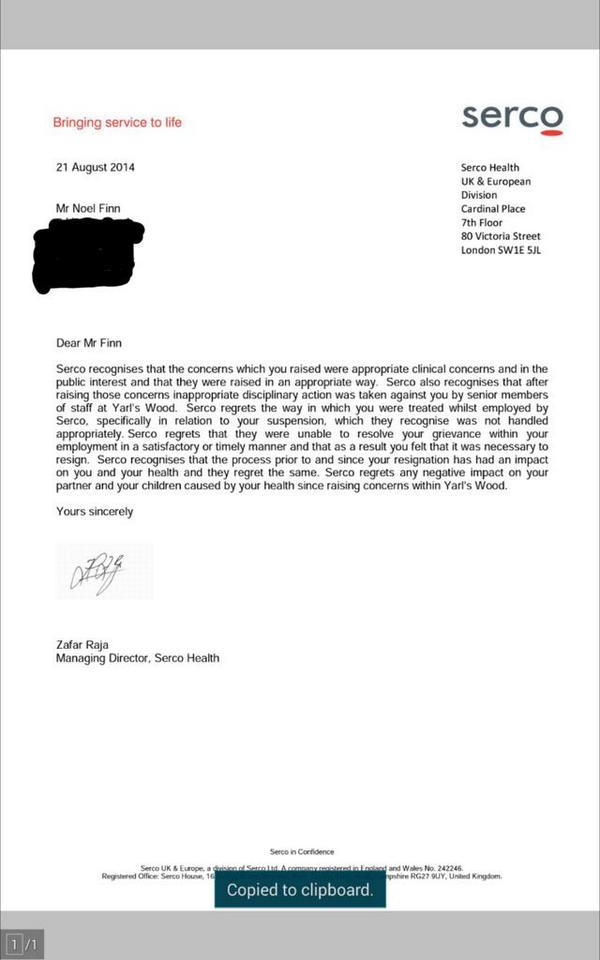
I was subjected to additional stressors through this process and continued expenses when I expected the case to be resolved. The case was eventually concluded over a year after resignation and I have received an open apology from Serco which recognises that the action taken against me was as a result of raising concerns, in the public interest, and was inappropriate.

Main problems were that people consistently did not listen or even acknowledge what I was saying, and did not act. In both experiences people made judgements about me as a troublemaker and for managers it seemed the easiest way to address problems was to get rid of me, anything else was too complicated.

There seemed to be a stronger culture of achieving targets and my concerns seemed to get in the way of achieving those.

In both experiences, colleagues often quietly agreed with my concerns but refused to speak out in fear of reprisals.

RCN legal team I believe have a conflict of interest with regards to nursing as their financial constraints prevent the public interest being served. The ET is not a fit place for whistleblowing as it is meant to represent individual employment issues and not the public interest. Timing issues should not be relevant to whistleblowing. Whistleblowers are not experts in employment law but healthcare companies have HR and legal teams on hand to advise at every opportunity meaning they have the upper hand. Finances also put employees at a disadvantage and thanks to Mr Vince Cable, the very individuals, who need to have a voice are unable to do so due to cost pressures, unemployment and having to pay for Employment Tribunals. On the ET application the new ‘whistleblowing box’ was ticked but the information was not raised to regulators, when I called the local Employment Tribunal office they did not even know who the CQC or HMIP were, this was shocking as the raised concerns need to be forwarded onto them. To this day I am still not aware if this has been done.

Regulators and responsible bodies failed consistently and more often took the assurances of organisations at face value rather than going to the source or exploring assertively in greater detail.

The experiences I had could be likened to abuse, however I think this is not at all appreciated or acknowledged anywhere and is not possible to resolve via ET.

I also submitted evidence to the Healthcare select committee and the Home affairs Select committee and have received no response or acknowledgement.

I believe the fact that the issues I raised related to mental health and latterly also immigrants, meant that they were less likely to be addressed as less priority or attention is given to these areas, and the present government does not make it any easier for these groups of people.

There should be a duty for all NHS (including commissioned providers) to report all concerns openly and for these to be taken to the board as the first step for oversight, assurance and accountability.

The CQC should have an independent element which is solely responsible for addressing whistleblowing concerns to ensure quality this includes involvement with other providers such as NHS England.

Whistleblowing detriments should not be taken through ET’s and should not be sectioned off into mild, moderate and severe pay-outs, this is nonsense; the detriment is a subjective thing, you can’t measure one against the other, people react and cope differently.   It should have a separate process to ensure that public interests are not kept secret and any organisation found to have acted inappropriately against whistleblowers should be put in front of a public committee for scrutiny.


Apology from Serco after 3 years:

Embedded image permalink


‘I have not been formally interviewed by any authorities to date, and despite an apology on both account on whistleblowing no one from CQC  HMIP and CCG NHS England Monitor had interviewed me the assessment of Yarlswood in 2013 some 4 week after i resigned was reported to be fit and well, yet CQC ort HMIP never interviewed me despite knowing about the whistleblowing, furthermore  they refused to peruse the document from Serco and myself . The CQC board had refused to talk with me directly, instead they passed my concerns down the line. I  have recoding of these meeting not one had a clue about why they where meeting me. where is the accountability for the board they keep talking about it so freely, “transparent” its not, they need challenging.’


Four top health experts jailed for scamming NHS out of £1.1m by only working HALF their contracted hours at hospital they dubbed ‘Bas Vegas’ as they raked in cash moonlighting

Mail on Line |

By STEPH COCKROFT FOR MAILONLINE

  • Experts were paid full-time salaries for 4 years at Basildon Hospital, Essex
  • They didn’t work 14,000 of the contracted hours for which they were paid
  • Instead, they raked in private fees by ‘arrogantly flitting’ across other trusts
  • Even set up ‘points’ scheme to reward themselves for carrying out scam well
  • Plot orchestrated by John Mulholland, who boasted of ‘truck loads of cash’
  • Judge said it was a ‘systematic, well-planned and executed deception’ 

An internationally-acclaimed medic and his team of workers showed a ‘cynical disregard’ for the NHS by working just half their contracted hours in a scam which cost taxpayers £1.1m.

The four top health experts, all from London, were employed by Basildon hospital in Essex on full-time salaries to provide expertise on operating heart and lung machines during operations.

But the fraudsters billed the hospital for 14,000 hours that they never worked – while ‘arrogantly flitting’ across other NHS trusts in London making ‘truck loads of cash’ as private contractors.

Their scam became such a cash cow that they secretly referred to the hospital as ‘Bas Vegas’ and set up a ‘bonus points’ in which they rewarded themselves for successfully carrying out the con.


Martin Oliver, pictured left, and John Mulholland, pictured right, were two of the four fraudsters who conned £1.1m out of the NHS in a ‘systematic, well-planned’ scam in which they worked just half their contracted hours

‘Leader’ John Mulholland, 41, a highly respected perfusionist who is published widely in academic journals, alone billed the NHS for more than £400,000 of work that was never done.

All four defendants – all of whom were directors at a private company in London at the time – have now been jailed for a total of nine years for the ‘systematic, well-planned’ scam.

Mulholland was jailed for three years while his co-defendants – Martin Oliver, 36, Ann Clements, 51, Tom Cumberland, 41 – were all handed two-year terms.

They all worked as perfusionists – blood circulation specialists who operate heart and lung bypass equipment which keep patients alive during heart surgery.

The shamed medics were convicted by a jury in July this year after a 13-week trial of one count of conspiracy to defraud the NHS between 2007 and 2011.

Judge David Owen-Jones branded Mulholland the ‘leader’ of the fraud, saying there was ‘no doubt’ his involvement was ‘greater than your co-directors’.

He said: ‘This was a systematic, well-planned and organised and executed deception by all of your over a significant period of time – four years, or so, in total.

‘While taking a salary from the NHS for a 37-and-a-half hour week, you worked elsewhere at other hospitals during NHS hours. You all four gravely abused the trust placed in you.

‘It’s awful to see people of your education, previous good character and achievements convicted of these kinds. I feel these offences were motivated purely by greed.’

The court heard that the four medics – who were directors at London Perfusion Science Ltd (LPS) – were contracted between 2007 and 2011.

They were employed to provide clinical perfusion services to manage heart and lung machines during cardiac surgery at Basildon.

But they failed to work their contracted hours, instead opting to make extra money at other hospitals, mainly Hammersmith.

The four top health experts, all from London, were employed by Basildon hospital in Essex, pictured, on full-time salaries but 'arrogantly flitted' across other NHS trusts in London making 'truck loads of cash'

The four top health experts, all from London, were employed by Basildon hospital in Essex, pictured, on full-time salaries but ‘arrogantly flitted’ across other NHS trusts in London making ‘truck loads of cash’

During the four-year period, the fraudsters were overpaid by about £420,000, the court was told.

The private work they charged for at other hospitals while they should have been at Basildon gave them a further £700,000.

Basildon Crown Court was told how a series of damning e-mails led to the downfall of the medics.

The defendants reminded each other in emails about doing ‘face shows’, which meant turning up to work every so often to stop staff becoming suspicious about their whereabouts

Opening the case earlier this year, prosecutor Shane Collery told jurors: ‘This is in many respects a sad case. It involves one of the perfusion medical teams at Basildon Hospital engaging in a fraud.

‘They provided significant services to the public and were rewarded by a salary but it was not enough.

‘They started to earn more by doing less and engaging in activities which stole from their employer, the public purse and from you.’

 This was a systematic, well-planned and organised and executed deception by all of your over a significant period of time

In one of the crucial e-mails, Mulholland warned that care needed to be taken with the amount they were billing the NHS ‘so as not to draw attention to the number of people we have doing nothing’.

In May 2010, he also referred in an e-mail to how one of his team would ‘continue to make us truck loads of cash paid for by Vegas’.

One, sent by Mulholland to other defendants, revealed he tried to avoid NHS work ‘unless it’s going to make cash/make our lives easier’.

And in another damning e-mail Clements sent to Mulholland, she said: ‘Look at ‘Bas’ and the manipulation that we go through there to make it run without highlighting people are missing.

‘That’s why when you are there you make sure you talk to everybody you are high profile so you are noticed!’

Mullholland was arrested by detectives as he arrived to attend a meeting at Basildon Hospital.

Mr Benjamin Summers, mitigating for Mulholland, said he had a seriously ill young daughter who requires round the clock care for a chronic lung condition.

Mulholland has also had to resign for a variety of highly respected roles within the industry and is highly likely to struggle to find work within the ‘small community’ when he leaves prison.

He said: ‘His career as a perfusionist is over – the destruction of that career in my respectful submission is utter and complete.’

Dean Armstong, QC, on behalf of Clements, told the court: ‘She was a high-class perfusionist, whatever the circumstances, she is a loss to the profession.

‘She is a loss to the general public who will no longer be treated by her. She has lost her reputation – she has lost her good character.’

Adam Kane, for Oliver, from East London, said it was a ‘most unusual fraud case’ in that the defendants had not achieved an easy life and were ‘still working all the hours that God sends’.

David Whittaker, for Cumberland, from Penge, said his client did not play a leading role in the scame. He now lives ‘quietly’ with his elderly mother in Anglesey and will never work within the industry again.

All the defendants were banned from holding directorships of companies for four years.

Two other junior colleagues from LPS charged with the same count were acquitted at the trial.

After the hearing Sue Frith, head of the National Investigation Service at NHS Protect, said: ‘From day one, John Mulholland and his associates set out to defraud the NHS of hundreds of thousands of pounds.

‘The time, effort and planning that they were willing to put in to their criminal activities reaped them considerable rewards – until NHS Protect caught up with them.’

‘These custodial sentences reflect the seriousness of the offences and will act as a powerful deterrent to others.’

There will be a proceeds of crime hearing at a later date.


Four jailed over £1.1m NHS fraud

First published 10:27 Wednesday 3 September 2014 in National News © by Press Association 2014

Four jailed over £1.1m NHS fraud


The judge at Basildon Crown Court said the health experts showed a

The judge at Basildon Crown Court said the health experts showed a
The judge at Basildon Crown Court said the health experts showed a “cynical disregard” for NHS funding

Four leading health experts who charged the NHS £1.1 million while moonlighting privately have been jailed.

Basildon Hospital employed the group to provide heart and lung services but they only worked about half of their contracted hours, instead offering their services to other hospitals.

A court heard they showed a “cynical disregard” for NHS funding – referring to the hospital as “Bas Vegas” as they sought to cash in.

Judge David Owen-Jones described the scam as “a systemic, well-planned, organised and executed initiative”.

He added: “While taking a salary from the NHS for a 37-and-a-half hour week, you worked elsewhere at other hospitals during NHS hours.

“You all four gravely abused the trust placed in you.

“It’s awful to see people of your education, previous good character and achievements convicted of these kinds.

“I feel these offences were motivated purely by greed.”

Martin Oliver, 37, Ann Clements, 51, John Mulholland, 41, and Tom Cumberland, 42, were convicted of conspiracy to defraud at Basildon Crown Court following a three-month trial.
Between 2007 and 2011, the four – directors of London-based private firm London Perfusion Science Ltd (LPS) – were contracted to provide clinical perfusion services to manage heart and lung machines during cardiac surgery at Basildon.

Over four years, the group failed to work 14,000 hours which they were paid for.

Instead, they earned an extra £700,000 for the company through their private work, largely at Hammersmith Hospital.

Prosecutor Shane Collery told the court Mulholland, an internationally renowned heart specialist, was the ring-leader.

As well as not working their own hours, they diverted more junior staff to work at other hospitals.

The court heard it was not clear exactly how much they profited from the scam, it is thought they earned salary overpayments totalling £420,000.

Emails read to the trial revealed their “cynical disregard” for NHS work, Mr Collery said.

They referred to the hospital as “Bas Vegas” – a nickname stemming from the US gambling capital Las Vegas.

One, sent by Mulholland to other defendants, revealed he tried to avoid NHS work “unless it’s going to make cash/make our lives easier”.

Benjamin Summers, mitigating for Mullholland, said the destruction of his career had been “utter and complete”.

He had been forced to stand down from several international roles and was likely to lose his professional accreditation.

He added that Mullholland had a daughter with a serious long-term illness and his wife would be left as sole carer while he served a jail term.

It was said in mitigation for Clements, Oliver and Cumberland, that they were all medium-scale players whose careers were also in tatters.

Adam Kane, for Oliver, pointed out that no patients had suffered as a result of the fraud.

Mullholland, of Copenhagen Place, London, was jailed for three years.

Martin Oliver, of Basin Approach, East London; Ann Clements, of Wharf Lane, Limehouse, and Tom Cumberland, of Penge, London, were each jailed for two years.

All were banned from working as company directors for four years.

After the hearing Sue Frith, head of the National Investigation Service at NHS Protect, said: “From day one, John Mulholland and his associates set out to defraud the NHS of hundreds of thousands of pounds.

“The time, effort and planning that they were willing to put in to their criminal activities reaped them considerable rewards – until NHS Protect caught up with them.

“These custodial sentences reflect the seriousness of the offences and will act as a powerful deterrent to others.”


Whistleblowing in the NHS – how safe are you?

This is a question for staff and patients in the NHS.

 Sharmila Chowdhury 4 August 2014


As an NHS staff if I suspect something is wrong, simplest thing would be to raise my concerns to my line manager. Simple. After all, we have decided to work for the NHS because we care? We care for patients and other staff who are placed under our care. Our managers would be grateful to us, surely, and make arrangements to investigate and where appropriate, put things right. After all it’s in patients’ interest. Wrong. This is not how the NHS currently works in many hospitals, care homes, institutions and clinics.


Staff do need to raise concerns – why? Because, like in most walks of life, there will be situations which needs special attention. There could be issues, such as potential fraud, mismanagement of resources, safety issues, staff training issues which can relate to  both staff and patients. There are of course, numerous more examples. As staff we have it ‘ingrained’ into us as part of our training about having ‘duty of care’ and reporting anything that we feel needs attention. Doing otherwise and ignoring would constitute neglect. Staff being able to safely raise concerns is vital to patient safety.


One of the earliest NHS whistleblower who has been in the public domain has been Steve Bolsin, who first raised concerns over 20 years ago about children’s heart surgery at Bristol. He is now based in Australia. Since then not much has changed. Whistleblowers’ raised concerns are still ignored despite in many cases, having extensive evidences. Whistleblowers are subsequently victimised and persecuted and find themselves being accused with false counter allegations, despite in most cases there are lack of evidence of any wrong doing. In some cases hyped up to be more serious than it really is as in David Drew, who was accused of quoting bible in a meeting. This was deemed to be more serious than the concerns he had raised about child safety, which led to the death of a child due to arrogance and neglect.


Whistleblowers within NHS come from a wide range of occupation, which include Chief Executives, such as Gary Walker and John Watkinson. Both raised patient safety concerns and both lost their jobs.


Since becoming a whistleblower myself, nearly 5 years ago and developing my website, I have been in contact with numerous whistleblowers. Many of the cases are devastating where the whistleblower have suffered gross injustice. Many cases are truly heartbreaking.


One example, is that of a senior staff member who was raised concerns about dealings with child abuse. She has now not only been left without a job, she is homeless, and now lives in a friend’s garage and depends on provisions from food bank. Another is a single mother of 2, who also now has to rely on food bank and in due time may have her home repossessed. I too, am likely to lose my home soon whilst suffering cancer.


My case is perfectly summarised by Courtesy of NHS Mess @NH_Mess

CARTOON

Many of the whistlebowers face years of stress. Many end up having counselling or have nervous breakdowns. It has profound effect on close family & friends. Many relationships breakdown under stress as in reported cases of Edwin Jesudason and Gary Walker. Sangita, Raj Mattu’s wife on Channel 4 news said that they have been unable to have children due to ongoing legal battle and stress.  There are also known whistleblowers who have committed suicide or have suffered mental breakdowns, as it all got too much for them. Their health take a toll. David Drew has suffered serious health problems, despite leading a healthy life. I have developed cancer, which numerous consultants believe is stress related.


There are very few known whistleblowers who have faced legal battle with their trust and have return to their workplace. I only know of one – Ramon Niekrash. However, he was left with legal fees of £120,000. Nearly all NHS whistleblowers, once dismissed, never return to their workplace. Very few continue to work in their field of expertise and even fewer manage to secure permanent posts. This is because of existence of blacklisting within the NHS. There is of course in addition gradual loss of skills once being unemployed. For many, only option is to leave the country and look for work in other parts of the world, such as Steve Bolsin.


So why do whistleblower’s bother to raise concerns or blow the whistle where not only are their concerns on the whole are ignored but their whole career is destroyed? Because on most occasions, they feel they are simply doing their job and are confident that their concerns will be sorted. Very few give a thought for their own safety as naively it never enters their head. However, having made an example of a whistleblower, trusts send out a strong message to other potential whistleblowers. Many are deterred from speaking up. This means that patient’s safety is compromised. If staff are too scared to speak up, it means that the risk factor is never investigated, let alone sorted.


So why are whistleblowers persecuted? In some cases by bringing to light the concerns could be a source of embarrassment to senior managers and could attract unwanted publicity. It could be a costly expense to fix and organisations may have targets they have to meet.  Individuals within the organisation may have vested interest for example, as in cases of theft and fraud. It could also be due to basic retaliation of ‘I go or they go’ (this could be due to the whistleblower having raised concerns about them) or it could be that individuals are looking out for their colleagues who have done wrong, but have a strong position in their organisation.


 Watch the dynamics of whistleblowing


Those spending public money covering up their wrongdoing have been getting away with it for over 15 years, since Public Interest Disclosure Act, PIDA, was introduced.


The Chief Executive, The Medical Director and The HR Director are ultimately responsible within Trusts to ensure that victimisation of whistleblower does not happen, but unfortunately far too often, they are part of the victimisation. Trusts are given easy access to legal funds which are paid by taxpaying public. These funds are authorised by the Department of Health and paid out by The Treasury.


Ironically, huge sums of money which should have gone into patient care is used to fight and get rid of whistleblowers – the very people who care and want to protect the patients and the health service. It would be interesting to survey the tax paying public to have their views on their hard earned money is continually being wasted on getting rid of whistleblowers. After all, they are paying for this wastage. Raj Mattu’s case is a good example, where not only did Raj suffer for 13 years, but it has costed the tax payer £20m. Money which should have been used to benefit the patient. In addition, more recently, case of Arjuna Weerasinghe, where seven figure settlement is now being considered.


Of course, it isn’t just money that is being wasted, but there is also huge waste of expertise at all levels, which is being drained from the NHS. The very people who care what happens in the NHS are the very people who are being removed and having their lives destroyed.


Why is this allowed to happen? Nearly all whistleblowers once they realise they are in trouble and are in need of urgent help their first port of call is to their unions. I have yet to meet a whistleblower who has been successfully supported by their union throughout the ordeal. I am not sure whether this is due to lack of understanding, lack of money, or simply they want to remain in good terms with individual organisations. Strange as it may seem, in some instances, unions have turned on their own members.


The next step for a whistleblower is to get legal advice. Some firms are happy to give free short advice over the phone. Consultations can be expensive but vary. Mine cost £398 per hour, four years ago. Often with no money, whistleblowers setlle for ‘no win, no fee’ arrangement. However, legal costs escalate at an alarming rate. Many turn to policies in their home insurance. This has certainly saved the day for many, such as Anabelle (Loo) Blackburn and Jennie Fecitt. However, unfortunately some, such as mine, there was an opt-out clause, where if you belonged to a union, your policy will not be covered. My legal fees had escalated to £130,000 on a ‘no win – no fee’ basis.


Nearly all whistleblowers I have come across had written to both Care Quality Commission and Department of Health for help. Virtually all have been left without help, despite having strong evidence. Nearly all have received a standard reply, which stated that they could not get involved due to ongoing legal case. So, where is a whistleblower to go when they find themselves in deep water? Nowehere, is the answer. No one will intervene or inspect surroundings of the case. Cases are frequently dragged out over years before reaching a settlement. This is often deliberate attempt by Trusts who have endless legal funds to drain any funds that the whistleblower may have, to reach a settlement in their desperation. Also, if they are on ‘no win –no fee’ arrangement, they often have to settle out of court with substandard pay-outs, often just enough to cover their huge legal expense.


In contrast, trusts and organisations are fully supported with advice and access to funds by The Department of Health. So, stating that either Department of Health or Care Quality Commission cannot get involved in their response to a whistleblower is untrue. They do get involved, but simply not on the side of the whistleblower.


So, having suffered over the years and finally reaching some sort of settlement, you would think that there will be some help. No, is the answer. With career and any remote job prospects, livelihood, personal life and health destroyed, there is simply no help.  Even when proven to be a whistleblower by courts, there is no help. Whistleblowers are left abandoned. So, who should be there to ensure that whistleblowers, responsible members of our society are taken care of?  Fingers currently point to Jeremy Hunt and The Department of Health. After all they are ultimately responsible for the running of the health service. To say that they ‘cannot get involved’ is no longer acceptable. Hunt has instigated review into NHS whistleblowing led by Sir Robert Francis QC. Results  and recommendations of which are due in November. This is a step forward. However, any recommendations made will need to be effectively implemented and not ignored.


I have yet to hear of any senior managers, directors, executives held to account for their treatment of whistleblowers. Yet, nearly all NHS organisations now have whistleblowing policies. Clearly, written policies are not worth the paper they are written on if no one acts on them. It needs a responsible governing body to take responsibility and ensure that all staff, patients and public for whom they are in charge have an in depth understanding, compassion, leadership and willingness to drive this forward. Until this happens, lives of both patients and staff will continue to be destroyed.


For more information and articles on whistleblowing visit sharmilachowdhury.com

Hunt orders NHS chiefs to set aside gagging orders

The Times Health News 11 August 2014
David Drew, a former NHS paediatrician, said many would-be whistleblowers would still be reluctant to come forwardDr David Drew Adam Gerrard/SWNS

Jeremy Hunt has ordered health chiefs not to block staff from speaking out as he launched a review into the treatment of whistleblowers.

Sir Robert Francis, QC, who led the public inquiry into the Mid Staffordshire scandal, has already begun taking evidence from whistleblowers who claim that NHS trusts and unions are silencing those who raise the alarm over poor care.

In a letter seen by The Times, the health secretary told the heads of English NHS organisations to set aside any gagging clauses.

“We believe that it is crucial that we hear the voices of those who say they have suffered detriment in the past and learn lessons for the future,” he wrote.

“My expectation would be that the existence of any confidentiality clauses, for example in employment contracts or settlement agreements, would not be used as a justification to prevent NHS staff from contributing evidence and their experiences to the review.”

A source close to Mr Hunt said: “The appalling events at Mid Staffs showed what can happen when staff are not able to raise concerns about standards of patient care, and though we have made progress since, Jeremy wants Sir Robert to have access to all the information he requires to make rigorous recommendations.”

David Drew, a former NHS paediatrician and one of the six campaigners whose appeal for justice helped to prompt the review, said many would-be whistleblowers would still be reluctant to come forward.

“It is surprising that the secretary of state has to remind trust chairs that staff must not be prevented from making statements in the public interest because they have signed a compromise agreement,” he said. “What could be more public interest than the Francis review?”

Whistleblowers are promised more protection and new jobs

The Times Health News
  • Sir Robert Francis, QC
    Sir Robert Francis, QC, is pledging to prise open an NHS ‘closed ranks culture’ Dominic Lipinski/PA

NHS whistleblowers could have their claims judged by independent regulators and be shepherded into new jobs under plans to end a “climate of fear” in the health service.

Sir Robert Francis, QC, is pledging to prise open an NHS “closed ranks culture” that harms patient care as he launches a review into staff victimised for speaking out. Today he urges doctors and nurses to tell him what is going wrong. Campaigners welcomed the pledge, saying it was vital to stop whistleblowers from being blacklisted and demanding the government takes responsibility for protecting them.

Writing on thetimes.co.uk today, Sir Robert says: “There are far too many reports of professionals reporting they have been victimised or forced from their jobs because they spoke out… The fear generated by all this is very real. Fear feeds on fear, which inevitably deters others from coming forward.”

Sir Robert chaired a public inquiry into the Mid Staffordshire scandal, where he concluded that appalling suffering had been inflicted on hundreds of patients by bullying managers who ignored the concerns of workers. He writes today that he was “struck by the fear some staff had to voice their concerns”, citing a consultant who insisted on meeting secretly at his home and a nurse whispering in terror at making an “innocuous suggestion” for change.

His review will scrutinise prominent whistleblowing cases from the past as well as exploring the experience of staff still working in the NHS in an attempt to make sure that doctors and nurses feel free to raise concerns, that they are listened to and that they are not victimised as a result.

“We need to do more to ensure that staff who are worried that something is going wrong feel totally free to talk about it,” Sir Robert writes, outlining a series of solutions he is considering.

These include making it easier for staff to raise concerns with someone independent and “arms-length scrutiny where conflict arises when someone speaks up” so that bosses are not marking their own homework.

Acknowledging that many whistleblowers struggle to find work again, he says there must be “better means of retaining the services of those who have unfairly lost their jobs for doing the right thing”, including mechanisms for staff who win tribunals to get back in to the NHS.

Cathy James, chief executive of the charity Public Concern at Work, said: “Getting jobs in the NHS is a key problem. Although there are lots of different employers, once someone is labelled a whistleblower that’s akin to a troublemaker and they can be blacklisted.”

However, Mark Porter, chairman of the British Medical Association Council, said: “Putting protections in place for staff who raise concerns is a vital part of the solution but it does not fix the underlying issue. It is in the interests of both staff and their patients to look much more closely at the culture across the NHS, which has left staff unwilling to provide feedback or raise concerns for fear of reprisals.”

Kim Holt, of the whistleblowers’ group Patients First, agreed that the “bullying culture” needed to be tackled at root, insisting that “things go wrong when concerns aren’t addressed early enough”.

Jeremy Hunt, the health secretary, said: “We still hear of staff concerns being ignored. That’s why I have asked Sir Robert to undertake this review, which will look at what more we can do to create an open culture where NHS workers are protected and encouraged to speak out in the best interests of patients.”

Robert Francis – Fear must not stop whistleblowers coming forward

The Times 7 August 2014

I want to hear suggestions about how best we can encourage people to speak out

Many patients and those close to them came to the Mid Staffordshire inquiries to tell me about awful care and indignity at the hands of a service that was meant to be effective, safe and compassionate. Their stories had an incredibly powerful impact – not just on me but on everyone who read the reports.

Sadly, I was struck by the fear some staff had in coming forward to voice their concerns. One nurse I met in a corridor whispered “I cannot believe I am saying this” before outlining an innocuous suggestion for change. A senior consultant was so afraid that he insisted on meeting me secretly at his home. A brave nurse, Helene Donnelly, felt so unsafe after reporting unacceptable practice that she left to work elsewhere. I was approached by a trainee from a different part of the NHS who had been report made by a chief executive – for sharing her concern with the person chairing the trust when asked if she was worried about anything.

There are far too many reports of professionals reporting that they have been victimised or forced from their jobs because they spoke out. Only last week the public accounts committee report on whistleblowing concluded that “too often whistleblowers have been shockingly treated”. The fear generated by all this is very real. Fear feeds on fear, which inevitably deters others from coming forward.

Many recent initiatives should help replace this climate of fear with openness, transparency and a commitment to patients. Last month the Care Quality Commission launched consultations on the new regulations for fundamental standards, the duty of candour and the fit and proper person test for directors.

Taken together these measures should form the foundation that enables people to speak up, for concerns to be addressed, and for accountability where that is needed.

But we need to do more to ensure that staff who are worried that something is going wrong feel totally free to talk about it. I am open to any constructive suggestion about what can be done, but the areas I am interested in include:

• Making it easier for worried staff to raise important concerns with someone independent from their manager, or even their employer;

• Better recording of concerns raised and the action taken on them;

• Arms-length scrutiny where conflict arises when someone speaks up;

• Better procedures to ensure that honestly speaking up about important issues does not adversely affect careers without impeding the fair management of proper concerns about staff;

• Mediation or other assistance by third parties to help resolve disputes;

• Better means of retaining the services of those who have unfairly lost their jobs for doing the right thing.

That is why I welcomed the chance to undertake the Freedom to Speak Up review. We have to learn from all experiences, good and bad, of those who have raised serious concerns and identify confidence-building measures.

I want to hear ideas from all NHS workers, employers and representative organisations. Details of how individual submissions can be made are on our website (www.freedomtospeakup.org.uk, currently in development). I have commissioned research into the how well the current system for reporting concerns works, and I will hold a series of seminars so I can hear about possible solutions to the problems we face.

We must value those who are bold enough to speak out as celebrated champions of patients and the public interest, and ensure that those who do not feel confident become so. All staff should see it as both a right and a duty. If we can achieve this the prize is a safer NHS

Sir Robert Francis, QC, led the report into Mid Staffordshire

Freedom to Speak Up – Independent Review into NHS Whistleblowing

Independent Review has been launched today led by Sir Robert Francis QC, looking into whistleblowing in the NHS. He will have a dedicated team who will be assisting him with the review.

Sir Robert Francis has appointed a series of advisers to support his work: Norman Williams, former president of the Royal College of Surgeons; Peter Homa, chief executive of Nottingham University Hospitals Trust and Kath Fenton, chief nurse at University College London Hospitals Foundation Trust.

The review will host a series of seminars in the autumn to explore key issues and solutions.

Two separate pieces of research into whistleblowing in the NHS and the views of NHS staff will be conducted at Middlesex and Greenwich universities.

The review secretariat will be led by Joanna Donaldson, the HR director of the Department for Business Innovation and Skills.

Robert Francis, head of the Mid Staffordshire NHS Foundation Trust inquiry
Sir Robert Francis QC


This has been come about as a result of  a group of six whistleblowers requesting for a public inquiry into their cases, so that lessons can be learnt,  and correct remedy for the future can be implemented in order to protect patients and whistleblowers. The six whistleblowers are: Sharmila Chowdhury, David Drew, Annabelle Blackburn, Jennie Fecitt, Edwin Jesudasson and Narinder Kapur.

Speaking to Health Service Journal, Sir Robert will also meet personally with selected whistleblowers, but will not make judgments on individual cases. He said all information would be treated in the “strictest confidence”. “We have gone to great pains to set up our website and emails so they are completely controlled by us and independent of any government organisations,” Sir Robert said.

Jeremy Hunt, Health Secretary, opted for a review rather than an inquiry according to The Times,  as he felt this would take shorter time, and some changes could be implemented prior to election. The review will be unable to intervene in individual cases.


Speaking to Shaun Lintern, Health Service Journal, Sir Francis said the review would examine whether hospital managers should be held more accountable for their involvement in cover ups.

“There should be consequences for that,” he added. “We should no longer tolerate people being in effect exiled from the health service because they have raised concerns,” he said.

This is called Freedom to Speak up as it will include all, not just who have reported or whistleblew externally.  It will be helpful for the team, if the submissions are focussed and clearly written. Survey is of all NHS workers and organisations.  The team want to hear of positive as well as negative stories of whistleblowing.  The submissions will start today & will end on 10 September. The report will be available in November this year.


Terms of reference and confidentiality


Some related articles leading up to review:

NHS whistleblowers to air complaint with Jeremy Hunt

Letter to Jeremy Hunt

Whistleblower sacked from Ealing Hospital meets Health Secretary to demand public inquiry

NHS may face whistleblower public inquiry

ITV London –

meeting with Hunt & Stevens

Ministers order inquiry into NHS whistleblowing

Hunt vows to punish NHS bullies

Message from Jeremy Hunt Jeremy Hunt –

Message from a whistleblower  

Independent review urges whsitleblowers to speak

I reported my concerns and was given the brush off


 For further details and submissions please visit:  http://freedomtospeakup.org.uk/


To contribute to the review


For article in the HSJ please visit: HSJ Website


I reported my concerns but was just given the brush off – NHS whistleblowers tell of being ignored and marginalised

Sunday Telegraph 3 August 2014

As Sir Robert Francis urges whistleblowers who have tried to raise the alarm over NHS standards to come forward, The Telegraph looks at some of their damning stories

 Robert Francis : 'I reported my concerns but was just given the brush off' - NHS whistleblowers tell of being ignored and marginalised

Sir Robert Francis Photo: PA

Sir Robert Francis, the chairman of the public inquiry into the Mid Staffs scandal, is launching the first independent review of whistleblowing in the NHS, and calls on those who have been mistreated to speak out.

The investigation is expected to begin on Wednesday, when he will ask those who have been affected to come forward.

Here are some of those whose experience has led to the review:

1. John Marchant

John Marchant, the former head of security at Dudley Group of Hospitals trust, claimed staff had routinely forced vulnerable patients to stay in their rooms – and even confined them to their beds – despite them posing no danger to anyone.

He said his security guards had become so concerned about the practice that in one instance they had refused to restrain a child and warned bosses the action was illegal. Mr Marchant also alleged that pensioners had been subject to restraints when all they wanted was to walk around a ward, or chat with fellow patients.

Mr Marchant said: “Detention is being used simply because the patient become so frustrated at not even being able to go out for a walk in the hospital grounds because there are no staff to accompany them.

“Some would go back to their rooms if you asked them, but others would have to be closed in and it would be very distressing for them.”

He repeatedly raised his concerns over the practice with senior managers, but was made redundant from the Dudley Group in December 2012.

The trust denied Mr Marchant’s claims and insisted it always acted in the best interest of patients. However, it admitted that security staff had raised concerns about the issue.

Following the revelations in The Sunday Telegraph, in January, the Department of Health has ordered the Care Quality Commission, the health regulator, to carry out an investigation into his claims.

2. Annabelle Blackburn

Annabelle Blackburn claimed says she felt effectively “blacklisted” and forced to work in a neighbouring county after warning about potentially dangerous problems at the Oxfordshire GP surgery where she was employed.

She said she had found blood test results ignored and emails going unanswered. She also claimed to have found evidence that a woman had not been told about a probable diagnosis of leukaemia, and a man who should have been told he had prostate cancer.

Mrs Blackburn said the delays in acting on test results or information in emails may have caused severe harm to several patients. In two cases she feared that patients could have died prematurely because the information had not been acted on.

But when the experienced nurse spoke out, other GPs in Oxfordshire were told she was “exaggerating her concerns” and should not be regarded as a genuine whistleblower.

When Mrs Blackburn took her case to a tribunal in 2012, a judge said that members of the local primary care trust, since disbanded, had thought that she was “making trouble”. Although Mrs Blackburn lost the case, the employment tribunal agreed that the trust had failed to deal with the complaints she had raised.

Mrs Blackburn said: “The way Oxfordshire PCT handled the situation was terrible. They failed to treat the crisis at the clinic with any urgency and then they tried to ignore and discredit me.”

3. The doctor “brushed under the carpet”

A doctor who worked at two hospitals at the centre of a scandal over patients dying after keyhole cancer surgery claimed managers ignored him when he tried to raise the alarm over poor standards and dangerous practices by surgeons.

The doctor, who wished to remain anonymous for fear of losing his job, said he and other members of staff were ignored when they tried to warn about the behaviour of surgeons at Maidstone and Tunbridge Wells hospitals. He said his colleagues’s fears were “brushed under the carpet” and that managers preferred to ignore their warnings rather than confront the way three surgeons responsible for the keyhole procedure, Professor Amir Nisar, Haythem Ali and Ahmed Hamouda, were working.

The doctor said: “I reported my concerns but I was just given the brush off. Several other junior doctors, and nursing staff, expressed their concerns, but they all had the same experience as me.”

He spoke out after a damning report found that managers at Maidstone and Tunbridge Wells ignored repeated staff warnings dating back several years about the behaviour of the surgeons.

This newspaper revealed in May how the hospitals were forced to stop carrying out keyhole surgery for upper gastrointestinal cancer (GI), on the instruction of The Royal College of Surgeons (RCS), following the unexpected death of five patients who had undergone the procedure in December 2012 and early 2013.

Maidstone and Tunbridge Wells NHS Trust barred Prof Nisar, Mr Ali and Mr Hamouda from carrying out the procedure on the recommendation of the RCS, but they were allowed to continue general surgery at the hospitals.

4. Rebecca Prideaux

Rebecca Prideaux, a former inspector at Britain’s health and care watchdog, claimed that elderly people were being left to suffer in appalling conditions because regulators refused to act on warnings.

She said poor care routinely went unchecked because staff at the Care Quality Commission (CQC) were given inadequate training. Workers were discouraged from taking action when they uncovered risks to the most vulnerable, she added.

Mrs Prideaux resigned from CQC in May last year, saying she had repeatedly urged senior managers to improve the training given to hundreds of inspectors who visit care homes and hospitals.

The former policewoman said she was put in charge of an inspection of a 120-bed care home the day after her induction finished, after witnessing just two such inspections previously and receiving no advice on how to draw up a report.

She accused regulators of failing to take proper action even after she warned of appalling failings in care and claimed reports often omitted some of the most damning failings.

Mrs Prideaux said: “When I joined CQC I was over the moon. I had cared for my grandparents and I really believed in a job where you could make a difference. In the end I was left feeling that if I cared, that was the last place you should be working.”

The CQC said Mrs Prideaux’s views were not shared by the more experienced and specialist inspectors who worked with her. But it said it had changed the way it carried out inspections, in particular to ensure that all inspectors are specialists in the areas they inspect.

5. Raj Mattu

Dr Raj Mattu, a hospital consultant who was “hounded mercilessly” out of his job after raising concerns about patient safety, won a landmark legal victory for unfair dismissal in April, following the longest-running and most expensive whistle-blowing case in NHS history.

The cardiologist, was suspended for eight years, then sacked in 2010, after warning that patients were dying because of cost-cutting practices introduced by the then Walsgrave Hospital hospital, in Coventry.

NHS bosses hired private investigators in an apparent attempt to discredit him, spending an estimated £6 million in pursuit of the case against him.

MPs said the employment tribunal ruling, which found the whistleblower had been unfairly dismissed, shone a light on a “sinister and dystopian” culture of cover-up within the NHS, which destroyed the lives of those who tried to speak up for patients.

Dr Mattu said: “My treatment by the trust over the past 13 years has damaged my health, my professional reputation and my livelihood and its effects on my personal and private life have been devastating.”

University Hospital of Coventry and Warwickshire NHS trust said it was disappointed by the employment tribunal’s decision.

6. Roger Davidson

Roger Davidson lost his job as head of media and public affairs for the Care Quality Commission just before the 2010 general election, after telling how a quarter of NHS trusts had failed to meet basic hygiene standards.

He also warned that the CQC had stopped telling the public how to find reports on infections in their local hospitals in order to limit publicity damaging to the NHS.

Mr Davidson was forced to sign a gagging order when he left but his testimony emerged during the Francis inquiry into appaling failings at Mid-Staffs which led to hundreds of “excess deaths”.

It formed part of a tranche of documents which detailed how the regulator was apparently intent on suppressing negative publicity about the NHS, amid political pressure from then Labour ministers and their advisers before the election.

Mr Davidson, who went on to become head of media at NHS England, said: “The message that ‘we don’t want bad news’ infected the whole organisation. There was no compass.”

7. Professor Narinder Kapur

Professor Narinder Kapur was dismissed as a consultant neuropsychologist and head of neuropsychology at Addenbrooke’s hospital in Cambridge after voicing his concerns about patient safety and poor standards of care.

Cambridge University Hospitals trust (CUH) dismissed Prof Kapur in 2010, claiming there had been a breakdown in their relationship because of his management style and working methods.

But in July 2012 an employment tribunal ruled that he had been unfairly dismissed. It added: “The tribunal condemns unreservedly the way in which the NHS has conducted itself in respect of this allegation.”

However, because the tribunal found Prof Kapur had not been sacked because of his whistle-blowing, but because there had been “an irredeemable breakdown in trust, confidence and communication” between him and other managers, it did not order his reinstatement.

Prof Kapur, 64, who is now a consultant neuropsychologist at Imperial College Healthcare Trust and visiting professor of neuropsychology at University College London, said: “I raised my concerns about staff shortages and the impact on patient care several times to my line managers, I had a duty to do so on behalf of my patients, but I was repeatedly ignored by the hospital senior management. If that can happen to a professor like myself, with a worldwide reputation in his field, imagine what happens when more junior members of staff try to raise the alarm.”

8. Sharmila Chowdhury

Sharmila Chowdhury had enjoyed an unblemished 27-year career with the NHS until she was sacked after blowing the whistle on senior doctors who were moonlighting at a private hospital while being paid to treat NHS patients.

The radiology service manager at Ealing Hospital trust repeatedly warned the hospital’s senior managers that doctors were dishonestly claiming thousands of pounds every month and that the trust had lost £250,000 of public money through such arrangements.

Ealing hospital failed for two years to take any action against the two doctors later accused of fraud at a tribunal hearing. Instead, Ms Chowdhury was suspended after a counter-allegation of fraud made against her by a junior whom she had reported for breaching patient safety. The allegation was never proven and in July 2010 the employment tribunal judge took the unusual step of ordering the trust to reinstate Ms Chowdhury’s full salary. However the trust made her post redundant and the case was eventually settled out of court.

Ms Chowdhury, a widow with a teenage son, received two years pay, although £77,000 of that was paid out in legal fees. She found her whistle-blowing made it hard for her to find further employment in the health sector. She is also fighting cancer.

Ms Chowdhury, 54, who met Jeremy Hunt, the health secretary, in June, to discuss the plight of whistle-blowers, said: “The public has a right to know what is happening with public money. Despite winning a hearing in which I was proven to be a whistleblower, I’ve no job and no money.”

9. Helene Donnelly

Helene Donnelly raised more than 100 complaints about the way patients were being treated at Stafford Hospital while she was working there as a nurse in Accident and Emergency.

She became was a key witness during the Mid-Staffs public inquiry into reports of poor care, abuse and neglect of care at the hospital, where there were between 400 and 1,200 more deaths than would normally have been expected between 2005 and 2008.

In her evidence, Ms Donnelly said nurses in A&E were expected to break rules as a matter of course in order to meet targets, including falsifying records to pretend that patients had not been kept waiting for more than four hours.

When she raised her concerns she was met with threats and bullying by some of her more senior colleagues. At one stage she had to ask members of her family to come and pick her up when she finished a shift a night because she was afraid to walk back to the car on her own.

Ms Donnelly was appointed an OBE in May for her services to the NHS, in recognition of her work to support hospital staff to raise concerns and improve care for patients.

She is now an ambassador for cultural change at the Staffordshire and Stoke-on-Trent Partnership NHS Trust and works to relay staff concerns to the chief executive and is helping the Department of Health draw up whistle-blowing training for NHS staff.

Ms Donnelly said: “I am frequently being contacted by individuals from all over the UK who have tried to speak out at their own trusts, but find they are ignored. Far too many who hold positions of power – and who could affect change – are still dragging their feet while patients and staff continue to suffer.”

10. Kim Holt

Kim Holt, a consultant paediatrician, was suspended after she told managers about serious failings at the clinic where Baby P was later treated just days before his death at the hands of his mother and her boyfriend.

Ms Holt and three colleagues wrote to managers in 2006, warning that understaffing and poor record keeping posed a serious risk to patients’ safety at St Anne’s clinic in Haringey, north London, and that a child would die if action was not taken. But bosses ignored her warnings and removed her from the clinic.

Baby Peter Connelly was seen by an inexperienced locum doctor, Sabah Al-Zayyat, at St Anne’s in the summer of 2007, three days before he was killed and some time after Ms Holt and her fellow whistle-blowers had left. Zayyat failed to spot signs that the 17-month-old boy, who was on Haringey’s child protection register, had been physically abused.

Ms Holt later said: “I believe that if our concerns had been taken seriously at the time we raised them, then we could have prevented the death of Baby Peter. Several of the failings found by the inquiries into his death were 100 per cent the same as the failings we complained about the year before he died.”

She also said the hospital had offered her £120,000 to withdraw her complaints in the wake of Peter’s death – a claim the hospital denied.

In 2011 Great Ormond Street hospital and Haringey primary care trust, which co-managed the clinic, formally apologised to Ms Holt, who is currently advising the CQC on how the regulator can help support staff who raise concerns about standards of care.

11. David Drew

Dr David Drew, a consultant paediatrician at Walsall Manor Hospital claimed he was sacked after raising the alarm in the case of a toddler who died after being discharged from the hospital.

Kyle Keen had been admitted to Walsall Manor on June 21, 2006, where bruises were noted but no follow-up action was taken and he was discharged. The toddler was then admitted to the the paediatric intensive care unit at North Staffordshire Hospital, in Stoke-on-Trent, on June 29 with a brain injury and died a day later.

Kyle had been shaken by his stepfather Tyrone Matthews, then aged 25, who was sentenced to six-and-a-half years in prison for manslaughter.

Dr Drew said he had tried to raise concerns over his death and warned that his case should have been referred to social services.

The hospital was criticised in a serious case review in 2009 after it emerged nurses treating Kyle for a stomach upset had spotted suspicious bruises on his body a week before he was admitted with the brain injury.

Matters had came to a head after Dr Drew emailed a prayer around his department in April 2009, hoping it would help motivate his colleagues. The 65-year-old, who had an unblemished 37-year career in the NHS, was told to “keep his religious beliefs to himself” by a review panel called to investigate his conduct in March 2010.

He was sacked for gross misconduct and insubordination for failing to accept the panel’s instructions and for disclosing confidential information in relation to other matters.

Dr Drew said the email had been used as a smokescreen to push him out of his post. He said: ‘My case was never about the religion, it was about the fact the hospital wouldn’t listen to its most senior paediatrician telling them they were cutting costs to the bone and putting patient safety at risk. It’s all about whistle-blowing.”

In April 2012 an employment tribunal rejected his claims of unfair dismissal, religious discrimination and victimisation against Walsall Hospitals NHS Trust.

12. Kay Sheldon

Kay Sheldon, a non-executive director of the Care Quality Commission, feared patients’ lives were being put at risk because the NHS’s official regulator was not doing its job properly.

After she raised concerns at the Mid-Staffs public inquiry, the CQC’s then chairman called for her to be immediately suspended, then ordered an assessment of her which suggested she could be suffering from paranoid schizophrenia.

Ms Sheldon, who had been open about her history of depression, said: “They were trying to discredit me as either mad or bad, as mentally ill or a troublemaker – it’s shocking the lengths they were willing to go to in order to get me out.”

She refused to sign a gagging order and last June told The Sunday Telegraph: “I am worried that the regulator has been giving false assurances that hospitals are safe, when they are not, and that could mean patients are at risk, it could mean that they are harmed and it could mean that some die, when their deaths could have been prevented.”

The following month she was vindicated by an inquiry into the Morecambe Bay baby deaths scandal, which accused CQC of presiding over a “cover-up” of their failings.

While the former managers involved denied her accusations, the organisation’s new management is now radically overhauling its inspection methods.

Ms Sheldon said that the CQC had been under pressure to avoid “finding another Mid Staffs” in the wake of the 2009 scandal.

Independent review urges NHS whistleblowers to speak

The Sunday Telegraph 3 August 2014

Sir Robert Francis, head of the Mid Staffs public inquiry, calls for an end to a culture of ‘denial and fear’ as he launches first ever independent review of whistleblowing

Sir Robert Francis, the chairman of the public inquiry into the Mid Staffs scandal

Sir Robert Francis, the chairman of the public inquiry into the Mid Staffs scandal Photo: PA

Whistleblowers who have tried to raise the alarm over risks to hospital patients will be urged to come forward, amid fears that too many have been hounded out by a “culture of denial and fear” in parts of the NHS.

Sir Robert Francis, the chairman of the public inquiry into the Mid Staffs scandal, will this week launch the first independent review of whistleblowing in the NHS, and call on those who have been mistreated to speak out.

The investigation is expected to begin on Wednesday, when the barrister will announce his panel and ask those who have been affected to come forward.

Last night he told The Sunday Telegraph that the inquiry will examine what changes the NHS needs to make to ensure that in future, staff receive support if they try to raise concerns about quality and safety of care.

“Every time a whistleblower is treated badly or says they have been treated badly, many people are deterred from speaking up – The Mid Staffordshire Public Inquiry showed the appalling consequences for patients when there is a culture of denial and fear,” Sir Robert said.

“Through the Freedom to Speak Up Review I want to find out what more we need to do to support staff to raise concerns, and make sure the NHS listens to them,” he said.

The public inquiry into Mid Staffs heard repeated evidence of how nurses and doctors who tried to warn that lives were being put at risk were bullied by colleagues and managers who were more concerned that the trust hit Labour’s NHS targets.

The Care Quality Commission, the regulator of health and social care, has also been dogged by accusations that it presided over a “cover up” of its failings, and put the reputation of the NHS ahead of patient safety.

Earlier this year, Sir Robert said he feared that attempts to bully and suppress those with concerns were even more common than he had thought, with increasing numbers of whistleblowers contacting him since his landmark report to Government last year.

This week those who have attempted to raise safety concerns will be invited to share their accounts with Sir Robert’s review, which will then invite witnesses to seminar hearings, before publishing its recommendations in November.

The review is likely to consider evidence from dozens of NHS staff and former employees, who say their careers have been left in tatters after warning that patients’ lives had been put at risk by cost-cutting or by too great an emphasis on Whitehall targets.

Earlier this year, Jeremy Hunt wrote to all health workers emphasising their rights to speak out about safety concerns, and promising changes to make it easier to do so.

Charlotte Leslie, a Conservative member of the Commons health select committee said she hoped the review would herald a turning point in NHS history.

She said: “For a decade or more, the message has been in the NHS that if you are clinician and speak out for patient safety, you can expect to be discredited, smeared and lose your livelihood. But if you are a manager doing a bad job or hiding the truth, you can often expect a promotion.”

She said that Jeremy Hunt had shown guts in tackling “a lethal taboo” in the NHS which had ended too many careers.

Exclusive:Former judge to probe GMC treatment of whistleblowing doctors

HSJ

A former Court of Appeal judge has been commissioned by the General Medical Council to investigate the way it handles whistleblowing doctors, HSJ can reveal.

Sir Anthony Hooper QC will examine the way the regulator treats medics whose fitness to practice is called into question when they blow the whistle on their employers or colleagues about patient safety.

The senior lawyer will also investigate how the GMC supports doctors who contact the council directly with public interest concerns about where they are working.

Sir Anthony, who retired from the Court of Appeal in 2012, chaired the Whistleblowing Commission for charity Public Concern at Work last year.

His review is expected to make recommendations on how the GMC could better support doctors who speak out in future.

It will hear evidence from doctors who have suffered as a result of raising concerns, as well as receiving input from employers and trade unions.

The review’s terms of reference said Sir Anthony will “provide independent advice and recommendations… on steps which the GMC may take to improve the experience of individuals who regard themselves as whistleblowers; who have appropriately raised concerns in the public interest; and whose fitness to practise is being investigated or have reported such a concern to the GMC”.

The review comes after GMC chief executive Niall Dickson admitted the council had lessons to learn from the way it handled whistleblowers when questioned by MPs on the Commons health select committee in June.

Conservative MP Charlotte Leslie told him there was a perception the GMC often supported “the bad guys”.

Confirming the review, Mr Dickson told HSJ: “Our guidance is quite clear about the requirement of doctors to raise concerns about poor care, but we want to make sure we are doing all we can to support those that do.

“We want to ensure the GMC has the proper processes and guidance in place to support doctors who raise concerns.

“We hope this review – which is focused on the GMC alone – will also be helpful in the context of the wider review of whistleblowing in the NHS being undertaken by Sir Robert Francis QC.”

Kim Holt, a whistleblowing paediatrician and founder of Patients First campaign group, welcomed the review as a “real step forward by the GMC”.

“We have raised our concerns with the GMC about the way they support whistleblowers,” she said.

“It is too easy for employers to make a referral to the GMC which is based on flimsy evidence and takes two years to get through the system.”

Such tactics made it “very difficult” for whistleblowers, she added. “The purpose behind it is to discredit what they are actually saying.”

Sir Anthony, who was appointed to the High Court in 1995 before joining the Court of Appeal in 2004, said: “Having previously chaired the Whistleblowing Commission, I am only too aware of the challenges faced, not only by the individuals who raise concerns, but the organisations and regulators who have to deal with them.

“This is a timely review by the GMC and I am delighted to have been asked to undertake it.”


Public service whistleblowers ‘treated shockingly’, report finds

The Guardian
Report accuses ministers of failing to protect whistleblowers despite their role in exposing a series of major scandals


Margaret Hodge aelsaid she was dismayed by way ministers failed to protect public interest

Margaret Hodge, the committee chair, said she was dismayed by the way ministers and senior managers failed to protect the public interest. Photograph: Richard Gardner/REX

Whistleblowers who risk their careers to uncover wrongdoing within public services are being victimised by managers who nearly always escape sanction, a public accounts committee report will say on Friday.

MPs were told that only one senior manager who has victimised a whistleblower has ever faced disciplinary procedures, while many government departments are still failing to support employees who come forward in the public interest.

The report also accuses ministers of failing to put in place effective policies to protect whistleblowers despite their role in exposing a series of major scandals including avoidable deaths at Mid Staffs NHS hospital trust and policing of the Hillsborough football stadium tragedy.

Margaret Hodge, the committee chair, said she had been dismayed by the way ministers and senior managers have failed to protect the public interest.

“A positive approach to whistleblowing should exist wherever the taxpayer’s pound is spent, by private and voluntary sector providers as well as public bodies. However, far too often, whistleblowers have been shockingly treated, and departments have sometimes failed to protect some whistleblowers from being victimised.”

MPs found there was a “startling disconnect” between Whitehall’s generally good whistleblowing policies and the way they operated in practice. It said that officials who did try to raise concerns often had to show “remarkable courage” in coming forward, and warned that the failure to provide effective protection could deter others from doing the same.

The report cited the example of Kay Sheldon, a member of the board of the Care Quality Commission, who was “victimised” by senior officials after she tried to raise concerns.

In evidence to the committee, Sheldon described how attempts were made to discredit her – including the drawing up of a secret report on her mental health. But while her concerns were subsequently vindicated, the committee said it appeared no one had faced any form of sanction over her treatment.

The committee said the treatment of whistleblowers was often shocking, with bullying and harassment from colleagues, but government departments were unable to say whether any action had been taken against their persecutors.

The charity Public Concern at Work was able to identify one example when a manager in the NHS was punished for victimising a whistleblower. The manager was eventually dismissed, the committee was told.

The committee has previously expressed concern that their members have been approached by whistleblowers because many government employees do not trust managers to take up their complaints.

MPs on the committee uncovered a “sweetheart deal” with Goldman Sachs, when tax officials wrote off up to £20m in interest payments owed by the bank. They did so after HMRC solicitor Osita Mba wrote to the committee and the National Audit Office with his concerns at the deal under whistleblowing legislation.

Managers at HMRC threatened to sack and prosecute Mba for disclosing information – but withdrew the threat after Hodge’s intervention.

Employees of welfare-to-work companies have also given evidence to the committee about wrongdoing in outsourcing companies.

South Norfolk MP Richard Bacon, a Tory member of the committee, said: “In theory, many departments have improved their whistleblowing policies but the civil service culture does not encourage those with concerns to speak up. Moreover, Whitehall’s inconsistent approach to whistleblowing has left one-third of civil servants not knowing how to raise a concern under the civil service code.”

Whistleblower treatment is often ‘shocking’ says MP’s

BBC News 1.8.14
Staffordshire General HospitalThe report highlighted the role of whistleblowing in the Mid Staffordshire NHS scandal

The treatment of employees in public services who have raised concerns about wrongdoing has often been “shocking”, a group of MPs has said.

The Commons Public Accounts Committee said whistleblowers had often been subjected to bullying and harassment.

Its report called for whistleblowers to be offered legal and counselling services and for “swift sanctions” to be imposed on staff who victimise them.

The government said it was acting to ensure people felt free to speak out.

‘Crucial source’

The report highlighted the “important” role whistleblowers had played in uncovering details about the Hillsborough disaster and the Mid Staffordshire NHS trust scandal.

The Commons Public Accounts Committee said whistleblowing was a “crucial source of intelligence to help government identify wrongdoing”.

However, it found there had been a “startling disconnect” between policies encouraging whistleblowers in theory and what happened in practice.

The report said it had “heard of too many cases of appalling treatment of whistleblowers by their colleagues”.

Officials who tried to raise concerns often had to show “remarkable courage” in coming forward, it added.

The report highlighted whistle-blowing in relation to the Hillsborough disaster, where 96 Liverpool football fans lost their lives at an FA Cup semi-final on 15 April 1989.

Prime Minister David Cameron later apologised for the “double injustice” of the disaster, after an independent report published in 2012 showed police and emergency services had attempted to deflect the blame.

‘Victimised’

It also highlighted the Mid Staffordshire NHS scandal, where staff at Stafford Hospital had blown the whistle on “appalling care” between 2005 and 2008.

The committee heard from Kay Sheldon, a member of the board of the Care Quality Commission, who the report said had been “victimised” by senior officials after she tried to raise concerns about the way it had been operating.

The report said no-one had faced any form of sanction over her treatment.

Labour MP Margaret Hodge, who chairs the committee, said a “positive approach to whistle-blowing should exist wherever the taxpayer’s pound is spent”.

“However, far too often whistleblowers have been shockingly treated, and departments have sometimes failed to protect some whistle-blowers from being victimised,” she said.

“Civil service staff should be given a “route map” of how to highlight issues, while the Cabinet Office should set out “how it will ensure whistleblowing policy and practices receive the strong leadership they need”.

A government spokeswoman said: “All civil servants must be able to raise concerns so that poor services and inefficient operations can be identified and acted upon.

“That is why this government is ensuring people feel free to speak out. Awareness of how to raise a complaint has risen by 20% and two-thirds of civil servants feel that any complaint will be investigated properly.

“In addition, we are ensuring that all departments have a clear whistleblowing policy.”